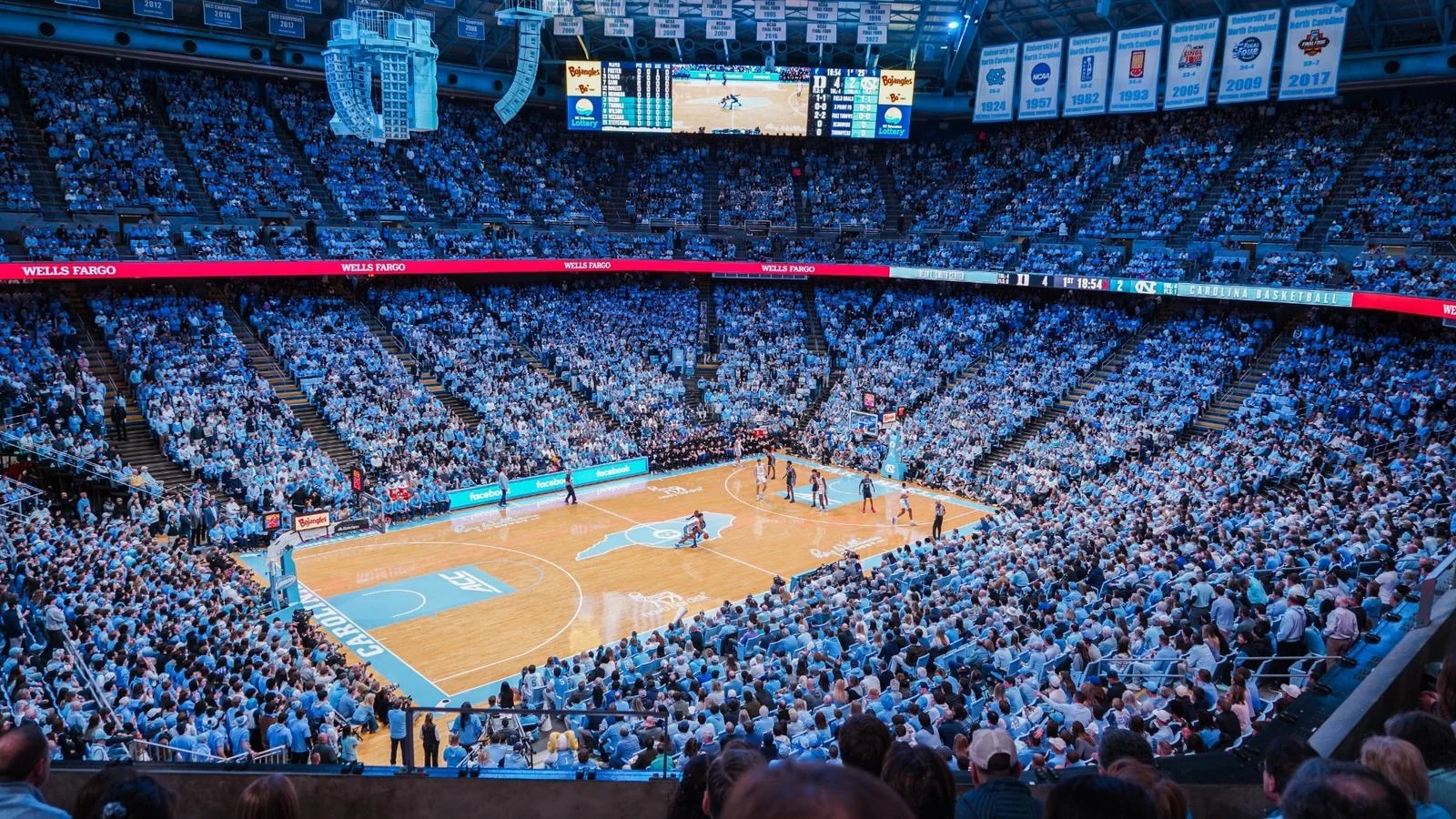
UNC opens the 2026-27 men's basketball regular season on November 2 against Western Carolina, begins ACC play on December 30 against Cal and meets Duke on February 13 and March 6. This guide examines the confirmed schedule through October 14, 2026, including the nonconference NC State and Illinois games, short turnarounds and viewing choices. Editorial observations explain what to follow without predicting results. The cover is the school's February 2026 Smith Center photograph from the Duke game.
UNC's 2026-27 schedule: the dates that frame the season
North Carolina begins its regular season against Western Carolina at the Smith Center on November 2. The published schedule contains thirty-two regular-season games: fourteen nonconference contests and eighteen ACC games. Conference play opens with Cal at home on December 30, and the regular season closes with Duke in Chapel Hill on March 6.
The calendar is not divided neatly into autumn nonconference basketball and an uninterrupted league season. Illinois appears in January, while NC State appears in both December and January with different competition status. Following those labels prevents a supporter from treating every result after Christmas as a contribution to the ACC standings.
For Michael Malone's first season as Carolina's head coach, the schedule is also a series of chances to learn how the team performs in different environments. The useful question is what carries from one setting to the next: defensive execution, the quality of available shots and the ability to create opportunities after stops. The opponent and location help interpret those observations; the calendar cannot supply a predicted win total.
What the October exhibitions can tell fans
The preseason slate consists of USC in Greensboro on October 9, Indiana in Indianapolis on October 18 and Charlotte at home on October 27. These games precede the regular-season opener and their results do not belong in the regular-season record. They offer preparation in two off-campus venues and then the Smith Center.
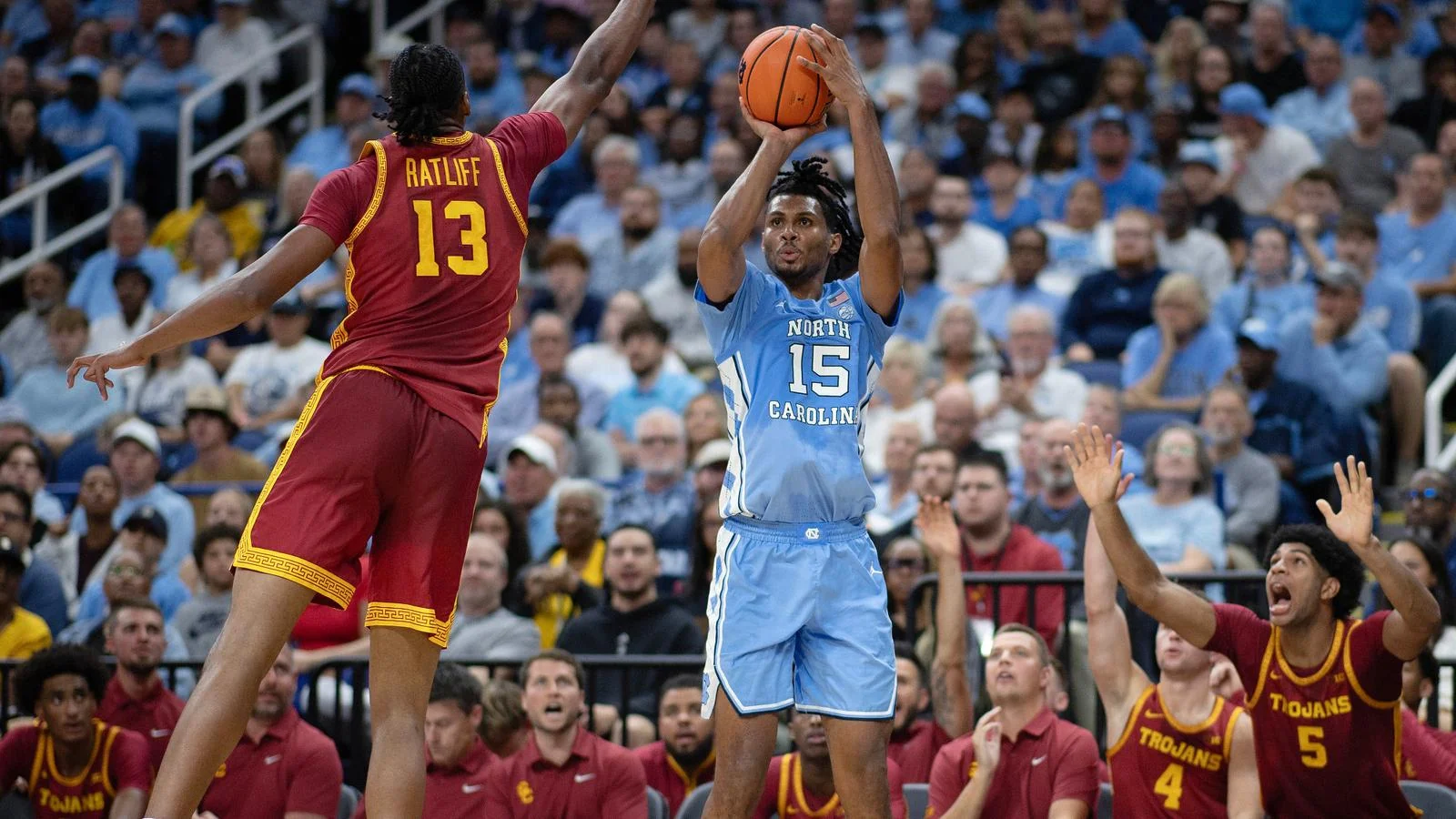
Carolina beat USC 88–70 in the completed opener. The Tar Heels won the second half 51–31, and USC shot 26.5 percent after halftime. Stevenson finished with twenty-five points and ten rebounds. Those are concrete signs of a strong second-half performance, rather than evidence that every future opponent will respond the same way.
Carry a specific question into the next outing: can Carolina again turn defensive possessions into useful attacking opportunities, including when shots are not falling early? Do not convert an exhibition total into a season average or a settled rotation. Our October exhibition guide explains the wider role of these preparation games.
November and December build a varied nonconference test
Carolina's first six regular-season games are in Chapel Hill: Western Carolina, Wofford, Wyoming, Georgia, Marshall and Monmouth. Georgia visits on November 13, giving the opening home sequence a matchup with an SEC opponent before the Tar Heels leave campus for West Virginia. Avoid grading that entire stretch as one uniform level of competition; each opponent presents a separate set of possessions to evaluate.
West Virginia on November 27 is a neutral-site game at Charlotte's Spectrum Center. Carolina then hosts Arkansas in the ACC/SEC Challenge on December 1 and Butler on December 6. These dates let fans compare home execution with an off-campus setting without assuming that the neutral crowd will divide equally or that a familiar conference name guarantees a particular test.
The middle of December moves through three distinct locations. UNC visits Georgetown in Washington, D.C., on December 12, plays NC State in Greensboro on December 15 and meets Kentucky at Madison Square Garden on December 19. The published gaps are three and four calendar days. Carolina then hosts The Citadel on December 21, two days after the New York game.
For a basketball observer, that sequence is an opportunity to follow how Carolina adapts after each contest: what carries into the next defensive plan, and whether the offense still creates good options when the venue changes. It is not proof that the team will be fatigued or that a particular result will follow. For travelers, Georgetown is an away game, while the Greensboro and New York matchups are neutral events with separate ticket arrangements.
Why the Greensboro NC State game is different
The December 15 Tobacco Road Classic is a nonconference game. NC State's official event announcement states that explicitly. The January 9 meeting at the Smith Center is the ACC game. Both contribute to Carolina's overall season, but only the January matchup belongs in the league standings.
That distinction creates a useful two-part comparison. Greensboro supplies an early look at the matchup on a neutral floor; Chapel Hill offers a later conference meeting in Carolina's home setting. Fans can compare adjustments while recognizing that time, personnel availability and location may change the game. Rivalry familiarity does not make the two contests interchangeable.
The Kentucky date also belongs to a doubleheader. UNC's published start is 2:30 p.m. Eastern, after Kansas–Ohio State at noon. Someone attending the session may want both games, while a viewer following only Carolina should set the reminder for its matchup. Read the event's individual game listing rather than confusing the session's opening time with UNC's tipoff.
The eighteen-game ACC schedule is not a full round robin
Duke is Carolina's primary home-and-away partner, while Louisville is its variable partner for 2026-27. Those four games are joined by fourteen single meetings to form the eighteen-game ACC schedule. UNC has nine league games at home and nine away, and does not face Clemson during the regular season.
| Allocation | UNC opponents |
|---|---|
| Home and away | Duke, Louisville |
| Home only | Cal, Georgia Tech, Miami, NC State, SMU, Stanford, Virginia |
| Away only | Boston College, Florida State, Notre Dame, Pitt, Syracuse, Virginia Tech, Wake Forest |
| No regular-season meeting | Clemson |
The omission has a practical consequence: a Carolina fan cannot find a Clemson date by waiting for the remaining regular-season listings to fill in. The opponent allocation intentionally leaves that matchup out. A possible postseason meeting would be a different matter, and the regular-season schedule does not establish one.
The league games are distributed as one in December, eight in January, seven in February and two in March. That keeps most of the conference race in the new year, but the December Cal result already belongs to it. The Illinois game between January league dates remains nonconference, so the month contains more Carolina games than its ACC count alone indicates.
For comparing the Tar Heels with another ACC team, first examine the repeated opponents and where the single meetings occur. Hosting Stanford and visiting Florida State are different tasks from the reverse arrangement. That observation concerns the schedule's design, not a claim about either opponent's eventual quality.
The two Louisville games deserve attention alongside Duke because they give Carolina another chance to revisit a matchup. Watch how the offense handles the same defensive problem in the return game, while accounting for location and available players. The variable-partner label applies to this season; it should not be read as a permanent annual guarantee.
Our ACC schedule guide places Carolina's allocation within the wider league. For this team, the essential distinction is eighteen conference results across sixteen opponents, rather than a meeting with every other ACC school.
The schedule stretches worth following as a sequence
Carolina opens January at Boston College on January 2 and Louisville on January 5, then returns home for NC State on January 9. The first two dates are three calendar days apart. That early away-away-home pattern supplies a more useful lens than judging each date in isolation: does the team carry its decision-making into a new venue, and what changes when it returns to Chapel Hill?
The schedule establishes where the next game occurs, but it does not reveal the team's exact travel or practice plan. Evaluate the basketball that appears on the floor. If a problem repeats, look for a specific adjustment in spacing, ball handling or defensive communication before assuming that travel alone caused it.
Illinois interrupts the January ACC run
UNC hosts SMU on January 26, plays Illinois at Bridgestone Arena in Nashville on January 30 and visits Notre Dame on February 2. The Illinois game is a neutral-site nonconference contest, even though it sits between ACC dates. It remains part of Carolina's overall season without adding an ACC result.
That placement offers a different opponent after weeks of conference basketball. The useful comparison is whether Carolina's established habits still work when it faces a team outside the league. A changed defensive problem can expose an issue that a comfortable stretch has hidden, or demonstrate that an improvement travels across matchups. Neither possibility can be settled before the game.
Nashville is followed by the Notre Dame away date three calendar days later. A fan attending both should plan two separate venues, not treat the showcase as the end of the trip. The schedule itself does not confirm that the team will travel directly between those cities.
February includes two quick home turnarounds
Georgia Tech visits on Saturday, February 6, and Louisville follows on Monday, February 8. The listed starts are 2:15 p.m. and 6 p.m. Eastern, respectively: fifty-one hours and forty-five minutes apart. Both are home games, which removes an intervening away venue from this particular pairing.
A second Saturday–Monday sequence runs from Wake Forest away on February 20 to Miami at home on February 22. Both are listed at 7 p.m. Eastern, giving a forty-eight-hour gap between scheduled starts. That includes the first game and the return from an away setting; it should not be described as forty-eight hours of recovery.
These sequences make the response after the first game interesting. Watch whether Carolina corrects a recurring mistake without losing the parts of its offense that worked, and whether the next opponent demands a different solution. For supporters, the Monday date also changes the practical choice between a weekend visit and a worknight game. Our Big Monday guide explains that television window alongside the individual Carolina assignments.
The two Duke games matter in different settings
Carolina visits Duke at Cameron Indoor Stadium on February 13, then hosts the Blue Devils at the Smith Center on March 6. The games fall twenty-one calendar days apart. Both count in the ACC standings, and the return meeting is the regular-season finale rather than another midseason date.
The first meeting arrives after Carolina's February 8 home game with Louisville. Duke's preceding game is at SMU on February 9. Those are different lead-in schedules, but they do not establish which team will be better prepared. Fans can use them to frame what they observe without assigning a result to an assumed travel disadvantage.
The two 2026 meetings illustrate why the return game deserves its own analysis. Carolina won 71–68 in Chapel Hill on February 7 after Seth Trimble hit a three-pointer with 0.4 seconds remaining. Duke won the March 7 return in Durham, 76–61, after a 24–2 second-half run. Those completed games belong to 2025-26; they do not predict the new season's scores or imply that the same players will fill the same roles.
The contrast is useful because a rivalry can produce very different possession patterns and finishes across its two dates. When reviewing the new first meeting, identify how Carolina finds shots and where Duke interrupts that process. Then look for an actual adjustment in the return, rather than treating the first result as a fixed description of the matchup. Availability, foul trouble and shot-making still need their own context.
March 6 also changes the planning stakes. It ends Carolina's regular season, so its effect on the league race will depend on the standings that exist then. No October guide can establish that it will decide a championship or a particular tournament seed. Keep the date marked while leaving those stakes to develop through the season.
For viewers, the first game has a published 5:30 p.m. Eastern start, while the return is listed with a 6 or 6:30 p.m. window. For travelers, Durham and Chapel Hill are separate home venues with separate ticket access. Confirm the actual event before making arrangements, even if both games appear under the same rivalry name.
UNC television and streaming require game-by-game choices
Carolina's published assignments span several viewing destinations. Western Carolina on November 2 is on ACC Network, Georgia on November 13 is on ESPN2, Georgetown on December 12 is on Peacock, and Kentucky on December 19 is on CBS with Paramount+ streaming. Georgia Tech on February 6 is assigned to The CW, while the first Duke game is on ABC. A conference affiliation alone does not identify the correct place to watch.
The Indiana preseason game provides a particularly specific option. UNC's October 13 viewing announcement lists the October 18 game at 5 p.m. Eastern exclusively on B1G+, with a one-time $8.99 pay-per-view offer for that game. The school says the offer must be purchased on the web, although viewing afterward is supported on mobile and connected devices. That is a game-specific alternative, not a promise about the rest of Carolina's season.
Charlotte's October 27 preseason listing is ACC Network Extra, or ACCNX, while the regular-season opener is ACC Network. ESPN's ACCNX support guidance identifies access through eligible television-provider credentials or an ESPN Unlimited plan. Having the ESPN app installed does not by itself confirm the necessary access. Check the event and the account that unlocks it before tipoff.
Keep flexible tipoffs and channels flexible
The school schedule uses Eastern time unless it states otherwise. Illinois on January 30 and the home Duke game on March 6 are listed at 6 or 6:30 p.m. Eastern. Some other dates have multiple ESPN-family channel options. Preserve those alternatives when planning instead of selecting one as if it were final.
Nashville's venue is in the Central time zone, so a visiting fan should distinguish the school's Eastern listing from local arrival plans. For television, recheck the matchup near the game through the TV schedule. Our live viewing guide explains how provider authentication and direct streaming access differ; use it alongside the current assignment rather than buying a subscription solely because its name sounds connected to the ACC.
Turning a UNC home date into a Smith Center visit
The Dean E. Smith Center is at 300 Skipper Bowles Drive in Chapel Hill. It has been Carolina basketball's home since 1986. Choose a game actually listed there, rather than assuming that a Carolina ticket always means a campus visit: the Greensboro, Charlotte, New York and Nashville events require separate plans.
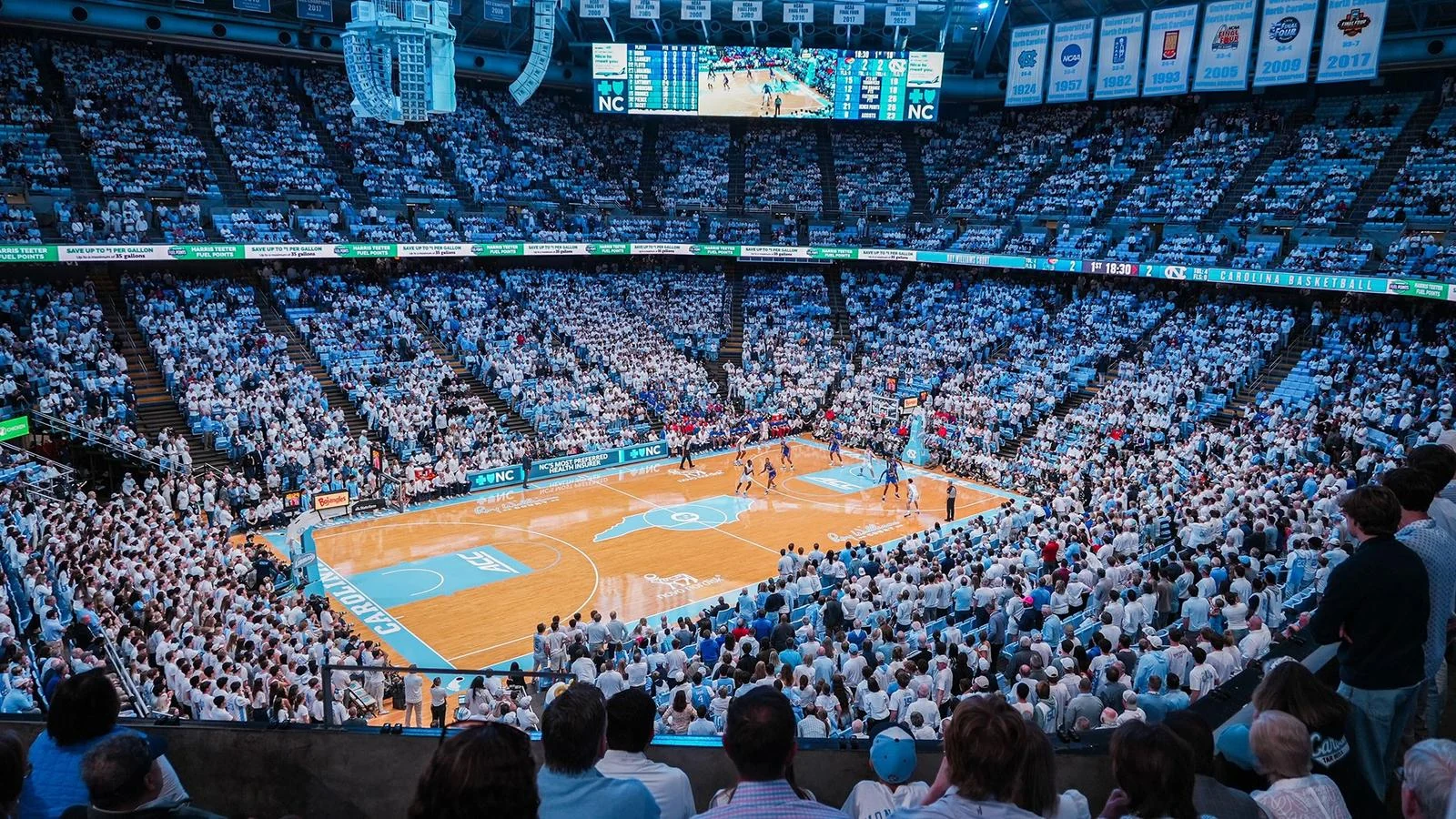
A fixed afternoon game can be easier to plan around than a flexible evening window. Georgia Tech on February 6 has a published 2:15 p.m. start, while Louisville on February 8 is a Monday evening game. Decide which fits your journey and weekday commitments before choosing only by the opponent's name. The Duke finale's alternative start window calls for another timing check before final arrangements.
UNC's October 12 Flex Pass announcement adds a specific ticket decision. Packages contain sixteen, twenty-four or thirty-two passes; each redeemed pass becomes one regular-season home-game ticket, subject to available primary inventory. A pass alone does not grant entry. Exchanges must be completed online through the GoHeels account before entering, and cannot be processed at the door.
The account holder must attend, and the passes or redeemed tickets cannot be transferred or resold. Unused passes are neither refunded nor carried into the next season. The announcement schedules exchanges and public single-game sales to begin October 15 at 10 a.m. Eastern. These conditions make a package most useful when its holder can realistically attend the chosen games; they do not guarantee access to Duke or another particular date.
For entry, the school's Smith Center information lists doors opening ninety minutes before men's basketball tipoff, enforcement of the clear-bag policy and cashless concessions. Review the current event guidance before leaving. Check parking and accessibility arrangements separately rather than assuming that a game ticket supplies a parking space.
Once seated, the wider view can make Carolina's off-ball spacing and defensive rotations easier to follow. A closer view emphasizes individual actions. Use the seating map to choose the experience you value, while leaving time to reach the right entrance and settle before the opening possessions. A well-chosen date and a valid ticket are the practical foundations for seeing how the new team develops.
Sign in with Google to join the discussion.