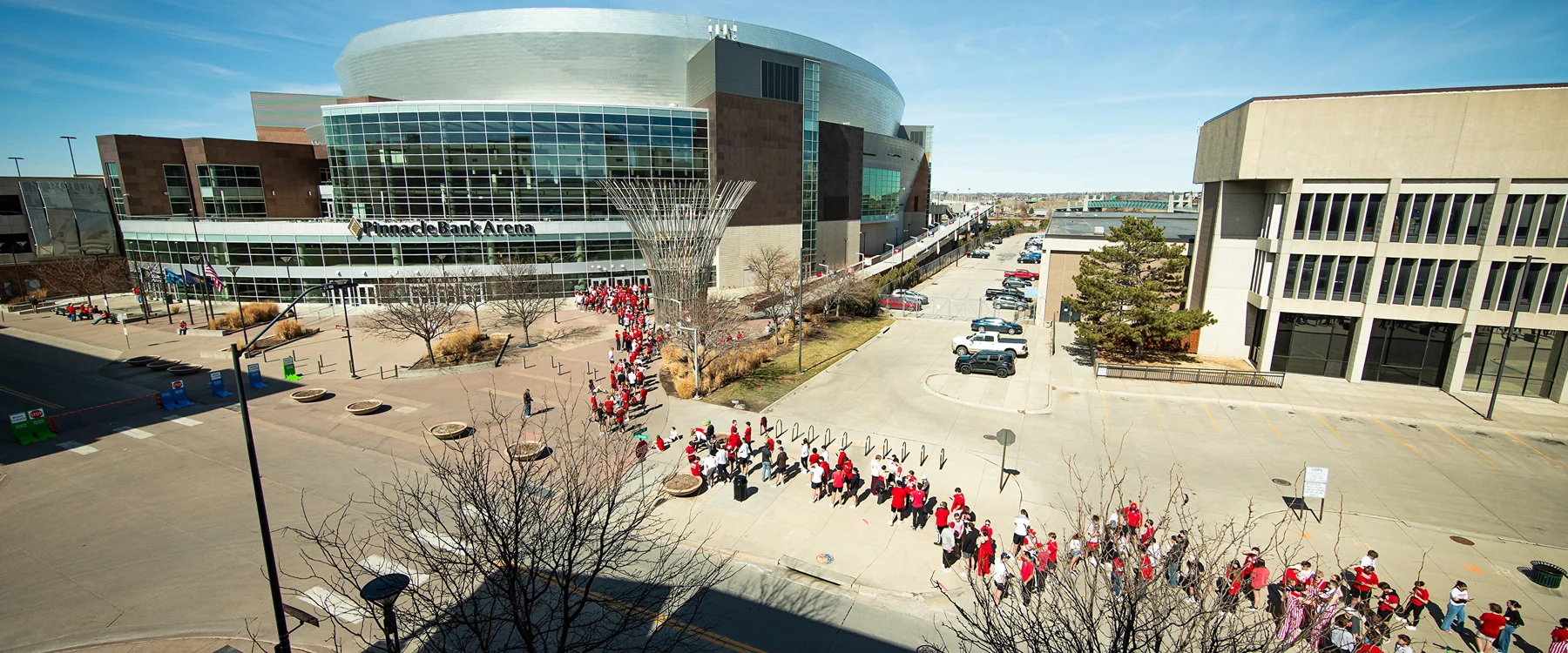
Nebraska's 2026-27 men's basketball season begins November 2 against Le Moyne, with a twenty-game Big Ten slate starting December 2 against Ohio State. Four nonconference neutral-site games and a busy January travel sequence make the itinerary worth examining beyond a list of opponents. This guide uses announcements checked through October 14, 2026, and distinguishes confirmed dates from editorial analysis. The cover shows supporters outside Pinnacle Bank Arena in the school's March 2026 photograph.
Nebraska's 2026-27 schedule at a glance
Nebraska opens its regular season against Le Moyne in Lincoln on November 2. The Huskers have 32 regular-season games: twelve outside the Big Ten and twenty in conference play. Seven of the nonconference games are at home. That structure gives fans two distinct calendars to follow: the early slate moves between home dates and off-campus tests, while the league schedule determines Nebraska's position within the Big Ten.
The useful starting question is where a game belongs. A November neutral-site matchup can contribute to Nebraska's overall record without affecting the conference standings. Conversely, the early December league games already count toward the Big Ten race even though nonconference basketball resumes afterward. Reading every December listing as part of one uninterrupted nonconference block would obscure an important part of the season.
For evaluating the team, separate the quality of a performance from the label on the calendar. A comfortable home result may reveal whether Nebraska executes cleanly against a particular defense; it cannot answer every question about handling an unfamiliar floor or a hostile crowd. Off-campus games supply different evidence. Neither setting guarantees an outcome, and a preseason reputation should not substitute for what an opponent actually becomes.
Exhibitions and regular-season games serve different purposes
The October preparation schedule includes Saint Louis at Pinnacle Bank Arena, BYU in Provo and Kansas State in Grand Island. Those are exhibition games, so their results belong outside the regular-season win-loss record. The variety of settings matters: Nebraska can experience home, road and neutral surroundings before the opener rather than learning every travel routine during a game that counts.
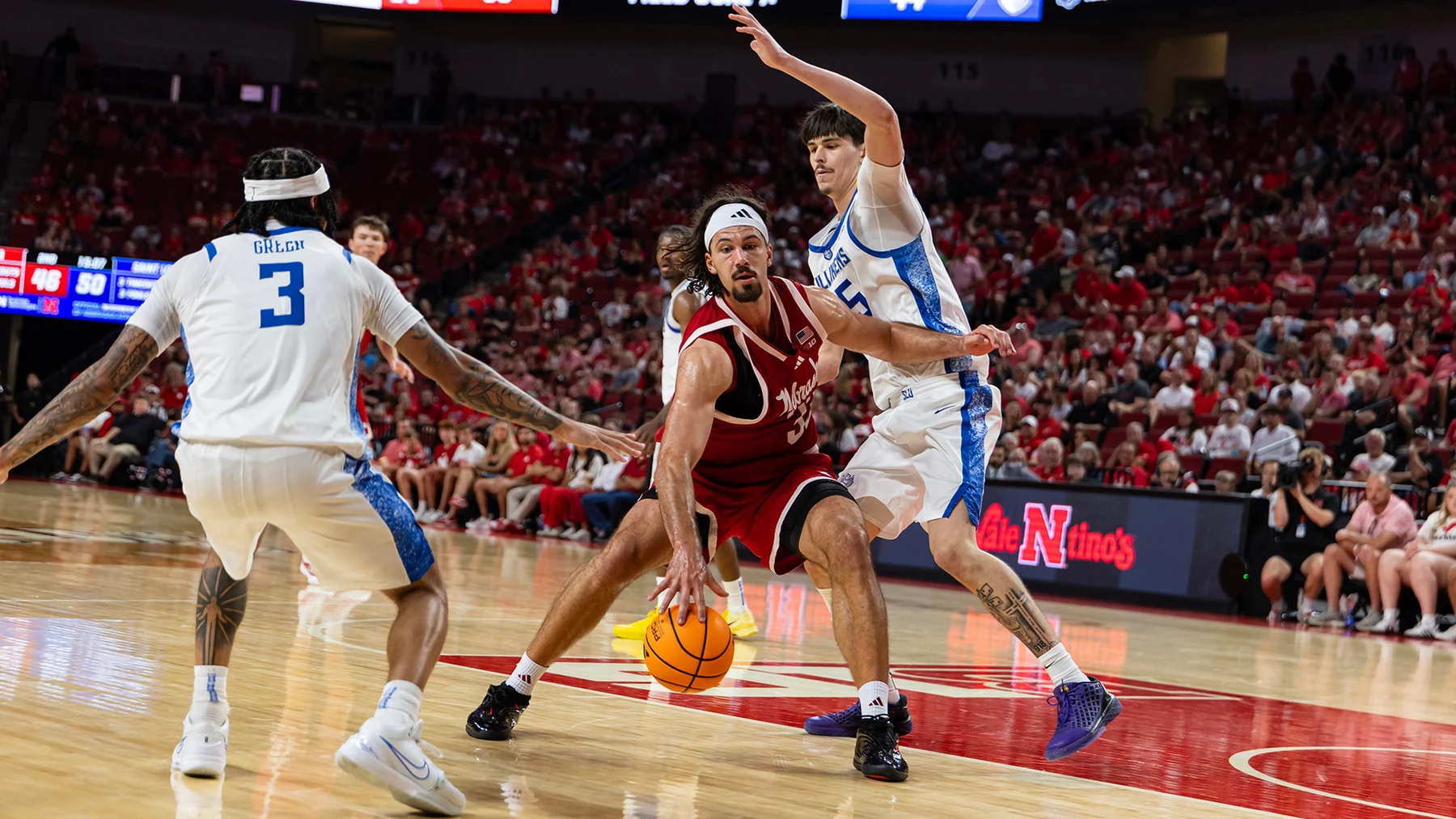
The completed Saint Louis exhibition offers a concrete example. Nebraska lost 79–74, but thirteen Huskers played and eleven logged at least ten minutes. Freshman Jacob Lanier scored fifteen points. Fred Hoiberg discussed pressure and securing defensive rebounds afterward. That gives fans specific questions to carry into the next outing: can Nebraska enter its offense under pressure, and can a defensive stop finish with possession?
Those questions are more useful than treating one October score as a forecast. Broad participation changes the combinations on the floor, and one opponent provides a limited sample. Follow the development of possessions and responsibilities alongside the result. Our October exhibition guide explains how these preseason dates fit the wider men's college basketball calendar.
The nonconference tests extend beyond Lincoln
The most distinctive feature of Nebraska's nonconference schedule is its variety of neutral floors. The Huskers face Providence in Uncasville on November 7, Boise State in Sioux Falls on November 15, Butler in Chicago on November 22 and Missouri in Kansas City on December 12. Creighton in Omaha on December 5 is a true road game. Those labels describe different competitive settings, even when a Nebraska supporter can reasonably make the trip.
| Game | Venue | Setting |
|---|---|---|
| Providence, November 7 | Mohegan Sun Arena | Neutral, Hall of Fame Tip-Off |
| Boise State, November 15 | Sanford Pentagon | Neutral, Sioux Falls |
| Butler, November 22 | Credit Union 1 Arena | Neutral, Chicago |
| Creighton, December 5 | CHI Health Center | Away, Omaha |
| Missouri, December 12 | T-Mobile Center | Neutral, Kansas City |
Providence provides the first of these regular-season tests. The Hall of Fame's broadcast announcement lists Nebraska's game at 7 p.m. Eastern, or 6 p.m. Central, on FS1. The doubleheader's earlier game starts at 4 p.m. Eastern. A ticket page advertising that session start should not lead a television viewer to expect Nebraska three hours early. Check the individual matchup when setting a reminder.
Sioux Falls offers a different scale of surroundings. Nebraska's Boise State announcement describes the Pentagon as a 3,200-seat facility. Butler brings the Huskers to Chicago rather than either school's campus. Hoiberg explained that the neutral matchup was intended to provide a Big East test before the December league games. In basketball terms, these outings let fans examine how Nebraska starts possessions and communicates defensively away from its familiar home setup.
Neutral does not mean the crowd will split evenly. Location, traveling supporters and ticket distribution can create an audible advantage without changing the official designation. Avoid treating every off-campus game as equivalent to visiting an opponent's home arena. The road game at Creighton asks a separate question about execution in a setting built around the opponent.
Missouri adds historical interest: the schools' previous meeting was in March 2011. That makes the reunion meaningful, but it does not determine the 2026 matchup. A fan judging Nebraska's progress should compare ball security, defensive possessions and shot creation across these tests, while allowing for the opponent and venue. Our rankings guide helps distinguish a changing season assessment from an offseason label attached to a schedule.
What Nebraska's Big Ten opponent allocation changes
The Big Ten's eighteen-team membership does not produce a full home-and-away round robin. Nebraska plays three opponents twice and the remaining fourteen once, producing twenty league games. The split is ten at home and ten away. That is balanced by venue count, but the opponent mix still matters when comparing the Huskers' record with another school's.
Nebraska's single home meetings are against Indiana, Michigan, Minnesota, Ohio State, Rutgers, UCLA and USC. Its single away meetings are at Illinois, Maryland, Northwestern, Oregon, Purdue, Washington and Wisconsin. A supporter hoping to see Purdue in Lincoln needs to recognize that this year's regular-season meeting is away; a possible postseason matchup would be a separate event.
The allocation also changes the meaning of a standings comparison. Two teams can finish with the same number of wins after different sets of repeated opponents and different locations for their one-off games. That does not invalidate the standings. It means that explaining performance requires a second question about the route to that record, particularly when judging a road win against a home result.
The three home-and-away opponents
Iowa, Michigan State and Penn State are Nebraska's repeated opponents. Each pair gives the Huskers one home game and one away game. For a fan following a matchup closely, the second meeting offers a useful comparison: did Nebraska change how it initiates offense, protect the ball differently, or improve its response to the opponent's preferred actions?
The second game should not be treated as a controlled experiment. Players' availability, foul trouble, shooting and the venue can change. Still, a repeated series can reveal adjustments that a single meeting cannot. Watch the first few half-court possessions and the response after timeouts alongside the final score. A tactical improvement can be visible even when the result moves the other way.
This is also why last year's conference reputation provides only background. The schedule tells us who Nebraska must face and where. It does not tell us how strong those opponents will be by the date of the game. The most defensible season analysis updates its view as the teams play, while keeping this underlying allocation clear.
January combines marquee home games with demanding travel
January contains nine Nebraska games, with four at home and five away. Michigan State visits on January 2 and Michigan follows on January 5. Those dates make the opening week an attractive home viewing stretch, but they also lead directly into a month in which Nebraska repeatedly changes arenas.
For evaluating the Huskers, follow a sequence rather than a single headline matchup. Watch whether offensive spacing survives those changes of setting, whether ball handlers recognize pressure early, and whether Nebraska completes defensive possessions. These are observation priorities, not a claim that the schedule will force a particular playing style or result.
The Pacific Northwest trip
Nebraska plays Oregon in Eugene on January 10 and Washington in Seattle on January 13, then hosts Iowa on January 16. The dates are separated by three calendar days each. They do not establish three full days of recovery: the games themselves, travel and preparation all occupy parts of the interval.
The consecutive western venues create a logical travel cluster on the published schedule. The itinerary alone does not reveal where the team will sleep between games or exactly when it will return to Lincoln. Fans should resist explaining an eventual performance with an assumed flight plan. What can be observed is whether decisions and defensive communication remain sharp across the Oregon, Washington and Iowa sequence.
For viewers in Nebraska, the Washington listing deserves special attention because it is a late Central-time game. Set the reminder from the matchup's stated zone, rather than treating a Pacific listing as local time. A supporter traveling to either western arena should likewise use the venue's local tipoff when planning arrival.
The final five games of January
After Iowa at home on January 16, Nebraska visits Illinois on January 19, hosts UCLA on January 22, travels to Purdue on January 26 and plays at Iowa on January 30. The gaps are three, three, four and four calendar days. This is a changing sequence of locations, rather than one long home stand or one uninterrupted road block.
The two Iowa meetings fall fourteen days apart. That makes them a particularly useful pair to revisit: identify what caused problems in the first matchup and then look for a concrete response in the second. Venue and game circumstances still differ, so the comparison should focus on possessions and adjustments rather than assuming a repeat result.
January's schedule is demanding on paper because of its frequency and travel. The precise competitive difficulty will become clearer as the opponents play. Keeping those two judgments separate lets fans acknowledge the workload without pretending that preseason expectations determine every night's test.
February and March change the balance of the schedule
Nebraska begins February with three home games in its first four contests: Indiana on February 6, Penn State on February 12 and Rutgers on February 16. The intervening trip is to Maryland on February 9. Compared with January's five away dates, this opening February sequence gives fans a concentrated set of opportunities to watch the Huskers in Lincoln.
Home availability is a practical advantage for supporters, not a forecast of easy wins. The basketball question is whether Nebraska carries its road lessons into familiar surroundings. Watch for improved handling of pressure and cleaner defensive finishes, then ask whether those gains persist when the schedule sends the team away again. A few successful home possessions should not erase a problem that still appears against a different opponent.
The closing sequence includes Michigan State away on February 20, USC at home on February 23, Northwestern away on February 27, Wisconsin away on March 3 and Minnesota at home on March 7. Three of those five are road games. The final two away dates are separated by four calendar days, followed by another four-day gap before the home finale.
The regular-season endpoint and the beginning of the conference tournament are different appointments. The Big Ten tournament runs March 9–14 at Gainbridge Fieldhouse in Indianapolis. All eighteen teams participate, but Nebraska's first day of competition depends on its seed. Fans cannot infer a Nebraska game on March 9 simply because that is the event's opening date.
Seeds fifteen through eighteen begin Tuesday; seeds nine through fourteen enter Wednesday; seeds five through eight enter Thursday; and the top four enter Friday's quarterfinals. That makes the standings consequential for the number of games a team must win and the spacing after the regular-season finale. Nebraska's position in those groups remains unsettled at this guide's October cutoff.
For travel planning, reserve the event's dates as a window and wait for the bracket before locking in a particular Nebraska session. For basketball analysis, keep the conference tournament separate from the national tournament. Our NCAA tournament schedule explainer covers that later calendar without assuming that a conference appearance establishes a national-tournament place.
How to follow Nebraska on television and streaming
Nebraska's October 6 announcement listed thirty of its thirty-two regular-season games for national television. That broad coverage still involves several networks and services. The right viewing plan starts with the individual game's assignment, rather than assuming that one Big Ten subscription covers the whole Huskers season.
| Selected game | Published assignment | Central time |
|---|---|---|
| Le Moyne, November 2 | B1G+ | 6:30 p.m. |
| Creighton away, December 5 | TNT | Noon |
| Michigan State, January 2 | CBS | 2:45 p.m. |
| Washington away, January 13 | BTN | 10 p.m. |
| Iowa, January 16 | FOX or FS1 | 7 p.m. |
BTN and B1G+ are different viewing destinations. B1G+ describes its live offering around non-televised events, while its support guidance directs televised BTN, FOX and FS1 games to FOX Sports with an eligible television-provider login. The conference's current broadcast announcement also identifies FOX One for those networks' games. Check access to the actual channel or service before buying a plan for one particular night.
Other assignments require a separate check. The Big Ten release identifies Paramount+ for CBS coverage and Peacock among the conference's streaming platforms. That does not make them substitutes for the Le Moyne opener on B1G+ or the Creighton game on TNT. A useful season plan lists the games you most want to see beside their individual providers, then checks which of your existing subscriptions already supply access.
Read the time zone before setting a reminder
The school's television table uses Central time. An opponent's schedule may instead use its home zone. Michigan State at Nebraska is 2:45 p.m. Central and 3:45 p.m. Eastern; those are the same tipoff. Washington's January 13 listing is 10 p.m. Central, making it a late evening for Nebraska viewers even though the game is played farther west.
Keep flexible windows flexible. Indiana's February 6 start was left to a later selection, and Iowa's January 16 channel was listed as FOX or FS1. Do not turn either option into a guaranteed assignment. Recheck near the game through the TV schedule, and use our live viewing guide when comparing television authentication with a direct streaming subscription.
Planning a game at Pinnacle Bank Arena
Pinnacle Bank Arena is Nebraska basketball's downtown Lincoln home, at 400 Pinnacle Arena Drive in the Haymarket District. Use that venue when planning a home game; Nebraska's off-campus dates require their own arena directions and entry policies. A ticket for the Huskers does not always mean a ticket for Lincoln.
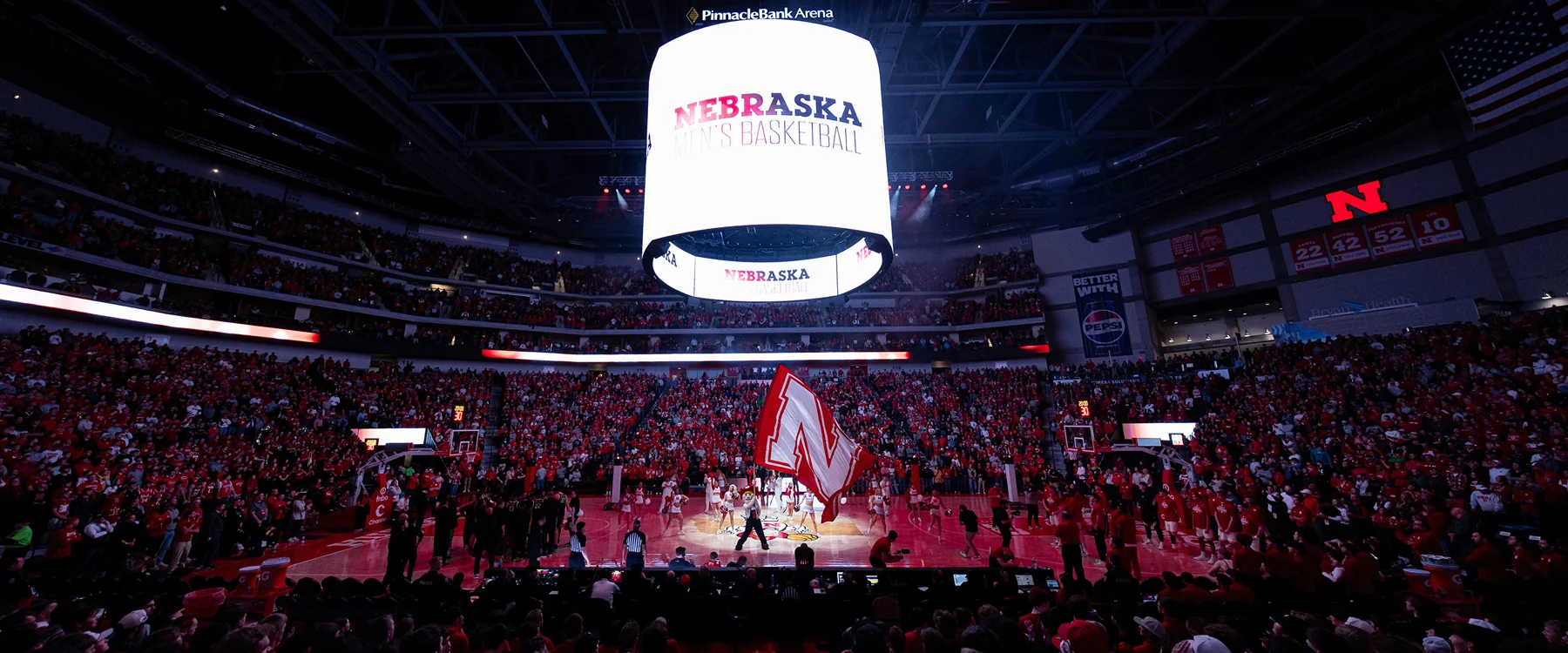
For an early conference visit, Michigan State on January 2 offers a published afternoon start, while Michigan on January 5 is an evening game. Decide whether a daytime or weeknight trip better fits your journey before choosing solely by opponent. Indiana on February 6 has a flexible start window at the guide's cutoff, so a precise dinner or return-trip arrangement should wait for the final time.
The school's single-game announcement identifies limited upper-level inventory, with lower-level availability for selected holiday dates. Treat those descriptions as the announced sales plan, not a guarantee that a particular seat remains available. Check the individual event and its seating chart. A higher central view can help a fan follow off-ball spacing across the floor; a closer view emphasizes individual movement and contact. Those are viewing preferences rather than promises about every section.
The official basketball game-day guide lists doors opening ninety minutes before the game. It permits clear tote bags up to 12 by 6 by 12 inches, one-gallon clear bags and small clutches within the stated 4.5-by-6.5-inch size. Re-entry is prohibited. Check the current policy before leaving for the arena, and finish any outside errands before entering.
Parking should be part of the ticket decision. The school distinguishes public parking from season-ticket parking locations, so do not assume that a nearby garage or lot comes with a single-game seat. If accessible seating is needed, indicate that when purchasing rather than relying on a change at the entrance. Allow time to reach your actual gate and seat without inventing a universal driving or queue estimate.
Keep the selected matchup's date, local start, venue and ticket together in your plan. Use the current schedule for a final check, then arrive ready to follow the game itself: where Nebraska creates its first advantage, how it handles pressure, and whether defensive possessions end with the ball secured.
Sign in with Google to join the discussion.