
The tournament schedule in one view
The NCAA men's basketball tournament is best understood as a three-week elimination rhythm rather than one continuous daily schedule. Selection Sunday reveals the field and bracket. Beginning in 2027, the Opening Round occupies the following Tuesday and Wednesday, the 64-team first round fills Thursday and Friday, and the second round follows Saturday and Sunday. The 16 survivors return the next Thursday and Friday for regional semifinals, the Elite Eight is played Saturday and Sunday, and the Final Four closes the event one week later with Saturday semifinals and a Monday championship game.
The confirmed 2027 calendar makes that rhythm concrete. Selection Sunday is March 14. Opening Round games are March 16-17, the first round is March 18-19, and the second round is March 20-21. The Sweet 16 runs March 25-26, the Elite Eight March 27-28, the national semifinals April 3 and the championship April 5. A fan can save those dates months in advance even when no team has been assigned to them.
| 2027 stage | Dates | Teams left after stage |
|---|---|---|
| Selection Sunday | March 14 | 76 selected |
| Opening Round | March 16-17 | 64 |
| First and second rounds | March 18-21 | 16 |
| Sweet 16 and Elite Eight | March 25-28 | 4 |
| Final Four and championship | April 3 and 5 | 1 champion |
The number of teams falls sharply inside those blocks: 76 selected, 64 after the Opening Round, 32 after the first round, 16 after the second round, eight after the regional semifinals, four after the regional finals, two after the national semifinals and one champion. That progression explains why the opening weekend feels crowded and the final weekend feels concentrated. It also explains why a bracket page and a TV listing solve different problems. The bracket tells you a team's possible route; the daily schedule tells you when the next confirmed matchup will actually be played.
For a printable planning view across the season and postseason, use the site's printable men's college basketball schedule. Treat it as the calendar layer, then verify the live game listing once opponents and television windows are official.
Selection Sunday starts the clock
What becomes official when the bracket is revealed
Selection Sunday turns a month of reserved dates and host sites into team-specific routes. The committee reveals the 76-team field, the seed lines, the Opening Round pairings and the first-round destinations into which those winners feed. Teams placed directly in the 64-team bracket learn an opponent and first-weekend site. Every team can also trace its possible regional destination and Final Four half.
That release comes at the end of three distinct committee jobs: selecting the at-large field, ranking all teams on a true-seed list and placing them into a legal bracket. The calendar existed before those decisions. The bracket attaches team names to it. Conference-tournament results immediately before the show matter because they settle automatic qualifiers and complete the pool the committee must place. Fans following that final qualification race can use the site's conference schedule directory.
The bracket is especially important for travel. A school does not merely learn that it plays Thursday or Friday; it learns where its opening pod is staged and which regional lane it occupies. In the 2027 format, an Opening Round team also learns the first-weekend site it will enter if it wins. There is no new draw after Tuesday or Wednesday.
Why the bracket is not a complete broadcast schedule
A bracket fixes competitive order, not every television detail for three weeks. Opening games can receive full tip times and network assignments around Selection Sunday, but later rounds contain unnamed winners. Broadcasters and tournament organizers cannot label a Sunday game “Team A versus Team B” while both teams still have Friday games to survive.
The 2026 process shows the practical pattern. Tip times for Saturday's second round were released after Thursday games concluded; Sunday's were released after Friday. That is not a late correction. It is the normal consequence of waiting until matchups, travel considerations and the available national windows are known. The 2027 men's championship has 75 games carried across CBS, TBS, TNT and truTV, yet a network family is not the same as a specific channel for one future team.
So save the round dates immediately, but treat a blank time or “TBA” as unresolved rather than missing. After each game day, return to the current schedule before arranging travel, recording or a watch party. The bracket tells you who can meet; the refreshed broadcast grid tells you when the surviving pair actually plays.
The 2027 Opening Round adds an extra scheduling layer
Twelve games over Tuesday and Wednesday
The expanded tournament begins with 24 teams playing 12 Opening Round games on the Tuesday and Wednesday after Selection Sunday. Dayton and Wichita each stage a tripleheader on both days, producing six games Tuesday and six Wednesday. This is a larger opening stage than the four-game First Four used through 2026, but it still fits before the traditional first round begins Thursday.
The participants come from two separate pools: the 12 lowest-seeded at-large selections and the 12 lowest-seeded automatic qualifiers. At-large teams play at-large teams; automatic qualifiers play automatic qualifiers. That separation matters when reading the schedule because a fan should not assume the lowest 24 teams simply form one continuous mini-bracket. Each game already feeds a designated seed line and first-round destination.
The two-site design also changes the viewing shape. Instead of one Dayton doubleheader each night, viewers face concurrent tripleheader schedules in Dayton and Wichita. Exact windows and networks still belong to the broadcast grid, but the competitive obligation is fixed: win once in one of those arenas, then enter the 64-team bracket already printed on Selection Sunday.
The winners inherit a short recovery and travel window
An Opening Round winner is not reseeded or given a fresh destination. The committee assigns the advancing slot and first-weekend site while building the bracket. The winner may need to recover, travel and prepare for a new opponent within roughly two days. NCAA procedure therefore gives Opening Round teams early placement priority within their seed lines so practical flight options for the winner can be considered.
The Tuesday-Wednesday split has another consequence. A team winning Wednesday cannot sensibly be sent into a Thursday first-round game. The published procedure accounts for that constraint: when an Opening Round winner is scheduled to face a No. 1 or No. 2 seed, the relevant top seed may need a Friday-Sunday site. This is one reason the committee cannot assign every top seed to its closest Thursday-Saturday destination in a vacuum.
From a basketball perspective, the turnaround is not automatically a penalty or an advantage. The winner has played a live elimination game and settled its rotation, but it also spends energy and loses scouting time. A deep team winning comfortably Tuesday faces a different burden from a short rotation surviving overtime Wednesday. Schedule analysis should describe that context, then return to the actual matchup.
Why the first weekend uses Thursday-Saturday and Friday-Sunday tracks
Each site turns two four-team pods into two survivors
The first round is the tournament's largest traffic jam: 32 games across Thursday and Friday reduce 64 teams to 32. The second round follows Saturday and Sunday, leaving 16. Sites are paired by day, so a Thursday first-round winner stays on the Thursday-Saturday track and a Friday winner stays on the Friday-Sunday track.
Each venue hosts two separate four-team pods. One pod might contain the 1-16 and 8-9 games; another might contain the 4-13 and 5-12 games. The winners inside each pod meet in the second round. The two pod winners can travel to different regional sites the next week, which is why “playing in the same first-weekend building” does not necessarily mean occupying the same region.
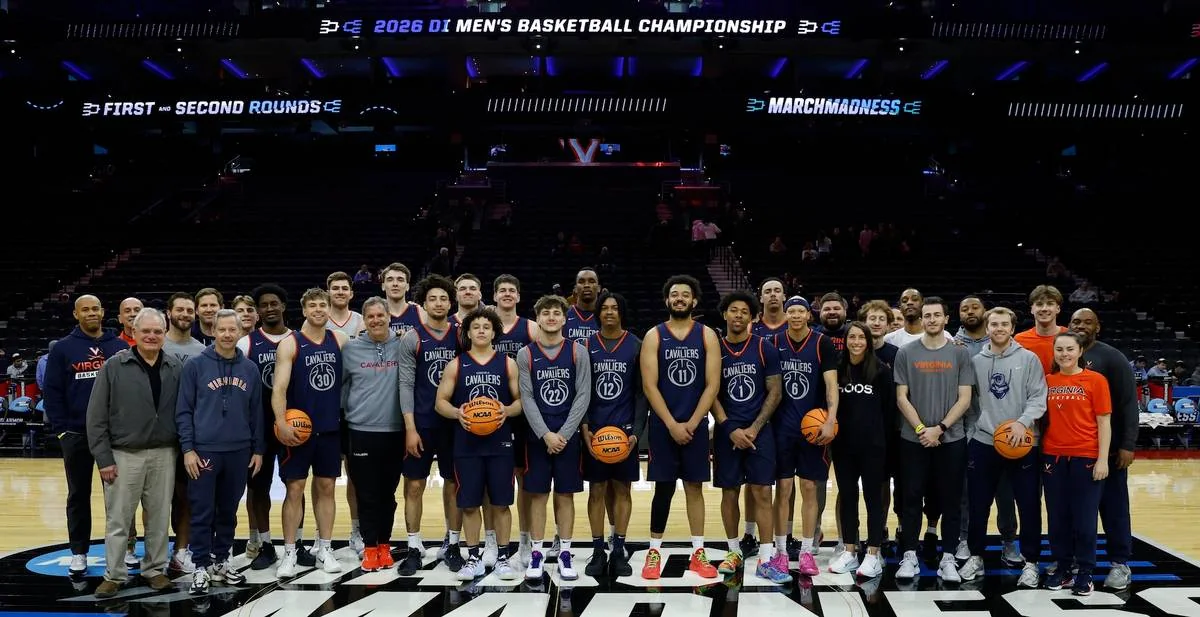
This structure is efficient for teams and venues. A school travels to one city for its first two possible games, while the arena can stage multiple sessions across its assigned dates. It also preserves the bracket: teams do not get moved across the country after one upset to create a newly balanced field. The route printed on Selection Sunday controls which winner advances.
Fans can check the site's men's college basketball games today page for the current slice of that crowded weekend. The full bracket shows possibility; the daily list removes eliminated teams and puts the actionable slate in one place.
One day off is really a scouting and recovery day
Thursday winners do not play Friday, and Friday winners do not play Saturday, but “off” is misleading. Players need treatment, hydration, sleep and a physical reset. Coaches move from a prepared first-round game plan to a second opponent whose identity may have been decided only hours earlier. Video staffs cut personnel clips, assistants divide scheme work, and the team receives a compressed walk-through rather than a normal multi-day preparation.
The schedule can expose different roster stresses. A team that used seven players in a high-possession overtime game has less recovery margin than one that controlled its opener with nine. A defense built on detailed opponent-specific coverages has less installation time than a group with stable rules. Conversely, both opponents face the same calendar, and an experienced team can carry habits that require fewer adjustments.
Broadcast timing also remains conditional. The tournament can reserve Saturday and Sunday windows in advance, but second-round team labels cannot be final until the paired first-round games end. That is why fans should expect updated tip-time announcements after Thursday and Friday play rather than treating an early blank as an error.
The Sweet 16 and Elite Eight form the second weekend
Regional semifinals arrive after a longer reset
The Sweet 16 resumes on the Thursday and Friday after the opening weekend. In 2027, those dates are March 25 and 26. The pause gives surviving teams several days to return to campus, recover, install a more detailed plan and travel to a regional site. It is the first meaningful preparation reset after the compressed first weekend.
That longer runway changes the tactical contest. A pressing team can study every inbound and secondary ball handler. A switching defense can map likely mismatch targets. An offense can prepare counters for a star being trapped or denied. Injured players receive treatment time, although the calendar does not guarantee recovery. The extra days make it harder to surprise an opponent with a tendency already visible on two tournament game films.
The venue structure also narrows. Eight first-weekend sites produce 16 survivors; four regional sites now hold four teams apiece. Two regional semifinals at each site create one Elite Eight matchup. A team stays within the same named region it entered on Selection Sunday, even if higher seeds elsewhere have been eliminated.
The one-day turnaround makes the regional final a different preparation test
Regional winners do not receive another multi-day break. Thursday semifinal winners return Saturday, and Friday winners return Sunday. In 2027, the Elite Eight dates are March 27 and 28. The day between games must again absorb recovery, media responsibilities, opponent study and a limited on-court plan.
The preparation problem is sharper than in the second round because the opponent is usually more complete. A staff may need to change ball-screen coverage, protect a weaker defender, solve elite rim pressure or find rebounding answers with minimal live practice. Players must translate video and walk-through instructions while carrying the physical load of a Sweet 16 game. Teams with adaptable base principles often have an advantage over teams that require many opponent-specific rules, but execution still matters more than the theory.
Each Elite Eight game is a regional final. Its winner cuts down a regional net and advances to the Final Four; there is no national reseeding to reward whichever survivors look strongest. That fixed path makes the schedule easy to follow: Thursday feeds Saturday, Friday feeds Sunday, and four weekend winners earn the week-long runway to the national semifinals.
The Final Four keeps the Saturday-Monday finish
The tournament's last weekend changes the scale, not the elimination logic. The four regional champions receive several days after the Elite Eight to recover, travel, handle media obligations and prepare for their national semifinal. In 2027, those semifinals are Saturday, April 3 at Ford Field in Detroit. The winners meet Monday, April 5 for the national championship.
The semifinal pairings are not created after the Elite Eight. They were embedded in the bracket when the four No. 1 seeds were assigned to regions. A lower seed that wins a region inherits that region's national-semifinal slot. There is no redraw to separate the highest surviving seeds and no reseeding to reward a team that looked dominant the previous weekend.

The week before Saturday permits the deepest opponent-specific plan of the tournament. Teams can build counters, simulate actions, manage bodies and acclimate to a football-stadium shooting background. The winner then returns to compression. Sunday becomes treatment, film and installation time before Monday's title game, similar in spirit to the first and regional weekends but with the emotional and media load of the sport's largest stage.
That difference is why “hot team” analysis needs detail. A national semifinal performance can reveal a sustainable advantage—rim protection, ball security, shot creation—or a matchup-specific one that may disappear Monday. The second finalist has watched the same game and has a day to construct an answer. Depth helps, but championship rotations often tighten; the relevant question is whether the core players can execute another plan under fatigue and foul pressure.
For viewers, Saturday and Monday are the durable calendar anchors. Exact tip times, networks and streaming access should still be verified on the live broadcast schedule, particularly when planning across time zones. The event's tradition makes the rhythm familiar; it does not make an old listing current.
How to follow dates, tip times and TV without getting lost
Separate fixed calendar facts from result-dependent details
Start with three layers. The calendar layer tells you which round is played on which date. The bracket layer tells you the possible opponents and sites. The live broadcast layer supplies confirmed matchup, tip time, channel and streaming information. Confusion begins when one layer is expected to contain all three.
Round dates and host cities can be known months or years ahead. A first-round matchup becomes official on Selection Sunday. A second-round matchup cannot be complete until both first-round games in its pod finish, and its exact time may be released only after the relevant day of play. The same logic applies when the Sweet 16 feeds the Elite Eight. A “TBA” in an early listing is often an honest placeholder for an unresolved winner or television window.
Check the site's men's college basketball TV schedule for the current channel grid, then use the men's college basketball scores page to confirm which team advanced. Every internal link serves a different task; opening five stale tabs does not improve accuracy.
Build a fan plan around the game day, not one estimated tip
First, confirm the time zone. Official NCAA tournament listings commonly display Eastern Time, so a 7:10 p.m. entry is not 7:10 everywhere. Convert once and label the result in your calendar. Second, confirm the network for that game rather than assuming a seed, region or previous-round channel carries forward. Early rounds use multiple simultaneous national networks.
Third, leave room around the listed window. Games can run long because of replay reviews, fouling, overtime and the mechanics of a doubleheader session. If a second game follows at the same site, its practical start can depend on the building clearing the first broadcast and resetting the court. Recording only a narrow scheduled block risks losing the finish.
Finally, refresh after each elimination day. Thursday results complete Saturday pairings; Friday results complete Sunday's. Later rounds repeat that dependency with fewer games. For travel, do not buy a plan that assumes your team will land in an unconfirmed later window, and read ticket language carefully because arena sessions may include more than one game.
The simple method: save the tournament's round dates early, attach team names on Selection Sunday, and attach exact time and channel only when the live listing confirms them. That respects how the schedule is actually built and prevents a possible route from being mistaken for an appointment.
Sign in with Google to join the discussion.