The October 29 poll: Gonzaga first, Utah State second
Gonzaga is the unanimous favorite in the 2026–27 Pac-12 men’s basketball preseason media poll, receiving all 17 first-place votes. Utah State is second and San Diego State third. The conference released the forecast on October 29, giving the rebuilt league an initial order of expectations before its teams begin the regular season.
| Predicted finish | Team |
|---|---|
| 1 | Gonzaga, 17 first-place votes |
| 2 | Utah State |
| 3 | San Diego State |
| 4 | Colorado State |
| 5 | Oregon State |
| 6 | Boise State |
| 7 | Texas State |
| 8 | Washington State |
| 9 | Fresno State |
The conference announcement and Gonzaga’s school release publish the same order. This is the men’s vote. A separate women’s preseason poll should not be blended into these positions just because the conference and some school names are the same.
The list is also a useful reminder that this is a different Pac-12 basketball membership from the one many supporters remember. Its nine teams need to be evaluated against the actual current field, rather than a mental list built from an earlier conference season. Familiarity with the league’s name does not make an old schedule or an old set of standings applicable.
The strongest signal is at the top: the panel agreed on Gonzaga as its preferred first-place choice. The remaining order tells supporters where expectations begin, but a position alone does not measure how closely the teams were judged. The published conference list does not supply an overall points table from which a reader can safely infer the distance between fourth and fifth, or second and third.
For Utah State and San Diego State, the immediate task is to turn challenger status into repeatable basketball. For the teams below them, the forecast creates a reference point rather than a deficit in the standings. Nobody starts conference play a game behind because of an October ballot. The coming schedule will reveal whether the order reflects the current rosters as well as the reputations attached to them.
What unanimous means, and what the poll cannot tell you
“Unanimous” is a statement about the ballots, not a guarantee about the season. Every first-place choice in this particular media panel went to Gonzaga. It is a strong expression of shared expectation, but it does not establish that the Zags will go unbeaten, win every head-to-head matchup or take the conference tournament title.
A league media vote is different from a national ranking
The Pac-12 ballot asks for an order within this nine-team conference. The national Associated Press and USA TODAY Sports/Coaches polls compare programs across the country. Gonzaga’s school announcements place the men No. 15 in the preseason AP poll and No. 12 in the preseason Coaches poll. Those positions can coexist with first place in the Pac-12 forecast.
Similarly, receiving national poll votes is different from appearing in the published Top 25. It indicates that a team appeared on at least one ballot, with the points shown in that poll, rather than awarding it the next available national rank. Keep the polling body and the question in view whenever two lists appear to disagree.
The conference’s coaches did contribute to the October 29 announcement, but their contribution was the player impact list. Calling the standings forecast a unanimous coaches’ vote would join two separate exercises into a claim the release does not make. Our national preseason rankings guide covers the broader Top 25 discussion.
Poll points are not championship probabilities
A ranking ballot asks a voter to choose an order. It does not normally ask that voter to assign a probability to every possible outcome. Even unanimous first-place support therefore cannot be translated into a 100 percent championship chance. Nor does third place mean a team has exactly one-third of the favorite’s prospects.
The conference’s published order also does not provide an overall points breakdown to analyze here. Avoid inventing a points gap from an assumed scoring system. More useful questions concern basketball: how the favorite responds to pressure, whether a challenger can finish defensive possessions and how the teams perform away from their preferred setting. The forecast helps organize those questions; it cannot answer them before the games.
Why Gonzaga starts as the favorite
Gonzaga’s position is easier to understand when the poll is connected to actual basketball resources. Braden Huff provides a demonstrated interior scoring option, and Davis Fogle gives the Zags a returning perimeter player with a season of collegiate experience. The school’s poll release lists Huff at 17.8 points and 5.6 rebounds per game in 18 appearances last season, a sample shortened by injury rather than a full uninterrupted campaign.
That distinction matters. The production is evidence of what Huff has done, while the number of appearances limits how confidently it can describe a complete season. His 19-point, 11-rebound exhibition against Arkansas on October 24 supplies more recent evidence of his involvement, but it still does not establish a future workload or guarantee availability throughout conference play.
Gonzaga also has a familiar coaching framework under Mark Few even as the conference setting changes. A program accustomed to being evaluated as a league favorite brings a different baseline of expectation from one still establishing its identity. That helps explain the panel’s confidence; it does not mean the new conference schedule can be treated as a replay of the old one.
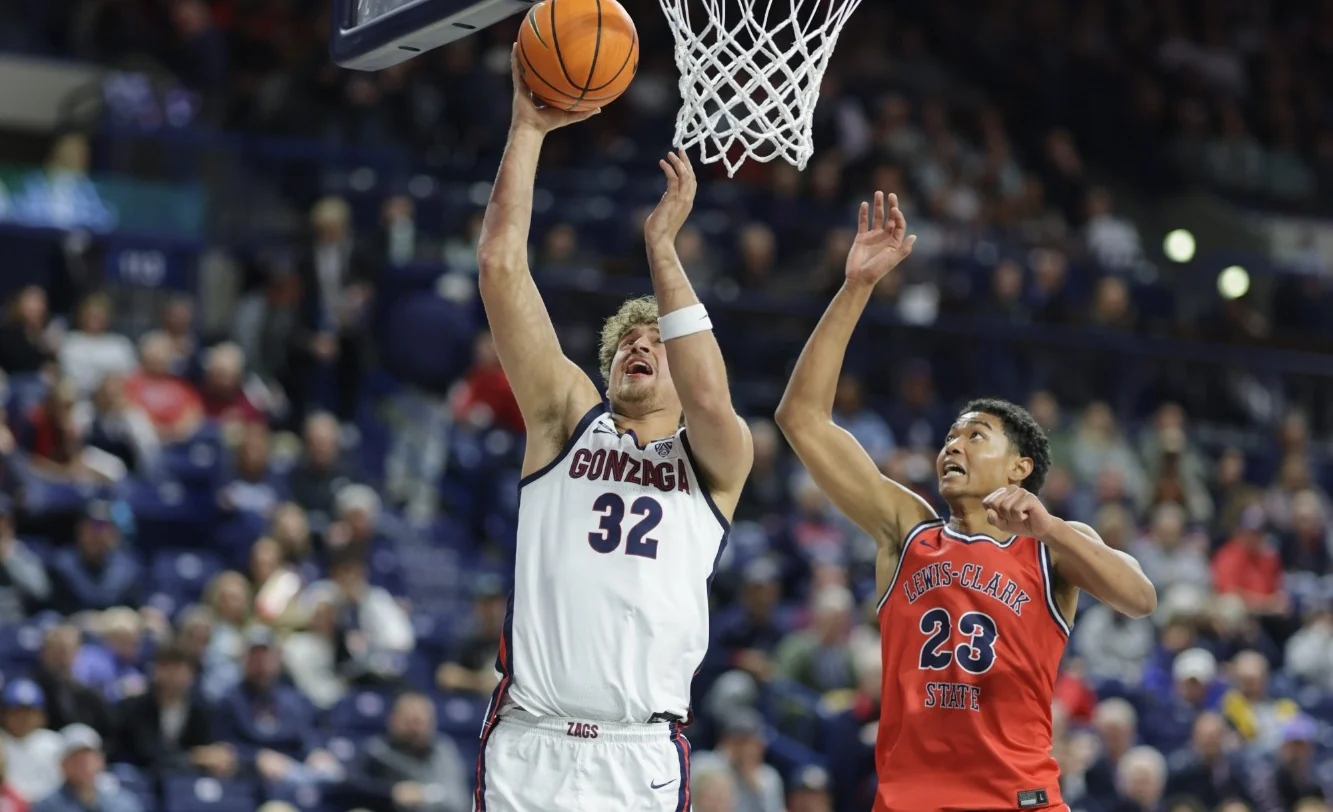
The preseason results show why both confidence and caution belong in the discussion. Arkansas beat Gonzaga 76–72 in an exhibition. The Zags then defeated Lewis-Clark State 91–59, with twelve players scoring and five reaching double figures. The latter opponent is an NAIA program, so the margin cannot be compared directly with the Arkansas game as a simple measure of improvement.
The useful question is whether the interior threat continues to create efficient choices when the opponent can match the size and pressure the passers. Watch how Gonzaga responds when the first entry is denied, whether the next player keeps the action moving and whether a contested miss becomes a second possession for the defense. Those details will say more about the favorite’s floor than an isolated preseason shooting run.
Unanimity is most persuasive when it identifies advantages that can survive different opponents and venues. Inside scoring, decision-making and the ability to finish defensive possessions are plausible places to look. The vote gives Gonzaga the benefit of that expectation. The team still has to demonstrate that its combinations can deliver it against the actual schedule.
How Utah State and San Diego State can test that assumption
The second- and third-place choices offer different questions for the favorite. Utah State’s case begins with experienced guards. San Diego State’s current player recognition points toward perimeter versatility and a physical frontcourt contributor. Neither needs to resemble Gonzaga to create a difficult game for it.
Utah State needs its guard play to travel
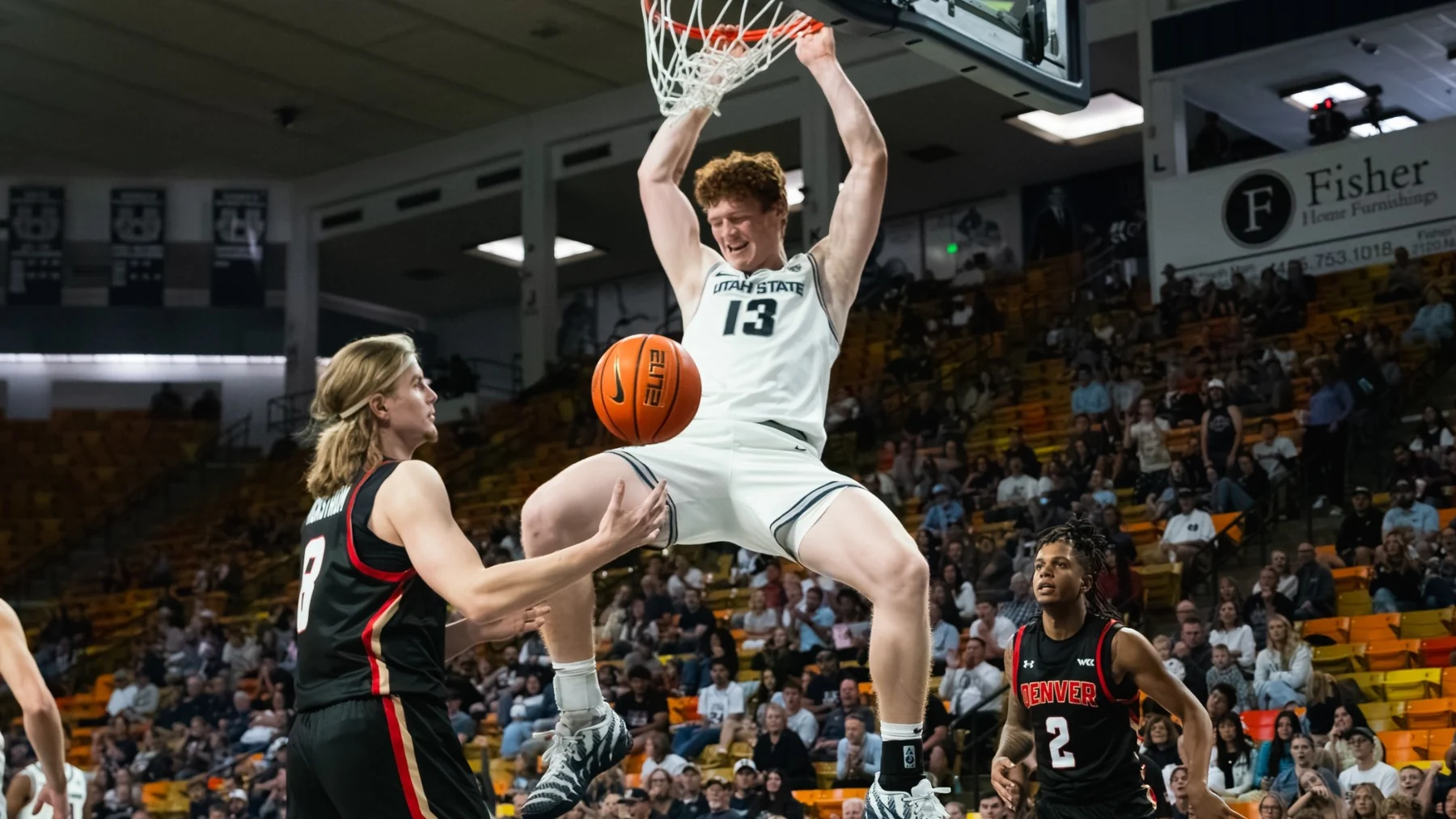
Mason Falslev is the reigning Mountain West Player of the Year, coming off a season in which he averaged 16.0 points. Dallin Hall joins Utah State after playing at Virginia, where he recorded 157 assists against 48 turnovers last season. The Aggies’ October 29 announcement provides concrete reasons to take the backcourt seriously.
Hall’s assist and turnover numbers belong to his previous team and season. They are evidence of experience organizing an offense, not Utah State statistics that have already been accumulated. The interesting test is whether the new partnership can create advantages without giving them back through hurried decisions against pressure.
That becomes especially useful to evaluate away from the familiar home setting. Can a guard get the team into its action when an opponent disrupts the first option? Can the next receiver use the advantage before the defense recovers? And can the players around the backcourt finish at the rim or secure the rebound that turns good organization into points? Second place in a poll answers none of those questions by itself.
San Diego State can make the favorite solve a different problem
San Diego State’s two impact-list players are sophomores Elzie Harrington and Tae Simmons. The school describes Harrington as a guard who can contribute at several levels of the offense and Simmons as a physical presence around the basket. That combination gives supporters a sensible place to look for the Aztecs’ response to a more celebrated opponent: controlled perimeter possessions, contact inside and a defense that makes the next action necessary.
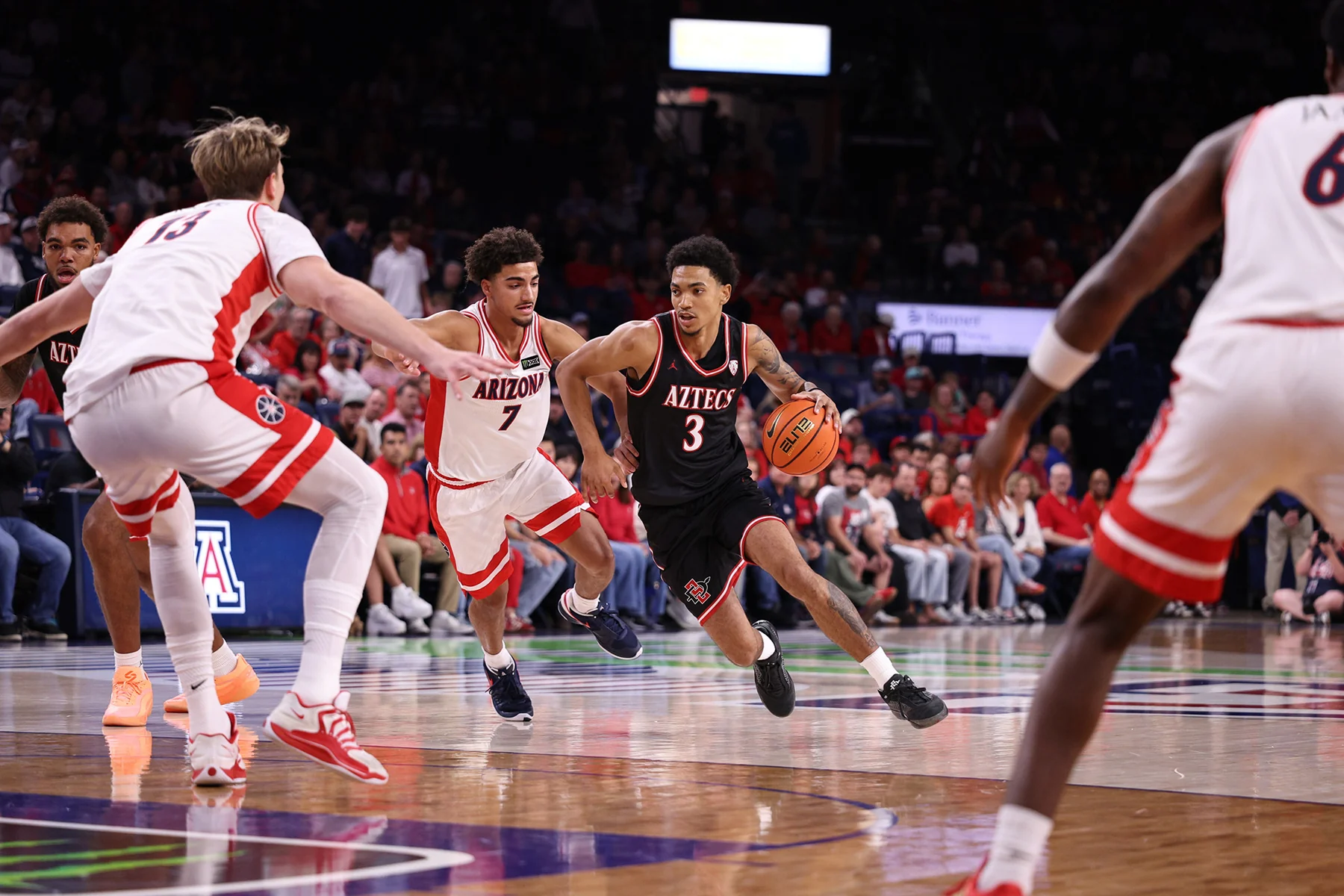
The physical label still needs evidence. In the Aztecs’ 82–67 exhibition loss at Arizona, the Wildcats won the rebounding count 49–38 and collected 20 offensive rebounds to San Diego State’s eight. That is a concrete reminder that matching an opponent’s first shot is not the same as finishing the defensive trip. It would be premature to promise that the Aztecs will control the glass against Gonzaga simply because physical play is part of the program’s identity.
Watch whether those possessions become cleaner as the season develops. If San Diego State can contest without continually conceding another attempt, it can ask the favorite to execute more often against a set defense. If it cannot, an opponent can accumulate points without needing its initial offense to work especially well. That is a more useful challenger test than treating third place as either an insult or a guarantee of proximity to first.
The coaches’ impact list is a separate judgment
The other part of the October 29 announcement is an eighteen-player impact list selected by the conference’s nine head coaches, with two players representing each school. Boise State’s official explanation of the format makes that equal representation clear. It is a different exercise from the media’s prediction of the standings.
That structure limits the conclusions a reader should draw. Two places for every program do not create a ranked list of the conference’s best eighteen players without regard to school. Nor should the names be relabeled as first-team and second-team all-conference selections. The announcement recognizes players expected to matter within their teams; it does not publish the sort of individual hierarchy those other labels would imply.
Texas State provides a useful example. The media picked the Bobcats seventh, while forwards DJ Hall and Paul Djobet appear on the impact list. Hall averaged 15.6 points and 7.7 rebounds last season for Texas State. Djobet averaged 17.5 points at Omaha before transferring. Those are meaningful individual credentials even though the team forecast places the Bobcats in the lower part of the table.
There is no contradiction to solve by dismissing one of the lists. A team’s outlook depends on how its pieces work together, the available depth, the ability to defend difficult matchups and the consistency of the whole rotation. Two productive forwards do not automatically settle the questions at every other position. Equally, a seventh-place prediction does not erase what those forwards have accomplished.
Keep the names attached to the right school as well. Texas State’s DJ Hall and Utah State’s Dallin Hall are different players. A short social post or an abbreviated watch list can make familiar surnames seem interchangeable, especially when several programs have changed conferences and brought in transfers. The official team entry is the better reference.
For viewing purposes, use the impact list as an introduction. When you watch a team outside the top three, it gives you players to follow and roles to investigate. Then watch the possessions around them: who creates their opportunities, who covers behind them defensively and whether the combination stays effective when a reserve enters. Recognition can direct attention toward a player; the games will explain how that player’s contribution fits into a winning team.
The games that will turn forecasts into evidence
Gonzaga’s first counted test is against Purdue in Las Vegas on Monday, November 2. The conference lists the tip at 4:30 p.m. Pacific, or 7:30 p.m. Eastern, and Gonzaga identifies T-Mobile Arena as the venue, with coverage on TNT, truTV and HBO Max. That is a neutral-site opener with its own broadcast arrangement, rather than a Pac-12 conference game.
Utah State begins at home against Idaho State on November 2 at 7:30 p.m. Mountain, according to its current school announcement. That game is listed for the Pac-12’s YouTube coverage. San Diego State opens at Viejas Arena against Cal State Fullerton on Tuesday, November 3, at 7 p.m. Pacific. Keep each opponent, venue and local time attached to the correct team.
Those appointments give supporters useful early evidence, but they are not equivalent tests. A result at home against one opponent and a neutral-site result against another cannot be compared by margin alone. Nor does a nonconference victory move a team ahead in the Pac-12 standings. It adds information about a roster that will later have to meet conference opponents under different conditions.
Read the early tests before rewriting the league order
Begin with the questions the preseason evidence has already raised. For Gonzaga, follow the quality of the decisions around its interior scoring. For Utah State, watch the relationship between the guards’ organization and the finishing around them. For San Diego State, check whether a good defensive contest is followed by control of the rebound. These are repeatable observations that can be tracked beyond one score.
Then account for the circumstances. A late run against reserves, an early foul problem or a short burst of difficult made shots can change a margin without establishing the same long-term lesson. The more useful case for changing your assessment is a pattern that appears against different opponents, particularly when a team has to solve a problem it did not choose.
There is no requirement to protect an October forecast when the evidence changes. There is equally little value in treating the first unexpected result as proof that every voter knew nothing. The poll is a clear record of the starting expectation. The season is the process that can support it, narrow the perceived gap or overturn it.
For the wider membership and calendar, the Pac-12 season guide provides the broader setting. The October 29 news is specific: Gonzaga has unanimous media support to finish first, with Utah State and San Diego State next. The next useful conversation is about what those teams demonstrate on the floor.
Sign in with Google to join the discussion.