What the NCAA changed on October 7, 2026
A men’s college basketball coach appearing in the crowd at another team’s game now raises a specific rules question. On October 7, 2026, the Division I Cabinet approved an attendance restriction aimed at reducing in-person recruitment of potential transfers. It covers coaches and other staff whose duties belong to the team. The exceptions matter as much as the headline: participation in the same event, a participating family member and basketball postseason access can change the answer.
The NCAA’s adopted-rule announcement is the starting point. Its main headline concerns transfer windows in several sports, but the basketball attendance provision appears in a separate part of the release. Reading the headline alone can therefore produce two mistakes: missing the attendance rule entirely, or assuming that the football transfer window announced alongside it also governs basketball.
The timeline also explains why older stories sound conditional. A September 25 NCAA report described a proposal awaiting Cabinet review. That was a stage in the process, not evidence that the October decision remained merely a suggestion. For a 2026–27 men’s basketball discussion, the useful distinction is between the earlier proposal and the later adopted restriction.
Consider a hypothetical coach visiting an unrelated November game simply because a promising guard is playing. That is a different situation from the same coach watching the other semifinal of a tournament in which his own team is entered. Both involve sitting in an arena. The event relationship is what changes the rules question; the quality of the guard does not supply an exception.
Fans should treat this as a restriction on a particular way of being present around other teams. It is not a finding that every coach who watches another player intends to recruit him. Nor does a permitted appearance prove that every conversation surrounding that appearance is permitted. Attendance, recruiting contact and player eligibility remain separate questions, even when a single transfer rumor brings all three into the same discussion.
Which basketball staff and games the restriction covers
It reaches beyond the head coach
The rule follows team responsibilities, rather than the fame of the person holding the ticket. An assistant or another institutional employee with men’s basketball duties cannot assume the restriction disappears because the head coach stayed home. The Big West’s account of the adopted legislation identifies the relevant category as institutional staff with responsibilities specific to men’s basketball.
That distinction matters when a fan says a program could simply send someone from the back of its bench. A change in job title is not, by itself, a change in the underlying team duties. On the other hand, a stranger wearing a school sweatshirt is not automatically a covered employee. A useful evaluation starts with the person’s actual institutional role, not their seat location or clothing.
For ambiguous positions, the school’s compliance staff should determine how the legislation applies. A public summary does not justify inventing a list of exempt analysts, volunteers or administrators. Nor does it establish that every university employee, alumnus or donor shares the restriction. The practical question is whether that person has the team-specific responsibilities described in the rule.
Preseason, regular season and conference tournaments
The covered calendar includes Division I preseason contests, regular-season games and conference tournament games. That last category is easy to misread. Fans often call every March elimination game “the postseason,” but the announcement specifically includes conference tournaments in the restriction and separately preserves access to NCAA championships and other postseason contests.
For a hypothetical staff member whose team is not entered in an unrelated conference’s tournament, calling that quarterfinal “postseason basketball” does not answer the attendance question. For a staff member whose own team is entered in the event, the same-event exception becomes relevant. The stage of competition and the staff member’s relationship to the event must both be considered.
The preseason designation matters too. An exhibition may not contribute a regular-season win, but that does not make it invisible to an attendance rule that expressly covers preseason play. Our October exhibition guide explains the competition distinction. Fans should avoid using “it does not count in the standings” as a substitute for checking the actual attendance provision.
The three exceptions that change the headline
Another game at an event your team is playing
The adopted text preserves attendance at a contest within a tournament or event in which the staff member’s own team participates. Imagine a four-team November event. Your team plays the early semifinal, and an assistant watches the late semifinal to prepare for the following day. The exception addresses precisely the event relationship that a headline saying “coaches cannot watch other teams” leaves out.
This makes basketball sense. A next-day opponent may use a different starting group, switch more ball screens or change its late-game lineup. Seeing another game within the event can help coaches prepare for what happens hours later. That competitive purpose does not require us to pretend every game in the same city belongs to the same event.
A shared hotel, arena district or travel weekend is therefore not enough information for a fan to make a confident judgment. Establish which event the game belongs to and whether the coach’s team is participating. Do not turn geographical proximity into a new exception that the legislation never states.
A family member is participating
The family exception is broader than “a coach’s son is playing.” The final legislative text gives examples that include an athlete, coach, band or cheer participant, and someone receiving a celebration or honor. That detail is useful when a photograph shows a staff member at an otherwise unrelated game: the participating relative may not be on either roster.
Participation remains the relevant condition. Bringing a relative along as another spectator does not, merely by itself, demonstrate the exception. Nor should a reader assume that the informal everyday meaning of “family” settles every case; the text refers to the NCAA’s family-member definition. Institutions should resolve specific circumstances before attendance, rather than rely on an internet thread afterward.
Think of a hypothetical assistant attending a game because a qualifying family member is being honored. The situation deserves a different initial question from a suspected scouting trip. It still does not give the assistant unlimited permission to recruit another school’s players. The exception answers why attendance can be allowed, not whether every separate interaction is allowed.
NCAA championships and other postseason games
The NCAA’s basketball announcement also preserves access to NCAA championship and other postseason contests. This is a separate point from the same-event exception. Fans should not add an unstated requirement that a coach’s own team must still be alive in the NCAA bracket before the coach can appear in the crowd.
Keep the earlier conference-tournament distinction in view. A league quarterfinal is specifically named in the covered categories; an NCAA Tournament game falls within the preserved postseason access. A March date alone cannot distinguish them. Correctly identifying the competition is much more useful than arguing over whether both games feel like postseason basketball.
Why an attendance rule became a transfer-recruiting measure
The NCAA frames the restriction as a deterrent to recruiting players before they have entered the Transfer Portal. Its legislative rationale focuses on undue influence while players are competing for another institution. That explains why a rule about spectators belongs in a recruiting discussion: an official’s presence can create an opportunity for contact, visibility or signaling even when the contest itself has nothing to do with the visitor’s schedule.
There is a real basketball tension here. A program may invest a season in teaching a guard how to defend a ball screen, manage possessions and become a reliable late-game decision maker. Its supporters naturally dislike the thought of a rival treating those games as a recruiting showcase. The athlete, meanwhile, has an interest in making informed decisions about his future. An attendance boundary addresses one setting in that tension; it does not settle the wider argument about transfer opportunities.
A recent enforcement example shows why attendance and contact must stay separate. In an October 23 Ole Miss decision, the NCAA described impermissible recruiting conversations between former assistant Wes Flanigan and an adviser to a player at another school who had not entered the portal. The communications included calls and texts. The player ultimately transferred elsewhere. This was a contact case, not a finding that the new October attendance restriction had been violated.
That example cuts against two shortcuts. First, a transfer does not have to end with the recruiting school signing the player for impermissible contact to matter. Second, keeping a staff member out of an arena cannot, by itself, prevent every prohibited conversation. A policy can close one route without eliminating every other route. Whether this particular restriction meaningfully reduces tampering will require evidence beyond the announcement of its purpose.
Eligibility is another distinct layer. A player being able to compete next season does not establish that another school could recruit him at any earlier moment. Conversely, uncertainty about eligibility does not prove that an attendance exception applies. The 2026–27 eligibility guide addresses who can play. This rule concerns where particular staff members can go while other teams are playing, with recruiting conduct still requiring its own evaluation.
What this means for scouting and tournament preparation
A basketball staff still has to prepare its team to play. Understanding an opponent’s ball-screen coverage, offensive rebounding priorities and preferred closing lineup remains part of that job. The October provision should be read as an attendance restriction with recruiting implications, rather than an instruction to stop understanding opponents. An April committee report helps explain the concern: the visibility created by coaches attending other conferences’ tournaments could itself produce recruiting advantages.
Live observation and film are different questions
The adopted attendance language does not establish a universal ban on watching game film or a television broadcast. That does not mean every way of obtaining footage, every scouting arrangement or every recruiting activity is automatically allowed. It means that those questions need the rules relevant to them. A clip on a coach’s tablet and the same coach seated behind another team’s bench are different sets of facts.
From a basketball standpoint, the distinction matters because the information is different. Film lets a coach replay how a defender navigates a screen or identify who failed to tag a rolling big man. A wide view of the floor can reveal spacing away from the ball. A single broadcast angle may omit a substitution discussion or a weak-side action. These are reasons preparation requires judgment, not evidence that a particular program has lost some measurable competitive advantage because of this rule.
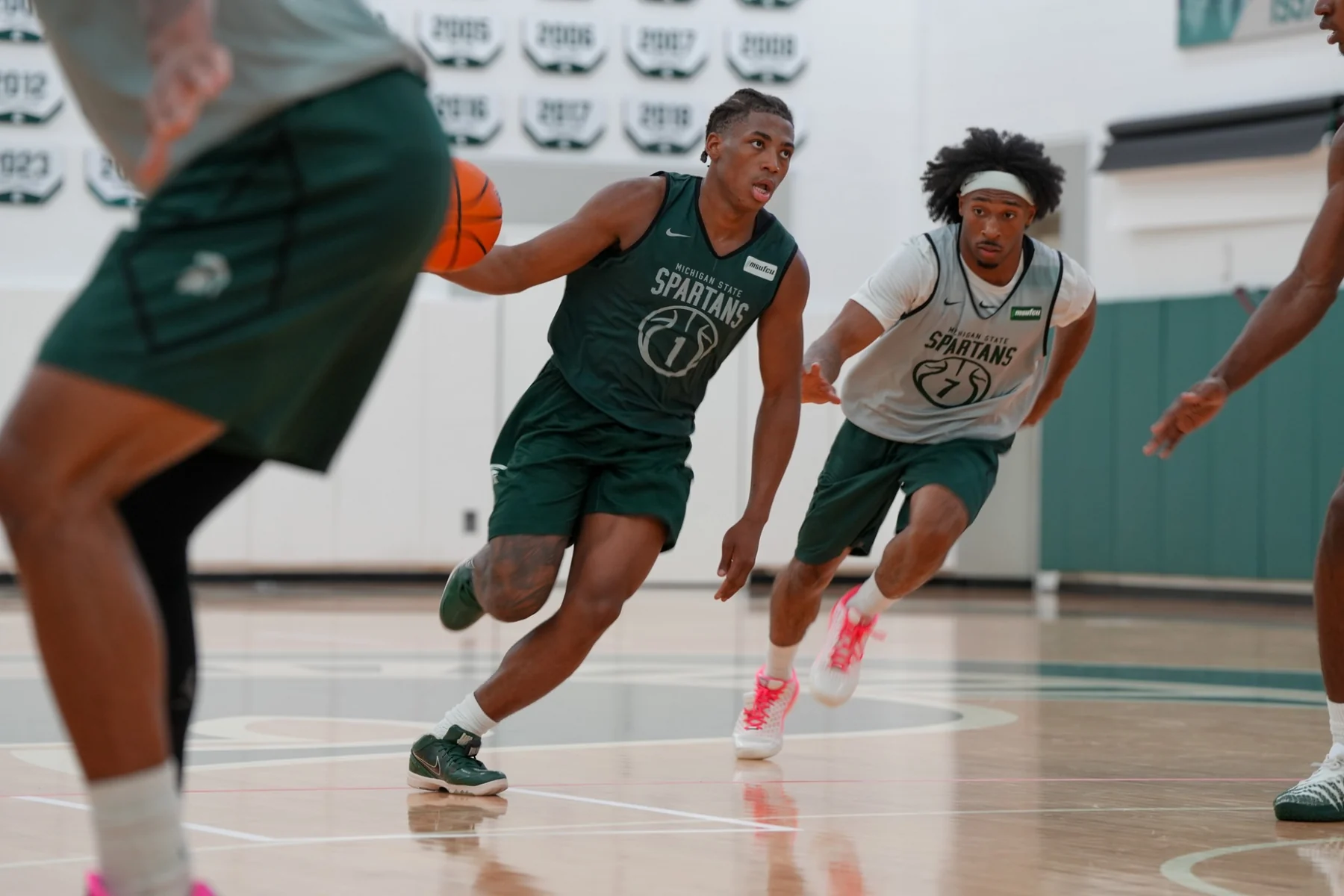
For a concrete team context, Michigan State’s September practice report highlighted the leadership of Jeremy Fears Jr. and Coen Carr. An opponent evaluating that group would need to think about decision making and how the returning players organize teammates. Merely knowing a scorer’s points total would not answer those questions. This is an illustration of basketball preparation, not a suggestion that Michigan State or a future opponent has breached an attendance rule.
At an event in which both teams participate, the exception helps preserve practical next-opponent preparation. Outside that setting, staff should not treat “I only wanted to scout” as a substitute for checking the restriction. The policy deliberately concerns attendance itself; a visitor’s claimed basketball interest does not create a fourth exception.
The reasonable expectation is a change in how staff plan certain trips and appearances. It is too early to assign a win total, a defensive-efficiency improvement or a transfer-retention percentage to that adjustment. Those would require actual evidence. Fans can discuss the cost of losing some live observation without pretending the NCAA has banned film rooms or that a familiar coach appearing on television automatically reveals recruiting misconduct.
How to judge the controversy without accusing a coach
The reaction is partly a reaction to incomplete headlines. In an October 8 community discussion, readers asked whether coaches could still watch other games at their own early-season tournaments and whether a child playing for another school changes the answer. Some commenters doubted that removing staff from the stands would stop other forms of contact; another defended the restriction as a way to prevent an expanding expectation of in-season recruiting appearances. These are observed opinions, not a survey of college basketball fans.
There is room to disagree about the policy while getting the facts right. Someone can support stronger protection against transfer tampering and still think a particular attendance boundary is difficult to police. Someone can dislike the rule’s effect on ordinary basketball watching and still acknowledge that its same-event and family exceptions exist. Neither position requires describing a coach as a cheater because a camera found him in an arena.
Before treating an appearance as a rules story, work through a short sequence:
- Identify the person’s role. Are there institutional responsibilities specific to men’s basketball, or is the person simply associated with the school?
- Identify the competition. A preseason game, conference tournament and NCAA championship are not interchangeable categories here.
- Check the event connection. Is the person’s own team participating in that tournament or event?
- Check a possible family participation reason. The participating relative need not be a player.
- Separate attendance from contact. Permission to watch does not settle the legality of recruiting conversations.
The Division I infractions process involves gathering and evaluating facts before violations and penalties are determined. A social photograph rarely supplies the role, event definition, family circumstance and communication history needed for a reliable conclusion. Asking those questions is a better contribution than circulating a screenshot with a verdict attached.
For the coming season, watch whether schools and event organizers explain attendance decisions clearly and whether enforcement produces specific, documented cases. Those developments could reveal how workable the restriction is. An empty courtside seat, an unverified transfer rumor or an angry thread cannot tell us whether tampering has declined. The useful standard is consistent application of the actual rule, with the exceptions intact and the evidence matched to the allegation.
Sign in with Google to join the discussion.