There is more than one national player of the year
College basketball has several national player-of-the-year awards, each with its own organizer and selection process. A headline calling someone the national player of the year needs a second question: which award? The Naismith Trophy, John R. Wooden Award and Associated Press honor are separate recognitions. Agreement among them can make a season especially persuasive, but their winners should never be combined into an unlabeled list.
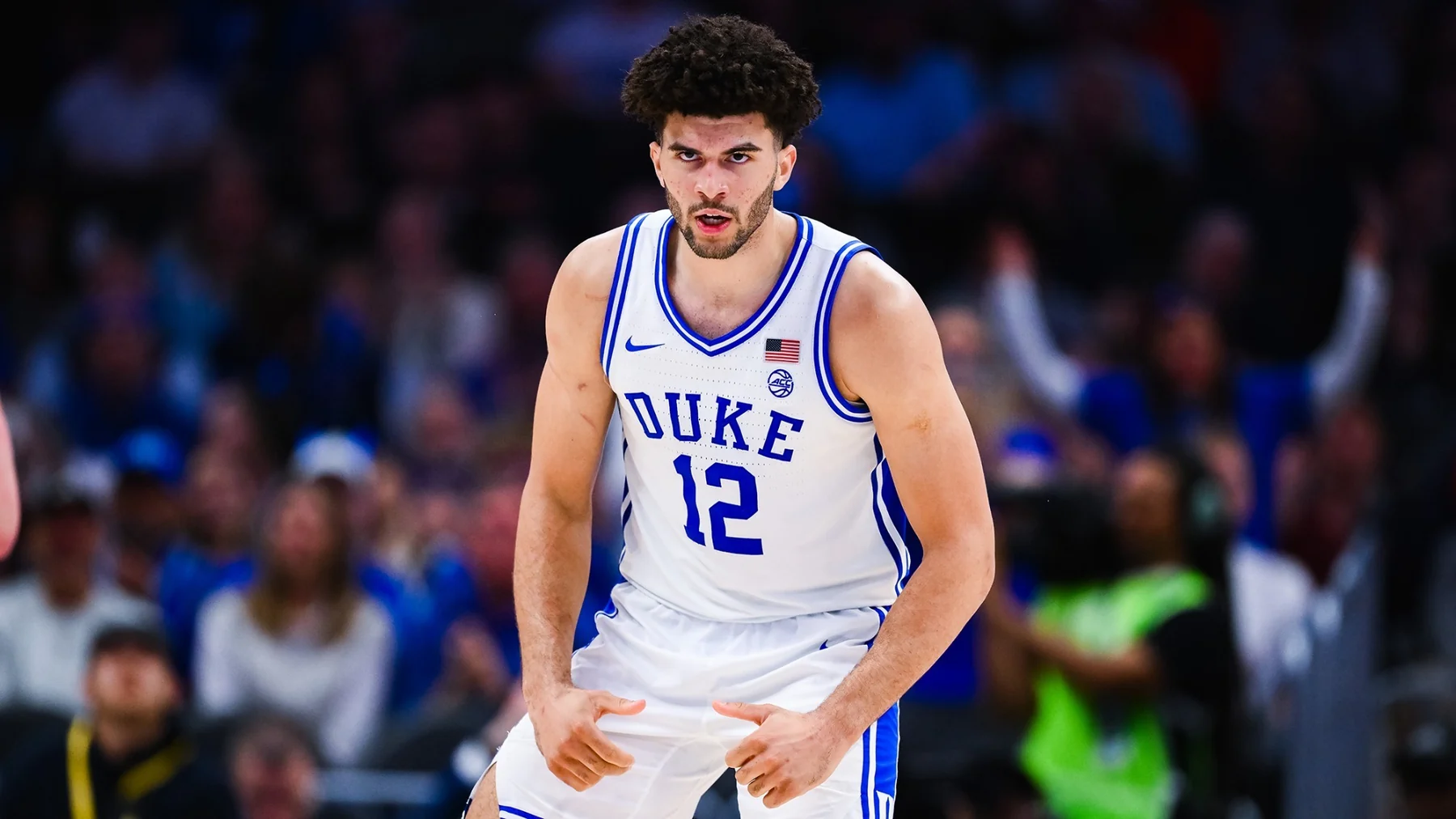
Start with the distinction between an overall player award and a specialist honor. In 2026, Duke's Cameron Boozer won the men's college Naismith Trophy, while Florida's Rueben Chinyelu received the organization's men's defensive award. Those announcements are compatible. They answer different basketball questions: who produced the strongest overall season, and who supplied an exceptional defensive contribution? Neither result says the other player failed at his role.
The same care applies to a conference award, a preseason selection or an All-America team. A conference player of the year is chosen from that league's population. An All-America honor places someone within a group. A preseason forecast is an expectation before the full season has supplied evidence. None should be silently promoted into the result of a completed national player-of-the-year vote.
Dates are equally easy to misread. The 2026 award recognizes the season completed in spring 2026, normally described as 2025–26. A list published in November 2026 concerns a new season ending in 2027. Putting both under a bare “2026 players” heading mixes established achievements with projections about different teams and roles.
For a useful answer, attach three labels: award, season and selection status. “2026 men's Naismith winner” is precise. “2026–27 preseason candidate” is also precise, but makes a much smaller claim. This guide uses the former kind of wording for historical results and keeps predictions separate.
Team rankings require another label altogether. A school's place in the AP poll, NET or a predictive rating does not award its best player an individual trophy. The college basketball rankings guide explains those team measures. Here, the focus is the player's season, the award attached to it and the people who actually select the recipient.
What Naismith, Wooden and AP actually recognize
The Naismith Trophy is administered by the Atlanta Tipoff Club. The Wooden Award has its own administration, advisory process and connection to the Los Angeles Athletic Club. AP supplies another national judgment. These names identify the award, rather than successive rounds of one competition. A player does not have to win one trophy to become eligible to win the next.
Wooden's published description emphasizes a complete collegiate player, with academic and character requirements alongside basketball performance. Its All-America selections and its single player award are also distinct honors. A player can appear on an award organization's season list without ultimately becoming its winner. Read the announcement's category before adding another trophy to a player's résumé.
The coach-selected and writer-selected awards
The National Association of Basketball Coaches supplies a different perspective through its member coaches. Its award directory separates NCAA Division I, II and III, the NAIA and two-year colleges. “NABC Player of the Year” therefore still needs a division attached. This article concerns the men's Division I season; another division's winner is not an alternative answer to the same field.
The U.S. Basketball Writers Association presents the Oscar Robertson Trophy for its men's national player of the year. It also presents the Wayman Tisdale Award for its national freshman. Cameron Boozer received both for 2025–26, as the USBWA announced in March 2026. That combination makes sense: a freshman can supply the country's strongest overall season as well as the strongest first-year season. The awards overlap in the player they recognize while retaining different eligibility questions.
A coach electorate and a writer electorate can reach the same conclusion from the season's evidence. They can also disagree. That disagreement should prompt a comparison of the awards' timing, candidates and stated criteria, rather than an attempt to declare one published result invalid because another organization preferred someone else.
A watch list is not an award
The Naismith organization published its 2026–27 men's college watch list on November 2, 2026. Its columns identify players, classes, positions, schools and conferences. They do not supply a ranked order of likely winners. Being on that list establishes early recognition, not a vote total or an assured finalist place.
That distinction helps when following a fast start. A candidate can strengthen his case by creating efficient shots, protecting the ball or anchoring a defense, but an impressive November week does not finish the national race. Keep the organizer's confirmed announcement separate from your assessment of the basketball. Both can be useful; they carry different authority.
Naismith men's winners by year, 1969–2026
The following is the men's college Naismith Trophy list, not a merger of national awards. The year names the spring in which the award was presented. Consecutive years with the same recipient are grouped together, so a range represents a win in each listed year.
The history begins in 1969 with UCLA's Lew Alcindor, later known as Kareem Abdul-Jabbar. That starting point matters when comparing eras. A player whose college career ended before the trophy existed could not win it. Absence from this table therefore cannot be used as a universal test of a great college career.
- 2026
- Cameron Boozer
- 2025
- Cooper Flagg
- 2023–2024
- Zach Edey
- 2022
- Oscar Tshiebwe
- 2021
- Luka Garza
- 2020
- Obi Toppin
- 2019
- Zion Williamson
- 2018
- Jalen Brunson
- 2017
- Frank Mason III
- 2016
- Buddy Hield
- 2015
- Frank Kaminsky III
- 2014
- Doug McDermott
- 2013
- Trey Burke
- 2012
- Anthony Davis
- 2011
- Jimmer Fredette
- 2010
- Evan Turner
- 2009
- Blake Griffin
- 2008
- Tyler Hansbrough
- 2007
- Kevin Durant
- 2006
- J.J. Redick
- 2005
- Andrew Bogut
- 2004
- Jameer Nelson
- 2003
- T.J. Ford
- 2002
- Jay Williams
- 2001
- Shane Battier
- 2000
- Kenyon Martin
- 1999
- Elton Brand
- 1998
- Antawn Jamison
- 1997
- Tim Duncan
- 1996
- Marcus Camby
- 1995
- Joe Smith
- 1994
- Glenn Robinson
- 1993
- Calbert Cheaney
- 1992
- Christian Laettner
- 1991
- Larry Johnson
- 1990
- Lionel Simmons
- 1989
- Danny Ferry
- 1988
- Danny Manning
- 1987
- David Robinson
- 1986
- Johnny Dawkins
- 1985
- Patrick Ewing
- 1984
- Michael Jordan
- 1981–1983
- Ralph Sampson
- 1980
- Mark Aguirre
- 1979
- Larry Bird
- 1978
- Butch Lee
- 1977
- Marques Johnson
- 1976
- Scott May
- 1975
- David Thompson
- 1972–1974
- Bill Walton
- 1971
- Austin Carr
- 1970
- Pete Maravich
- 1969
- Lew Alcindor
Read a repeated winner as evidence of recognition across separate seasons. Bill Walton's three awards and Ralph Sampson's three awards reflect annual judgments over extended college careers. Zach Edey's consecutive wins cover two later seasons. The table does not convert those spans into an exact numerical comparison of their opponents, possessions or responsibilities.
Duke's official 2026 announcement also places Boozer within that program's particular history: he followed Cooper Flagg as a freshman recipient. That is useful institutional context, but school totals count awards, not a common team contribution measured across every season. Two teammates sharing offensive work face a different setting from a player carrying a larger share of an offense.
For comparisons across generations, combine the chronology with an explicit question. Are you evaluating one extraordinary season, sustained college excellence or an entire playing career? The historical college players guide addresses the broader career question. This table supplies the narrower answer to who received this particular award, in this particular year.
It also establishes a clean stopping point. The latest completed award here is 2026. The 2027 race concerns a different season and remains open; a new watch-list entry should not be appended to a winners table before the organizer announces its final recipient.
What the 2026 and 2022 races tell us
Two completed seasons make the comparison more concrete. Cameron Boozer's 2026 Naismith award and Oscar Tshiebwe's 2022 award were confirmed by the same organizer, but their statistical profiles illustrate different ways to shape possessions. The purpose of comparing them is to understand the case each supplied, rather than to manufacture a formula that retrospectively picks every winner.
Cameron Boozer's 2026 season
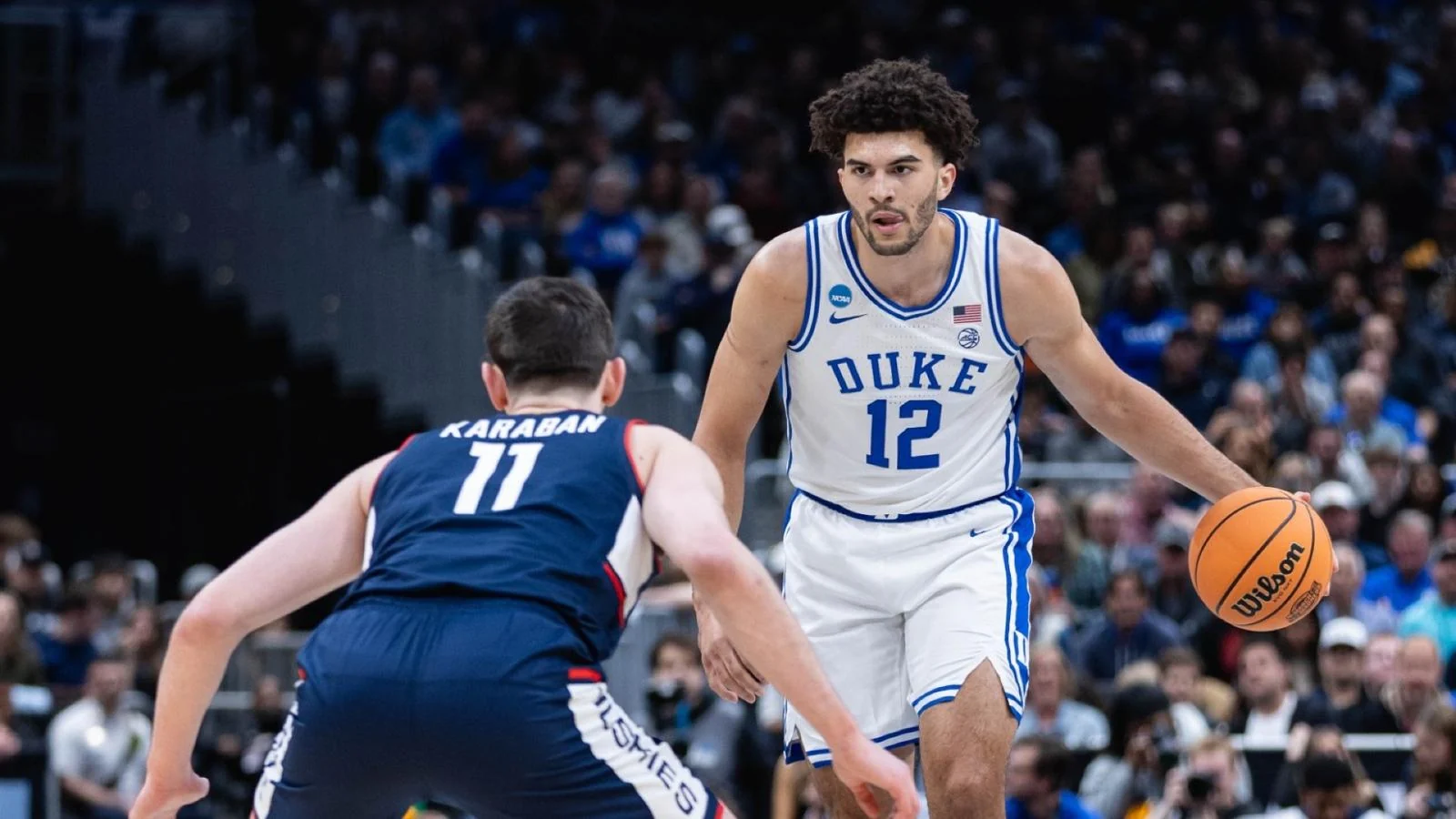
Duke's final 2025–26 statistics credit Boozer with 22.5 points, 10.2 rebounds and 4.1 assists per game across 38 appearances, shooting 55.6 percent from the field. Those figures describe several responsibilities at once: finishing possessions, securing the ball after a miss and helping a teammate obtain a shot. His school's Naismith announcement also records 22 double-doubles.
The passing contribution belongs beside the scoring. A defense trying to limit a productive interior scorer must decide how much help to commit. When that player can locate a teammate, the cost of the help can extend beyond his own shot attempts. That is the basketball reason to examine assists and decision-making alongside points, while acknowledging that an assist total does not capture every valuable pass or every turnover risk.
Field-goal percentage also needs its proper definition. It describes made field goals divided by attempts; it does not weight a three-pointer like a true-shooting measure or include free throws. Boozer's number supports a statement about efficient shooting from the floor. It should not be relabeled as a different statistic merely to make his case appear more comprehensive.
Oscar Tshiebwe's 2022 rebounding case
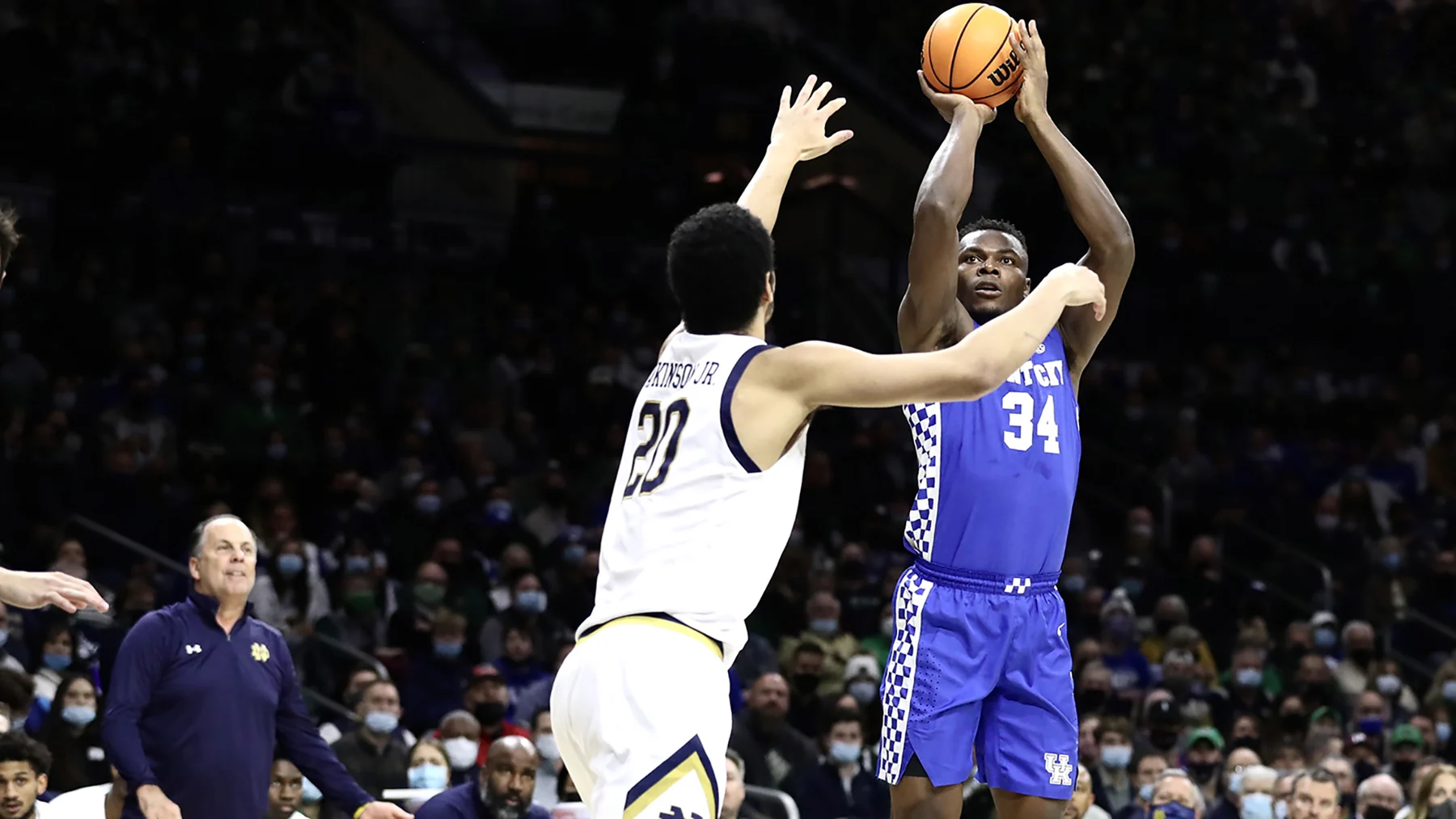
Kentucky's historical account of 2021–22 lists Tshiebwe at 17.4 points and a nation-leading 15.1 rebounds per game, including 5.3 offensive rebounds. He also finished with 28 double-doubles. Keep those numbers attached to that season: the roster page containing the historical biography also carries a later roster-year label.
An offensive rebound creates another opportunity within a possession. It can lead to a close finish, a foul or a pass back out to reset the attack. The rebound itself does not guarantee points, but repeatedly recovering missed shots changes how often an opponent must defend a second action. Defensive rebounding has a separate value: a sound initial contest does not complete the stop until the defense secures the miss.
That distinction explains why a rebounding-centered candidacy cannot be evaluated by the scoring column alone. It also prevents the opposite mistake of treating every rebound as equally difficult. Minutes, pace, available misses and the surrounding lineup affect the chances a player receives. The award recognizes a season's contribution; a responsible comparison explains how that contribution arose.
How the voting works—and where fans have a say
There is no single national player-of-the-year voting system. Check the award's electorate, evaluation window and current instructions separately. A final ceremony can occur after voting closes, and the final date on a schedule does not necessarily tell you which games a voter was instructed to consider.
Naismith's finalist vote
For the 2026 men's college award, the Atlanta Tipoff Club described a national academy including media members, current and former coaches, former winners and conference commissioners. Its finalist announcement also opened a fan vote for the overall player and coach awards. The fan component accounted for five percent of the total, leaving the professional academy as the dominant part of the process.
That edition allowed one fan vote each day, beginning March 27 and ending at noon Eastern Daylight Time on April 1. Those are historical instructions, not a currently open voting window. For another year, wait for the organizer's new announcement. A large social following alone does not establish the outcome when the public component is a small part of the combined vote.
Wooden's ballot and eligibility requirements
Wooden's published process combines basketball evaluation with eligibility certification. Candidates must be full-time students, progress toward graduation and meet a minimum cumulative grade-point average of 2.00. The stated considerations also include character, contribution to the team and performance at both ends of the court.
Its advisory board selects a national ballot, while the award's description says media experts evaluate performance across the season, including tournament play. The published progression allows players absent from earlier watch lists to remain eligible for the final ballot. Consequently, an omitted preseason name is not automatically eliminated, and an early list is not a closed set of possible winners.
Read the specific year's ballot release before assuming exactly when a performance can influence the selection. A description of whole-season evaluation and a published submission window must be interpreted together. Neither creates a rule that every late tournament possession will be included in every elector's completed ballot.
AP's poll voters
Duke's official account of Boozer's 2026 AP award identifies a panel of 61 media members covering college basketball and describes the honor as based on regular-season performance. That is a different electorate and scope from an open internet poll. Supporting a player online does not submit an AP award ballot.
The practical lesson is to keep the result and its basis together. An AP winner, a Naismith winner and a Wooden winner may be the same person, yet the announcements describe separate decisions. Evaluate a disputed result against the named award's process before arguing that an unrelated voting rule should have applied.
How to compare two candidates without counting trophies twice
Awards are evidence of recognition, but counting them is not a complete evaluation method. When the USBWA honored Boozer as both its overall player and freshman in 2026, the two selections recognized overlapping achievements. They did not represent two separate seasons of production that can be added to a box score.
Different awards can also divide. In 2016, Buddy Hield won the Naismith Trophy, while the NABC's Division I history records Denzel Valentine as its player of the year. Valentine was among Hield's Naismith finalist opponents. Both results belong in an accurate account. The winner alone does not reveal every elector's reasoning, so the split is a starting point for analysis rather than proof of a particular voting motive.
Separate production, role and team results
For an editorial comparison, begin with the same performance window. Do not put one candidate's full-season average beside another's conference-only number. Then establish minutes and pace. A player with more possessions and playing time has more chances to accumulate points, assists and rebounds. That context does not erase his production; it explains the opportunity behind it.
Next examine the job. A primary ballhandler must create against pressure and make decisions after the first option disappears. A screening center can improve shot quality without receiving the assist. A defensive rebounder completes possessions, while a help defender may prevent an attempt that never becomes a block. None of those observations should be converted into invented statistics. Use them to identify what the film or available evidence can actually show.
Finally, separate the team's accomplishment from the individual's contribution to it. Strong results against difficult opponents can provide a convincing stage for a candidate. They do not establish that every starter had the same responsibility, or that a player on a less successful team supplied no national-level value. Ask which actions the player repeatedly performed and whether they held up against different defenses.
This is an evaluation framework, not a claimed universal ballot. An organizer may have additional eligibility requirements or a different cutoff. Likewise, career achievements and professional upside answer other questions. The career scoring records guide measures accumulated scoring; a national season award measures recognition within a particular year's field.
Following the next award race from November to April
Start the next race with an organizer's dated list, then add the basketball you actually watch. In the current 2026–27 cycle, NABC's October 29 announcement identifies its preseason candidates and says its Division I coaches' vote comes at the conclusion of the regular season. The Naismith calendar follows its own sequence. Those announcements begin an observation period; they do not settle the award months in advance.
Choose a few candidates with different roles. Watching only high-scoring guards can obscure the influence of a versatile forward or a center who changes an opponent's shot selection. Choose different opponents as well: a comfortable home win and a difficult road possession can reveal different parts of the same player's game. Neither one should automatically outweigh the full body of work.
Use today's games page to find when a candidate plays, and the TV schedule to identify the announced carrier. Record the season and date beside any statistics you compare. If a report uses an average taken before a later game, preserve that cutoff instead of merging it with another player's updated total.
When the next watch-list stage arrives, distinguish a new official selection from ordinary movement in public discussion. Check whether the list is for the overall player, defensive player, freshman or a position award. If the organizer permits later additions, an absent name is not proof of ineligibility. If a fan ballot opens, use that edition's instructions rather than recycling last spring's deadline.
At the finish, look for the organizer's winner announcement and retain the award's full name in any comparison. That keeps a season's genuine recognition intact without pretending every trophy came from one electorate or every preseason expectation became a result. The useful historical record answers a specific question clearly: which player, which award, which season?
Sign in with Google to join the discussion.