Lew Alcindor takes first place in our ranking of the best men's college basketball players of all time. Three UCLA championship seasons and three individual tournament honors give his college case unusual depth. The ten selections below compare completed college careers, using documented performances to explain the close choices. This is our editorial ranking, with historical records checked through October 14, 2026; it is not an official NCAA list.
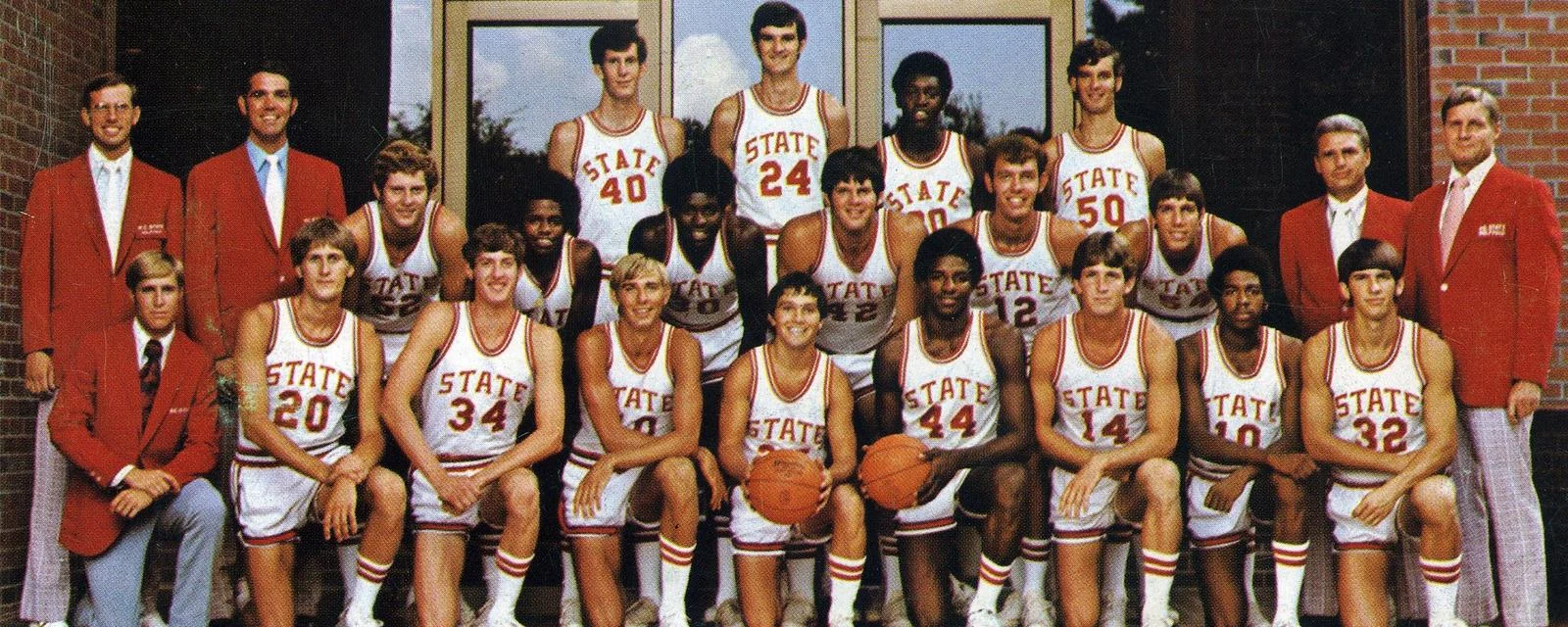
The cover shows NC State's 1974 team, including David Thompson, in a school archive photograph. The historical photographs illustrate college careers, rather than current rosters.
Our top 10 and how we chose them
This is an editorial ranking of completed men's college basketball careers, reviewed on October 14, 2026. The order belongs to this publication; it is not an official NCAA list or a claim that every basketball historian agrees. NBA production, professional championships and draft position do not decide the places below.
| Rank | Player | College |
|---|---|---|
| 1 | Lew Alcindor, later Kareem Abdul-Jabbar | UCLA |
| 2 | Bill Walton | UCLA |
| 3 | Bill Russell | San Francisco |
| 4 | Oscar Robertson | Cincinnati |
| 5 | Pete Maravich | LSU |
| 6 | David Thompson | NC State |
| 7 | Ralph Sampson | Virginia |
| 8 | Larry Bird | Indiana State |
| 9 | Christian Laettner | Duke |
| 10 | Tyler Hansbrough | North Carolina |
What counts as college greatness
We begin with a player's demonstrated college peak: how strongly his scoring, creation, rebounding or defense shaped the level at which his team could compete. Next comes sustained achievement. Repeating an exceptional contribution across several seasons strengthens a career case, especially when opponents had time to learn the player and prepare for him.
Tournament contribution is the third major consideration. It supplies evidence against consequential opponents, but a championship is a team accomplishment. The question is what a player actually contributed to that run. A roster spot on several title teams cannot automatically outweigh a dominant player whose team had a less successful final game.
These are ordered considerations rather than a numerical formula that pretends to calculate precision across eras. We use school records, award histories and documented games to explain the judgments. Adjacent positions are deliberately open to argument: a reader who places more value on defensive influence can prefer Russell to Walton, while a reader who emphasizes individual scoring can move Maravich higher.
Even award comparisons need dates. The Naismith Trophy's official history identifies its first presentation in 1969, to UCLA's Lew Alcindor. An earlier player could not win an award that did not yet exist. The cases that follow therefore focus on achievement within a player's college setting, with trophies and statistics used as evidence rather than interchangeable counters.
No. 1 Lew Alcindor: the strongest complete college case
Lew Alcindor's UCLA career offers the strongest combination of the three considerations in this ranking. UCLA's Hall of Fame credits him with three college player-of-the-year honors and three consecutive NCAA championships, from 1967 through 1969. A separate UCLA account records an 88–2 team record across his three playing years. These are varsity achievements, rather than a claim that his freshman year supplied another championship season.
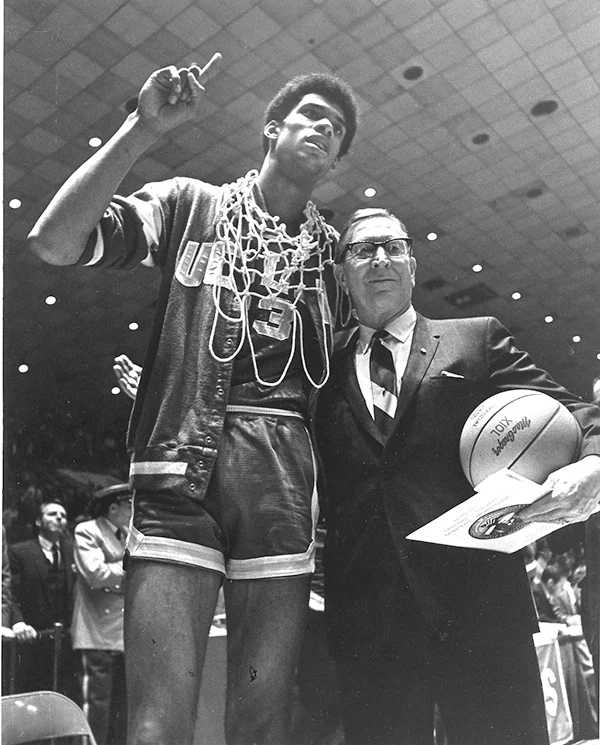
The team record establishes an exceptional competitive setting. It does not, by itself, tell us how to divide credit between the center, his teammates and John Wooden. The additional individual evidence is essential: Alcindor's official career history records three NCAA tournament Most Outstanding Player honors. His postseason recognition therefore repeats across the same championship period rather than resting on one particularly memorable final.
That repetition is the heart of the first-place argument. A single brilliant performance can supply a powerful peak case, but Alcindor has a record of returning to the highest stage and earning the leading individual recognition again. It connects sustained excellence with championship contribution. Neither an impressive career total nor a famous isolated highlight makes that complete combination easy to match.
The program context also makes the judgment more useful. The men's champions history situates these seasons within UCLA's broader success. A great program can support a great player, and the presence of that support should be acknowledged. It does not require treating the player as a passenger when the individual postseason honors show repeated prominence.
We place Alcindor first because his college case remains strong under several reasonable priorities: exceptional team performance, sustained individual recognition and repeated tournament distinction. Readers can debate how much each should count. The important point is that this conclusion can be defended entirely from the UCLA years, without borrowing anything from Kareem Abdul-Jabbar's subsequent professional career.
Bill Walton and Bill Russell: championship anchors
No. 2 Bill Walton and the value of an extraordinary peak
Bill Walton's 1973 championship game provides an unusually clear example of scoring efficiency under the greatest tournament pressure. The Basketball Hall of Fame records 44 points on 21 successful field goals from 22 attempts. High scoring normally leaves room to ask whether a player needed an extraordinary number of shots. This performance scarcely leaves that opening: Walton repeatedly converted the possessions that UCLA gave him.
The same biography identifies a broader center's toolkit: rebounding, outlet passing and a jump hook with either hand. Those skills explain why the final should be viewed as a concentrated example of his value rather than the entire case. A rebound ends the opponent's opportunity; a strong outlet can start the next attack before the defense is settled. The center therefore affects the transition between possessions as well as the finish at the basket.
UCLA's career account adds the sustained setting. Walton's first two varsity seasons each ended 30–0 and with the 1972 and 1973 NCAA championships. Across three varsity seasons, his teams went 86–4. These figures belong to the team, but two perfect championship seasons give the spectacular final a much larger foundation. Our second-place choice rewards that combination of an exceptional peak and repeat success.
No. 3 Bill Russell and the defensive foundation
Bill Russell's San Francisco career shifts the emphasis toward controlling the opponent's possessions. The Dons' 1956 championship history records a 29–0 season and an 83–71 final win over Iowa. Russell supplied 26 points and 27 rebounds in that final. The combination matters: he could finish enough attacks to be a major scorer while repeatedly securing the ball after missed shots.
The school's retrospective also recalls three consecutive shot rejections before halftime. That account illustrates the pressure he could apply around the basket; it should not be converted into a modern official blocked-shot total. The strongest measurable evidence here is the rebounding. San Francisco's college-career remembrance records a 20.3 rebound average and championships in both 1955 and 1956.
Russell's case is consequently more than a defensive reputation carried backward from professional basketball. A title-game performance and the college career's rebounding record establish it directly. Readers who give possession-ending defense greater weight can reasonably move him above Walton. We narrowly prefer Walton's documented scoring peak and wider offensive toolkit, while recognizing that this is a close editorial judgment between two very different championship centers.
Robertson, Maravich and Bird: greatness beyond a title count
No. 4 Oscar Robertson supplies one of this list's strongest combinations of scoring and work on the glass. Cincinnati's college statistics record 2,973 points, a 33.8 scoring average and 15.2 rebounds per game. That rebounding figure matters for a player whose scoring could otherwise dominate the conversation. Ending defensive possessions and creating further chances on the boards are substantial additional contributions.
The table also shows 7.3 assists per game in his final varsity season, 1959–60. It establishes a third part of his offensive value: teammates could receive opportunities from him as well as watch him finish possessions. The earlier table has missing assist data, so it cannot support a complete three-year assist average. His recorded final-season production is sufficient to show why a scoring-only description would be incomplete.
No. 5 Pete Maravich's LSU career presents the most extreme scoring volume in our ten. The school's historical roster records 3,667 varsity points in 83 games, a 44.2 average, during an era without a three-point shot. Those achievements do not need imagined extra points from a modern three-point line to be remarkable.
His game log also allows a more precise assessment than the career average alone. In the February 7, 1970 game at Alabama, Maravich scored 69 points, making 26 of 57 field-goal attempts, yet LSU lost 106–104. Against Oregon State on the road that season, he made 30 of 31 free throws and scored 46 in a 76–68 win. The two examples reveal different scoring routes and outcomes: enormous shooting responsibility in one, exceptional conversion at the line in the other. Volume, efficiency and the final team result answer different questions.
No. 8 Larry Bird offers another substantial all-around college record. Indiana State's Hall of Fame lists career averages of 30.3 points and 13.3 rebounds, alongside 435 assists. Its account highlights his passing as well as his scoring. The Sycamores went 81–13 during his three playing seasons and won 33 consecutive games on the way to the 1979 NCAA final. That sustained contribution belongs in the assessment alongside the famous final appearance.
How much should a team finish change an individual ranking?
A championship game provides a demanding test, but its result does not isolate one player's performance. Maravich's Alabama loss demonstrates the problem at a smaller scale: a scorer can produce an extraordinary total without his team winning. Bird's longer team record similarly contains much more information than the last game alone. We reward the championship anchors above these players because their individual distinction repeats on that stage; we still retain Robertson, Maravich and Bird because their documented college contributions remain exceptional. A different list can reasonably give their creation and scoring a larger share of the judgment.
David Thompson and Ralph Sampson: two forms of ACC dominance
No. 6 David Thompson's NC State case includes a decisive test against the UCLA dynasty. In the school's 1974 championship history, Thompson scored four consecutive points late in the second overtime of the national semifinal, putting the Wolfpack ahead 78–75 with 34 seconds left. NC State won 80–77, then defeated Marquette 76–64 for the title. This is concrete evidence of finishing under pressure against the defending champions, rather than simply membership on the winning roster.
That account also explains the offensive setting. Norm Sloan allowed freedom within a passing game, while Tim Stoddard helped supply alley-oop opportunities for Thompson. Center Tommy Burleson and point guard Monte Towe were other prominent contributors. Thompson's finishing belongs within that network: the passer creates the chance and the receiver converts it. Giving Thompson considerable individual credit need not erase the teammate who delivered the ball.
NC State's team Hall of Fame retrospective identifies Thompson as the NCAA tournament's Most Outstanding Player and Burleson as the ACC tournament MVP. Those separate honors make the division of credit especially clear. Thompson's three ACC player-of-the-year honors add sustained recognition to the championship performance.
No. 7 Ralph Sampson presents a longer college body of work. Virginia's career account records three consecutive Naismith awards, 2,228 points, 1,511 rebounds and 462 blocked shots. His four-year teams went 112–23 and reached the 1981 Final Four. The scoring total is substantial, but the combination of rebounding and recorded blocks gives the defensive side equal importance.
A specific example comes from Virginia's historical blocked-shot table: 12 blocks against Army on December 22, 1979. A blocked attempt is different from a secured rebound; a defender can reject the shot without necessarily winning possession. Sampson's large totals in both categories therefore describe complementary contributions, rather than two interchangeable ways of counting defense.
Our order narrowly rewards Thompson's verified individual role in the championship breakthrough. Sampson would move ahead if sustained national recognition and four years of interior defense were the leading considerations. Both have far more specific college evidence than a reputation based on athletic potential or later professional success.
Laettner and Hansbrough: sustained modern college careers
No. 9 Christian Laettner and repeated tournament impact
Christian Laettner's most famous shot should begin the discussion without ending it. Duke's 1992 season retrospective describes the regional final against Kentucky: with 2.1 seconds remaining in overtime, Grant Hill delivered the inbounds pass, Laettner caught it, faked right, turned left and made the winning jumper. Duke advanced 104–103. The sequence combines a difficult reception, control of the available time and a balanced shooting action. It also makes Hill's essential contribution visible.
A less frequently replayed example from the same account is Laettner's 1992 ACC championship game: 25 points, 10 rebounds and seven steals against North Carolina. The line demonstrates scoring, possession recovery and activity beyond one late shot. The school's career biography adds 2,460 points, 1,149 rebounds and 407 NCAA tournament points, alongside the 1991 and 1992 national championships.
The individual tournament honors need care. Laettner earned the 1991 Final Four MVP; Bobby Hurley received that distinction in 1992. Winning two titles does not mean the same teammate received the leading individual honor both times. Laettner's ninth-place position rests on a substantial college career and repeated high-pressure contribution, rather than claiming every award associated with those teams.
No. 10 Tyler Hansbrough and four years of production
Tyler Hansbrough's case is built around returning production. North Carolina's Hall of Fame announcement records 2,872 points and 1,219 rebounds, and identifies him as his team's scoring and rebounding leader in all four seasons. The continuity matters when distinguishing an excellent single-season player from someone who repeatedly carried major responsibilities.
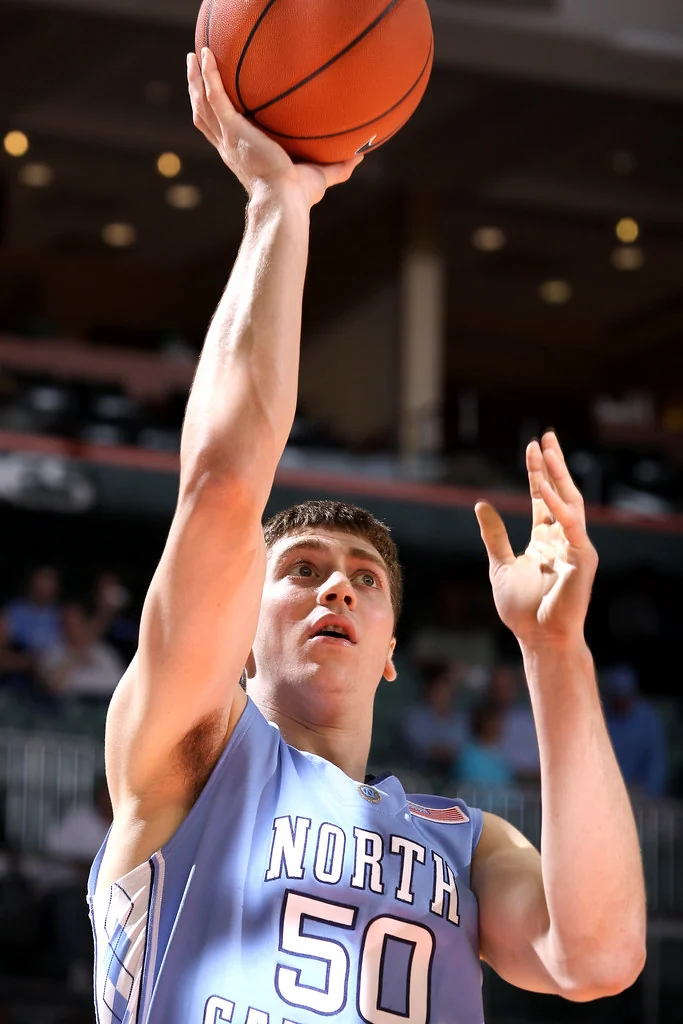
His free throws make the offensive case more concrete. He converted 982 of 1,241 attempts, shooting 79.1 percent. Generating opportunities at the line and converting them are separate tasks: the attempts reflect how often his college scoring involved free throws, while the percentage shows that he made substantial use of those chances. The record is more informative than simply describing him as relentless.
Hansbrough also scored 18 points in both the 2009 national semifinal and final as North Carolina won the championship. These performances connect the career totals with the final weekend, while leaving room for his teammates' contributions. UNC's team awards ceremony named Hansbrough and Ty Lawson co-MVPs. Our tenth spot rewards Hansbrough's sustained scoring, rebounding and meaningful championship participation. It is a close final selection, not a claim that other outstanding college careers lacked an equally serious argument.
The difficult omissions and how to compare eras
Kevin Durant is a particularly strong alternative if the ranking emphasizes a single season's ceiling. Texas's college account records averages of 25.8 points and 11.1 rebounds in 2006–07. His January 31 performance at Texas Tech combined 37 points with 23 rebounds. That example supplies much more substance than assuming a brilliant professional player must have been a brilliant college player: the college evidence stands on its own.
Durant misses our ten because we gave repeated seasons of major college contribution substantial weight after considering peak performance. Someone who places a larger premium on the highest single season could reasonably include him. The important adjustment is to say which existing criterion changes, rather than quietly switch from college achievements to later fame.
Magic Johnson poses a different challenge. Michigan State's 1979 tournament retrospective records triple-doubles against Lamar and Penn. It also identifies Greg Kelser's major scoring contribution and regional MVP honor. Johnson therefore has a powerful college postseason argument involving several statistical categories, while the archive simultaneously reminds us that the team contained another outstanding contributor. An emphasis on postseason creation can move him into the ten without borrowing any professional achievements.
Comparing all these careers also requires attention to the rules. The NCAA's official historical timeline records the introduction of a 45-second shot clock in 1985 and a three-point line in 1986. A point total from a different scoring system is real, but it does not directly tell us how the player would produce within another one. Adding hypothetical three-pointers to Maravich's total would alter the record rather than explain it.
The same restraint applies to incomplete statistical coverage. Robertson's missing early assist data does not mean he failed to pass, and Russell's retrospective shot-blocking accounts should not be treated as a complete modern statistical table. Use the recorded categories to establish what they can show, then describe the limits of the comparison.
For your own list, decide first whether you value the highest peak, sustained college production or repeated tournament contribution most. Then compare players using evidence that speaks to that choice: Walton's near-perfect championship shooting, Sampson's repeated national recognition, or Hansbrough's four seasons of scoring and rebounding responsibility. The disagreements become more informative when each side identifies the college performance it values and keeps the same standard for every candidate.
Sign in with Google to join the discussion.