The quick answer: latest champion and counting rules
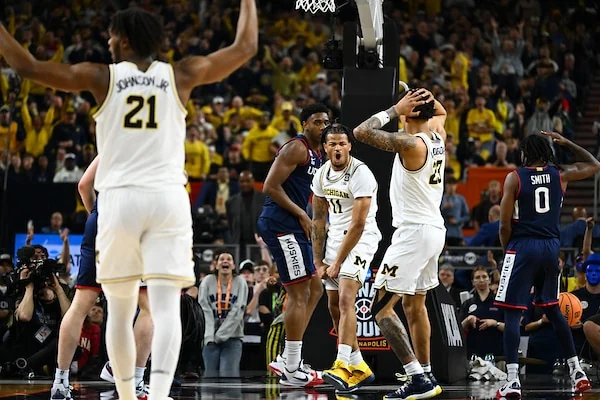
Michigan is the latest NCAA Division I men's basketball champion. The Wolverines beat UConn 69-63 at Lucas Oil Stadium on April 6, 2026, finished 37-3, and secured the program's second NCAA tournament title. The first came in 1989, which makes the 37-year space between Michigan championships part of the story: this was a return to the summit, not the extension of a recent dynasty. It also ended the Big Ten's men's title drought that had stretched back to Michigan State in 2000.
This guide counts championships won through the NCAA Division I men's tournament, beginning with Oregon in 1939. That definition matters because “national championship” can mean several things in college sports. Some schools recognize pre-NCAA selections or championships awarded by polls and foundations, but those claims are not added to the NCAA tournament totals here. Readers looking for today's results can move from this historical record to the site's current men's college basketball scores.
Last 10 means completed tournaments
The 2020 tournament was canceled before a bracket was played, so there was no NCAA men's basketball champion that year. It appears in the chronology but does not occupy a winner slot.
A vacated result is labeled, not reassigned
Louisville beat Michigan in 2013, but its tournament participation was later vacated. The on-court result is shown with a marker; Michigan is not retroactively named champion.
Complete NCAA men's basketball champions list by year
The annual record below follows the official NCAA Division I men's tournament chronology. Team names use their familiar current form where that improves recognition, with historically important names preserved in notes. The table is intentionally a championship lookup, not a ranking: a 1940 title won in an eight-team event and a 2026 title won in a 68-team event are both official championships, but the competitive routes were structurally different. For upcoming games rather than historical results, use the current men's college basketball schedule.
2026 through 2007
| Year | NCAA men's champion |
|---|---|
| 2026 | Michigan |
| 2025 | Florida |
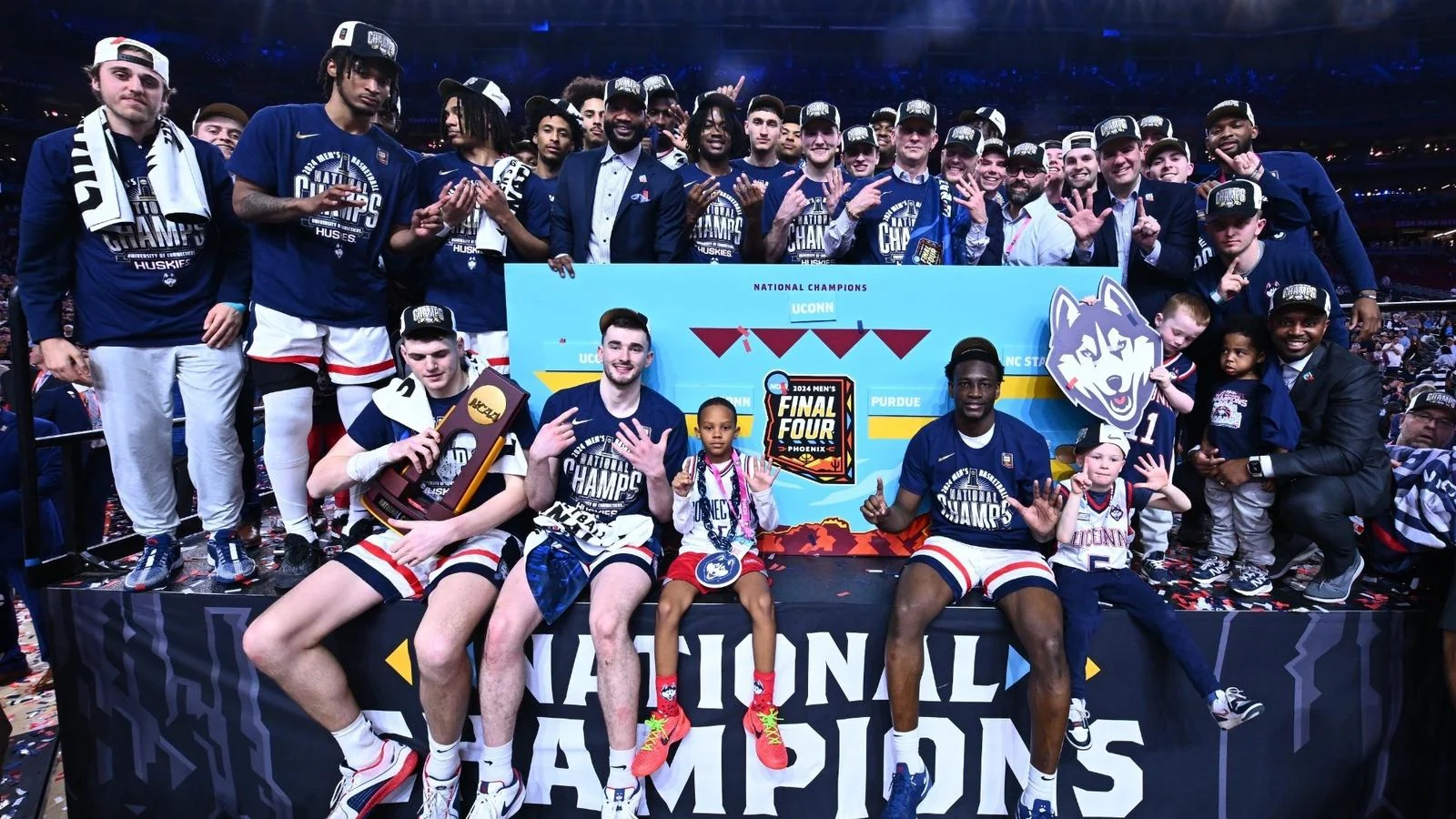
| 2024 | UConn |
| 2023 | UConn |
| 2022 | Kansas |
| 2021 | Baylor |
| 2020 | Tournament canceled; no champion |
| 2019 | Virginia |
| 2018 | Villanova |
| 2017 | North Carolina |
| 2016 | Villanova |
| 2015 | Duke |
| 2014 | UConn |
| 2013 | Louisville* |
| 2012 | Kentucky |
| 2011 | UConn |
| 2010 | Duke |
| 2009 | North Carolina |
| 2008 | Kansas |
| 2007 | Florida |
This block captures both concentration and churn. UConn won four times from 2011 through 2024, while Virginia and Baylor broke through for first championships. Florida bookends the span with 2007 and 2025 titles, an 18-year gap that underlines why “recent champion” and “modern power” are not always the same claim. The asterisk on Louisville indicates that its 2013 tournament participation was later vacated.
2006 through 1987
| Year | NCAA men's champion |
|---|---|
| 2006 | Florida |
| 2005 | North Carolina |
| 2004 | UConn |
| 2003 | Syracuse |
| 2002 | Maryland |
| 2001 | Duke |
| 2000 | Michigan State |
| 1999 | UConn |
| 1998 | Kentucky |
| 1997 | Arizona |
| 1996 | Kentucky |
| 1995 | UCLA |
| 1994 | Arkansas |
| 1993 | North Carolina |
| 1992 | Duke |
| 1991 | Duke |
| 1990 | UNLV |
| 1989 | Michigan |
| 1988 | Kansas |
| 1987 | Indiana |
This is the heart of the post-1985 expansion era. The 64-team bracket increased the number of elimination games a champion had to survive and made seed-line shocks more visible. Yet established programs still converted elite seasons: Duke repeated in 1991 and 1992, Kentucky won twice in three tournaments, and UConn's 1999 breakthrough began the century's most productive championship run.
1986 through 1967
| Year | NCAA men's champion |
|---|---|
| 1986 | Louisville |
| 1985 | Villanova |
| 1984 | Georgetown |
| 1983 | NC State |
| 1982 | North Carolina |
| 1981 | Indiana |
| 1980 | Louisville |
| 1979 | Michigan State |
| 1978 | Kentucky |
| 1977 | Marquette |
| 1976 | Indiana |
| 1975 | UCLA |
| 1974 | NC State |
| 1973 | UCLA |
| 1972 | UCLA |
| 1971 | UCLA |
| 1970 | UCLA |
| 1969 | UCLA |
| 1968 | UCLA |
| 1967 | UCLA |
No period is more visually striking in the record. UCLA won seven consecutive tournaments from 1967 through 1973, lost the 1974 championship to NC State, then won again in 1975. The next decade brought a broader cast: Indiana's unbeaten 1976 team, Magic Johnson's Michigan State in 1979, NC State's 1983 run, Villanova's 1985 upset and Louisville championships six years apart.
1966 through 1939
| Year | NCAA men's champion |
|---|---|
| 1966 | Texas Western (now UTEP) |
| 1965 | UCLA |
| 1964 | UCLA |
| 1963 | Loyola Chicago |
| 1962 | Cincinnati |
| 1961 | Cincinnati |
| 1960 | Ohio State |
| 1959 | California |
| 1958 | Kentucky |
| 1957 | North Carolina |
| 1956 | San Francisco |
| 1955 | San Francisco |
| 1954 | La Salle |
| 1953 | Indiana |
| 1952 | Kansas |
| 1951 | Kentucky |
| 1950 | CCNY |
| 1949 | Kentucky |
| 1948 | Kentucky |
| 1947 | Holy Cross |
| 1946 | Oklahoma A&M (now Oklahoma State) |
| 1945 | Oklahoma A&M (now Oklahoma State) |
| 1944 | Utah |
| 1943 | Wyoming |
| 1942 | Stanford |
| 1941 | Wisconsin |
| 1940 | Indiana |
| 1939 | Oregon |
The formative era includes several two-year runs—Oklahoma A&M, Kentucky, San Francisco, Cincinnati and UCLA—but also one-time champions whose place can disappear in a modern-brand discussion. CCNY, Holy Cross, La Salle, Loyola Chicago, California, Wyoming and Stanford all belong in the official championship history. Texas Western's 1966 title remains listed under the name used at the time; the institution is now UTEP.
The last 10 NCAA men's basketball champions
Counting completed tournaments rather than calendar years, the last 10 champions span 2016 through 2026 and skip the canceled 2020 event.
| Tournament | Champion | Championship-game result |
|---|---|---|
| 2026 | Michigan | Beat UConn 69-63 |
| 2025 | Florida | Beat Houston 65-63 |
| 2024 | UConn | Beat Purdue 75-60 |
| 2023 | UConn | Beat San Diego State 76-59 |
| 2022 | Kansas | Beat North Carolina 72-69 |
| 2021 | Baylor | Beat Gonzaga 86-70 |
| 2019 | Virginia | Beat Texas Tech 85-77 in overtime |
| 2018 | Villanova | Beat Michigan 79-62 |
| 2017 | North Carolina | Beat Gonzaga 71-65 |
| 2016 | Villanova | Beat North Carolina 77-74 |
Seven programs won across those 10 tournaments. UConn and Villanova are the only repeat winners in the window, and only UConn repeated in consecutive tournaments. That combination captures the modern tournament neatly: the field produces variety, but programs that build elite roster fit, shot creation and defensive answers can still convert more than once.
The sequence also warns against treating the national championship as a proxy for an entire era's weekly dominance. Virginia, Baylor and Michigan each appear once; their titles came from distinctly built teams and distinct paths. Villanova's two championships were separated by North Carolina, while UConn's 2023 and 2024 teams became the first back-to-back men's champions since Florida in 2006 and 2007. A list tells us who survived six games. It does not, by itself, rank every team those champions beat or quantify how difficult each bracket became after upsets.
For fans using the list in trivia or historical comparisons, the safe formulation is: the last 10 completed NCAA tournaments. Saying “the last 10 years” would either force a nonexistent 2020 champion into the record or produce only nine winners.
The last 20 champions and what the modern sample shows
The 20 most recent completed tournaments begin with Florida in 2006 and end with Michigan in 2026. UConn won four of them; Florida, Villanova, North Carolina, Duke and Kansas also appear more than once. The list includes first-time champions Virginia and Baylor alongside brands with deep title histories. That is a better description of the period than either “total parity” or “the same teams always win.”
| Completed tournaments | Champions |
|---|---|
| 2026-2021 | Michigan, Florida, UConn, UConn, Kansas, Baylor |
| 2019-2015 | Virginia, Villanova, North Carolina, Villanova, Duke |
| 2014-2010 | UConn, Louisville* (vacated), Kentucky, UConn, Duke |
| 2009-2006 | North Carolina, Kansas, Florida, Florida |
Repeat winners are rare, but repeat programs are not
Only Florida in 2006-07 and UConn in 2023-24 won consecutive tournaments in this sample. Florida's repeat was the first since Duke in 1991-92, which shows how hard it is to bring a champion back through another six-game bracket. Graduation, early NBA departures, transfers, injuries and a new path of matchups can dismantle the previous year's advantages even when the program remains excellent.
Program-level repetition is more common. UConn's four wins in the sample came under three different championship cycles, and Villanova won twice in three tournaments under Jay Wright. North Carolina, Duke and Kansas each converted more than one Final Four-caliber roster during the span. Infrastructure can keep reopening the door, but the tournament still demands a fresh solution each March. Fans can compare those programs within the site's men's college basketball conference directory, where league schedules provide the season-long context a winners list omits.
One title game can hide a very different tournament path
The champion column flattens meaningful differences. UConn's 2014 team won as a No. 7 seed after entering the tournament 26-8; the 2024 Huskies were a No. 1 seed and finished 37-3. Both add one championship to the same total, yet their pre-tournament expectations and routes were nothing alike. Michigan's 2026 final was another distinct test: the Wolverines shot only 2-for-15 from three but made 25 of 28 free throws to close a 69-63 win over UConn.
That is why the last-20 table should be a starting point, not a strength ranking. Seed, opponent sequence, possession profile, close-game execution and injuries change the difficulty and texture of a run. The official result answers who won; responsible analysis needs more evidence before answering which champion was best.
NCAA men's basketball championships by school
The all-time leaders
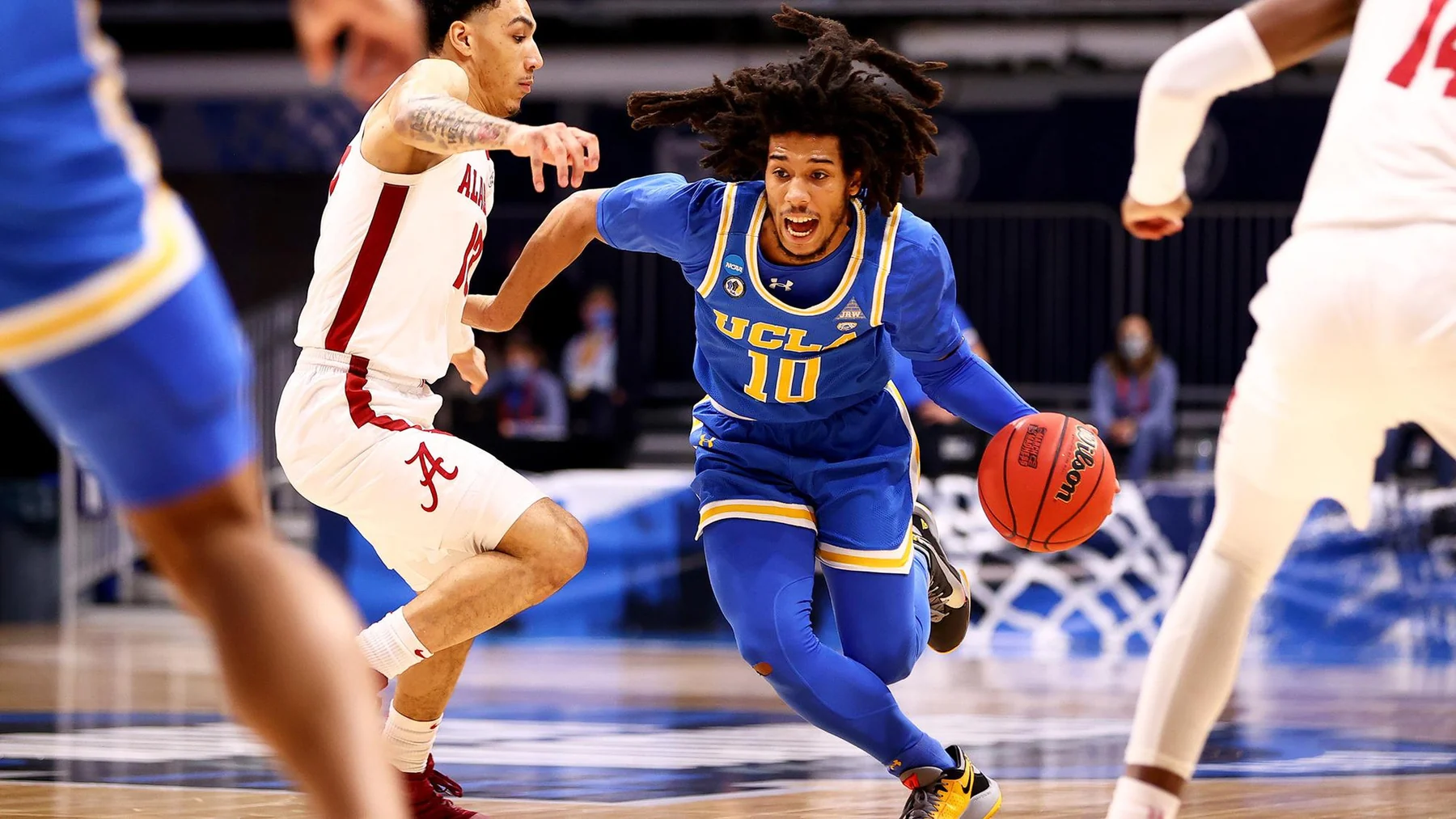
UCLA remains first with 11 NCAA men's tournament championships. Kentucky is second with eight, while UConn and North Carolina share third with six. Duke and Indiana have five apiece, and Kansas has four. Those totals answer the trivia question, but their timelines are just as revealing.
Ten of UCLA's championships arrived in a 12-tournament stretch from 1964 through 1975, including seven consecutive titles from 1967 through 1973. The Bruins added their 11th in 1995. Kentucky's eight stretch from 1948 through 2012 and were won under five head coaches, which makes longevity across eras the center of its case. UConn's six arrived from 1999 through 2024, compressed into a modern bracket environment and spread across Jim Calhoun, Kevin Ollie and Dan Hurley.
Those are different kinds of dominance. UCLA owns the unmatched peak; Kentucky combines volume with historical reach; UConn has the sharpest championship conversion of the 21st century. Fans who want present-day team pages rather than the historical ledger can use the men's college basketball team directory.
Every program with multiple NCAA titles
| Rank band | Program | NCAA titles | Championship years |
|---|---|---|---|
| 1 | UCLA | 11 | 1964, 1965, 1967-73, 1975, 1995 |
| 2 | Kentucky | 8 | 1948, 1949, 1951, 1958, 1978, 1996, 1998, 2012 |
| T-3 | UConn | 6 | 1999, 2004, 2011, 2014, 2023, 2024 |
| T-3 | North Carolina | 6 | 1957, 1982, 1993, 2005, 2009, 2017 |
| T-5 | Duke | 5 | 1991, 1992, 2001, 2010, 2015 |
| T-5 | Indiana | 5 | 1940, 1953, 1976, 1981, 1987 |
| 7 | Kansas | 4 | 1952, 1988, 2008, 2022 |
| T-8 | Florida | 3 | 2006, 2007, 2025 |
| T-8 | Villanova | 3 | 1985, 2016, 2018 |
| T-10 | Cincinnati | 2 | 1961, 1962 |
| T-10 | Louisville | 2 | 1980, 1986 |
| T-10 | Michigan | 2 | 1989, 2026 |
| T-10 | Michigan State | 2 | 1979, 2000 |
| T-10 | NC State | 2 | 1974, 1983 |
| T-10 | Oklahoma State | 2 | 1945, 1946 |
| T-10 | San Francisco | 2 | 1955, 1956 |
The list counts Louisville's standing titles from 1980 and 1986; the vacated 2013 participation does not raise the total to three. It also treats Oklahoma A&M's 1945 and 1946 championships as Oklahoma State's institutional history. The table therefore preserves historical identity without splitting one program into two entries.
NCAA champions since 2000: the balance of power
There have been 26 completed NCAA men's tournaments from 2000 through 2026. Twelve programs account for the standing championships, with Louisville's 2013 on-court win listed separately as vacated. The distribution is broad enough to reward different styles and regions, but concentrated enough to reveal which programs repeatedly turned contention into the final cut of the net.
UConn owns the century's strongest title conversion
UConn's five championships since 2000—2004, 2011, 2014, 2023 and 2024—are the most of any men's program in the period. The striking part is not only the total. Those teams crossed coaching tenures, roster archetypes and tournament seeds. The 2014 Huskies won from the No. 7 line; the 2024 team was a No. 1 seed, finished 37-3 and completed the first repeat since Florida 17 years earlier.
That range makes “conversion” the useful word. UConn did not simply remain ranked every week for a quarter-century; it repeatedly produced teams that solved six elimination games when the opportunity appeared. Michigan denied the Huskies a third title in four tournaments in 2026, but reaching that final still reinforced how quickly the program had rebuilt around new personnel after the repeat.
The field widened even as a few programs kept returning
Florida, North Carolina and Duke each won three tournaments in the period. Kansas and Villanova won two apiece. Michigan State, Maryland, Syracuse, Kentucky, Virginia, Baylor and Michigan each won once, while the 2013 Louisville result is marked vacated. Put another way, the century has room for both recurring brands and breakthrough champions.
The machinery behind repeat contention changed as well. A modern staff cannot assume four-year continuity from its best players. It has to identify lineup fit, replace creation and rim protection, manage transfer integration, and preserve a defensive or offensive identity without freezing the roster in place. UConn's 2023-24 repeat is impressive precisely because the second champion was not a photocopy of the first.
For fans, the right conclusion is not that one conference or recruiting model owns March forever. The champion list rewards program infrastructure, but each tournament resets the matchup map. A veteran backcourt, defensive rebounding and half-court shot creation may travel; the exact opponent sequence still decides which strengths get tested. Use the site's team schedule directory to judge current versions of these programs rather than assuming an old trophy predicts the next bracket.
How to read canceled, vacated and pre-NCAA title claims
Historical tables become unreliable when three different situations are treated as if they were interchangeable. Cancellation means no tournament result existed. Vacatur means games were played but the official record was later altered. Pre-NCAA selections belong to an earlier championship ecosystem. This guide labels each rather than forcing all three into a single winner column.
Why 2020 is not assigned a champion
The NCAA canceled its winter and spring championships in March 2020 as the COVID-19 crisis escalated. The men's tournament never produced an official bracket winner, so no poll leader, projected No. 1 seed or conference champion can be substituted. A model might estimate who was most likely to win; that is a counterfactual exercise, not a championship result.
For counting windows, 2020 remains a year in the chronology but not a completed tournament. That is why this page's last-10 list reaches back to 2016 and its last-20 list reaches back to 2006. The method counts actual championship events.
Why Louisville's 2013 result is marked vacated
Louisville defeated Michigan 82-76 in the 2013 title game. In 2018, the NCAA Infractions Appeals Committee upheld penalties requiring Louisville to vacate records involving ineligible student-athletes during the affected seasons, including its tournament participation. The official history marks the 2013 Louisville entry with an asterisk.
Vacatur does not turn Michigan into the champion. The clean presentation is to preserve the on-court result, label it vacated, and exclude it from Louisville's standing title total. That tells a reader both what happened in Atlanta and how the NCAA record now treats it.
Why this list begins with the 1939 NCAA tournament
The first NCAA men's basketball tournament was played in 1939 with eight teams. Oregon beat Ohio State 46-33 in the championship game. College basketball existed long before that event, and the NIT began in 1938, while retrospective selectors have recognized teams from earlier seasons. Those histories matter, but they answer a different question.
This page asks who won the NCAA tournament. It therefore begins with Oregon and does not add Helms selections, poll championships or NIT winners to school totals. That boundary makes comparisons reproducible. It also prevents a fan from seeing two different totals for the same program without understanding that the sources are counting different competitions.
Era warning: an official title remains an official title, but Oregon's eight-team path in 1939 and a modern champion's route through a 68-team bracket are not identical tests. Use the list for championship history; use bracket, opponent and game-level evidence when making “best team ever” arguments.
Sign in with Google to join the discussion.