The all-time ranking through the 2026 tournament
UCLA ranks first with 95 points, followed by Kentucky at 78 and North Carolina at 77. Eleven national championships give the Bruins the clear lead. The race for second is tighter. Kentucky has two more titles, while North Carolina has four more official Final Four appearances and reached the last weekend in one more era. The one-point gap is a good example of how much the choice of weights matters in an all-time list.
This ranking covers NCAA Division I men’s tournament results from 1939 through the completed 2026 championship. It uses five points per title, two per official Final Four appearance and one per era in which a program reached the Final Four. The same calculation was applied to every program with a credited appearance. The table shows each component so you can see how the order was produced.
| Rank | Program | NCAA titles | Final Fours | Eras | Points |
|---|---|---|---|---|---|
| 1 | UCLA | 11 | 18 | 4 | 95 |
| 2 | Kentucky | 8 | 17 | 4 | 78 |
| 3 | North Carolina | 6 | 21 | 5 | 77 |
| 4 | Duke | 5 | 18 | 4 | 65 |
| 5 | Kansas | 4 | 15 | 5 | 55 |
| 6 | UConn | 6 | 8 | 3 | 49 |
| 7 | Indiana | 5 | 8 | 4 | 45 |
| 8 | Michigan State | 2 | 10 | 4 | 34 |
| 9 | Villanova | 3 | 6 | 4 | 31 |
| 10 | Florida | 3 | 6 | 3 | 30 |
| 11 | Louisville | 2 | 8 | 4 | 30 |
| 12 | Michigan | 2 | 7 | 4 | 28 |
The title column breaks both point ties at the bottom of the table. Florida edges Louisville on three titles to two. Michigan takes the final spot ahead of Ohio State, which also scores 28 points but has one title. The teams close to that line show why the underlying counts are worth keeping beside the final order.
The most recent result in the table is Michigan’s 69–63 win over UConn on April 6, 2026. That championship adds to what the Wolverines did in 1989. It also raised UConn’s appearance total when the Huskies returned to the title game. The year-by-year championship results provide the individual finals behind the title column.
How the program scores are calculated
The most useful way to read the table is to keep the three columns beside the score. The title column measures the program’s ability to finish a run. Appearances quantify how often it got within two wins of a championship, and the era column adds a limited reward for doing so over long stretches of the sport’s history.
Titles and official Final Four appearances
Multiply NCAA titles by five, Final Four appearances by two, and add one point per qualifying era. Kentucky’s eight titles produce 40 points, its 17 Final Fours supply 34, and its four eras add four, for 78. Each champion also reached the Final Four, so a championship season is worth seven points before any first-appearance credit for its era. A runner-up gets two points for the appearance and can earn that same era credit. Conference trophies, regular-season wins, poll positions, NIT runs and titles dating to before the NCAA tournament sit outside the calculation.
Use the NCAA’s retained results when two sources show different counts. The 1992 and 1993 Michigan runs appear in the school’s historical notes with asterisks. They contribute zero here. The same rule removes Kansas’s 2018 appearance and Louisville’s 2013 appearance and championship. Michigan’s credited runner-up finish in 2013 remains a Final Four result. The vacated championship stays vacant. There was no tournament in 2020, so that year adds nothing to any program.
A tie on total points goes to the program with more titles, followed by more Final Fours and then more eras. Programs with identical components share a position. One way to test the weights is to reduce the value of a title from five points to four. Holding the other two components constant, North Carolina would lead Kentucky 71–70, reversing their order. The calculation lets a reader see exactly where the ranking reflects a preference.
How staying power earns points
A program earns one point for reaching the Final Four at least once in each of five blocks: 1939–1959, 1960–1979, 1980–1999, 2000–2019 and 2020–2026. A second appearance in one block adds the usual two points. A first appearance in another period adds one more. The newest block has barely begun relative to the others, and a run near a boundary can lead to credit in two neighboring blocks within a relatively short span. The era bonus is small enough that it rewards staying power without dominating the results column.
The tournament had eight teams in 1939 and reached 64 in 1985. Getting there and getting through the bracket called for different things in different periods. Using the four retained teams as the common measure makes the historical calculation consistent. The weight assigned to a berth does not represent a claim that every tournament path was equally difficult.
Why UCLA, Kentucky and North Carolina lead
The three leaders earned their places in different ways. UCLA has a championship lead no other program approaches. Kentucky won NCAA titles under five head coaches. North Carolina built the widest record of returning to the final weekend.
UCLA’s title advantage
John Wooden won 10 championships in his final 12 UCLA seasons, including seven straight from 1967 to 1973. The title teams could play very different games. His relatively small 1964 group used a zone press and beat Duke 98–83 in the final. Four years later, a team built around Kareem Abdul-Jabbar, who played at UCLA as Lew Alcindor, beat North Carolina 78–55 in the championship game. He scored 34. Opponents had to solve a program that could win with pressure and quickness in one title run and a dominant center in another.
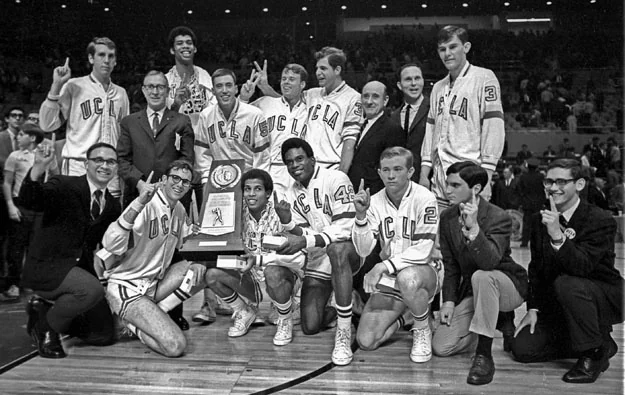
Jim Harrick’s 1995 team supplied UCLA’s 11th title in a different era. Ed O’Bannon had 30 points and 17 rebounds in the final against Arkansas, with Cameron Dollar taking on a larger backcourt role after Tyus Edney hurt his wrist in the semifinal. Final Four trips in 2006, 2007, 2008 and 2021 also make it possible to trace UCLA deep into later brackets. The program has 55 points in title credit alone, more than half of its 95. The 18 official Final Fours and four eras explain the rest of the lead.
The Kentucky and North Carolina trade-off
Kentucky’s eight titles stretch from Adolph Rupp’s four wins between 1948 and 1958 to John Calipari’s 2012 title. Joe B. Hall won in 1978, Rick Pitino in 1996 and Tubby Smith in 1998. Titles in the 1970s, 1990s and 2010s show how the school kept winning across coaching changes. See the coaching records guide for how those runs compare with Wooden’s.
North Carolina’s strongest number is 21 Final Fours, reached under six head coaches. Its first came in 1946. Frank McGuire won in 1957, Dean Smith won in 1982 and 1993, and Roy Williams added titles in 2005, 2009 and 2017. Hubert Davis took a No. 8 seed to the 2022 final after beating Duke in the semifinal. That appearance put Carolina in the last era block, as well as giving it two more Final Four points. Its four-appearance advantage over Kentucky is worth eight points, and the extra era adds another. Kentucky’s two additional titles are worth 10, which decides second place by one point.
How Duke, Kansas, UConn and Indiana built their records
Duke and Kansas have recurring runs deep into the bracket across different coaching eras. UConn and Indiana can point to five or more championships each, with a shorter list of appearances. The ranking balances the highest finishes with the number of chances a program created for itself.
Duke and Kansas across multiple eras
Duke reached the Final Four four times before Mike Krzyzewski coached the program. He added 13 trips and five titles, and the Blue Devils made another under Jon Scheyer in 2025. The 1990 and 1991 teams show what repeated chances can mean. After UNLV beat Duke 103–73 in the 1990 title game, the Blue Devils came back the following March and beat the unbeaten Rebels 79–77 in the semifinal. They won the championship against Kansas and repeated the next season. Duke’s 18 retained Final Fours keep the program firmly in fourth, even though its titles cluster under one coach.
Kansas earned its four NCAA championships in 1952, 1988, 2008 and 2022. The latest came after North Carolina led by 15 at halftime. Kansas scored 47 in the second half and got two late baskets from David McCormack to win 72–69. The Jayhawks’ timeline also includes a 1940 runner-up finish and reaches into all five era blocks. Duke has three more credited appearances and one more NCAA title, which together yield 11 points. Kansas regains one through its extra era. The result is a 10-point gap that reflects both the reach of Kansas’s tournament history and the size of Duke’s Final Four record.
UConn and Indiana on championships
UConn won its first championship in its first Final Four, in 1999. Jim Calhoun then won in 2004 and 2011, Kevin Ollie in 2014, and Dan Hurley in 2023 and 2024. The eight appearances include the 2026 return to the final. Those years cover three scoring eras. Six championships account for 30 of UConn’s 49 points before any credit for appearances and breadth.
Indiana’s five title seasons span two distinct coaching chapters. Branch McCracken won in 1940 and 1953. Bob Knight added a 32–0 championship in 1976 and wins in 1981 and 1987, the latter secured by Keith Smart’s late jumper against Syracuse. A 2002 appearance in the final supplies the fourth era point. The Hoosiers and Huskies both reached eight Final Fours. Indiana’s extra era narrows the gap by one point, while UConn’s extra title supplies five. That is the difference between 45 points and 49.
The programs nearest the ranking cutoff
Michigan State has the best total after the first seven. Its two championships came in 1979, when the Spartans beat Indiana State 75–64, and 2000, when Tom Izzo’s team beat Florida with Mateen Cleaves as the Final Four’s most outstanding player. That second title followed a trip to the semifinals the previous season. Ten official appearances, including the school’s first in 1957, give Michigan State 20 points from that column alone. Its four qualifying eras help make up the title difference with Villanova and Florida.
Villanova is a point ahead of Florida because it reached the final weekend in four eras to Florida’s three. Both schools are at three titles and six credited appearances. The Wildcats’ earliest credited trip came in 1939. In 1985, Rollie Massimino’s team made 22 of 28 field-goal attempts to beat Georgetown 66–64 in the final. Jay Wright’s teams added two championships. The first came on Kris Jenkins’s shot at the horn against North Carolina in 2016, and the second followed in 2018. The path from that 1939 appearance to Wright’s wins gives Villanova its edge in this calculation.
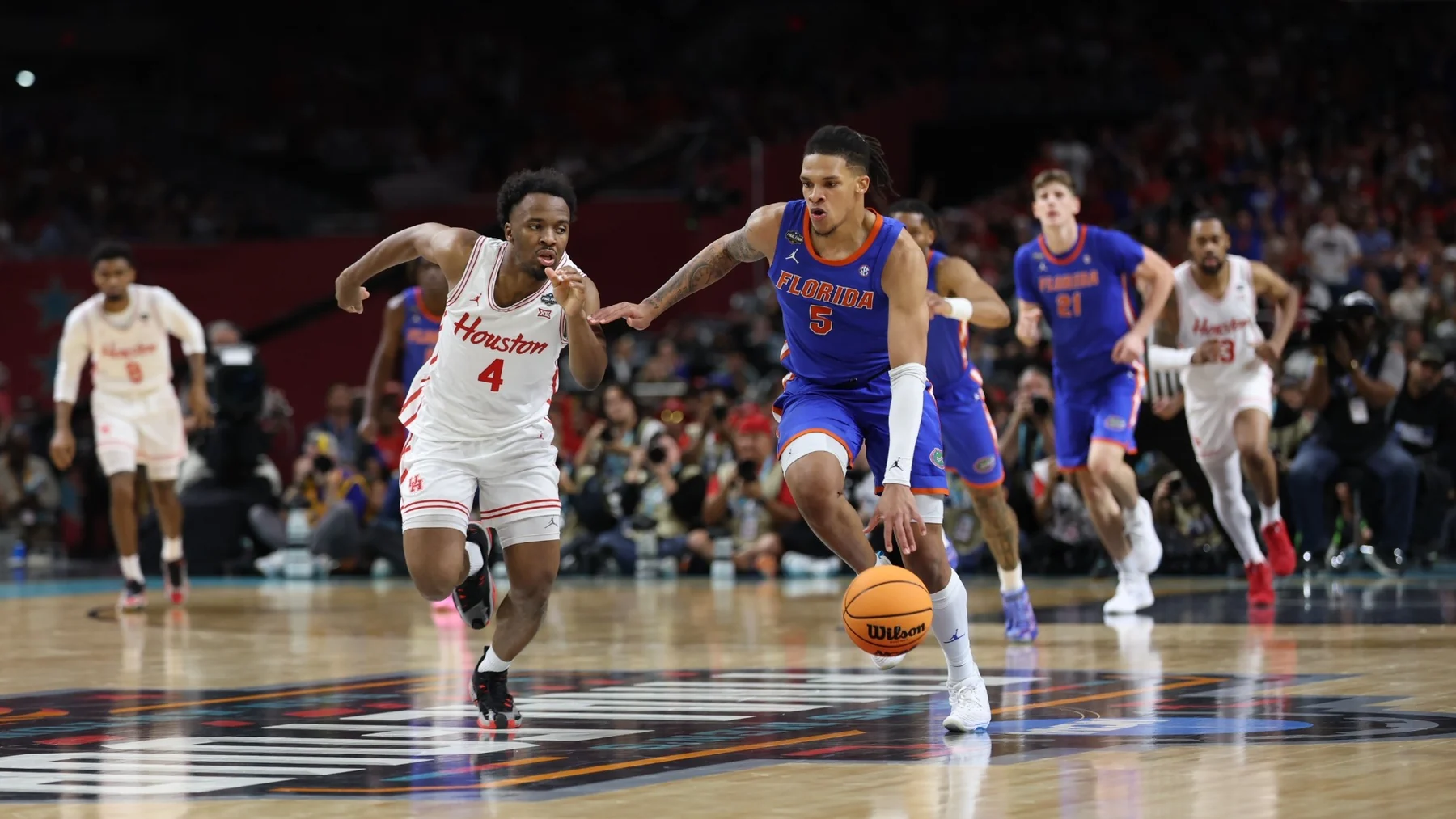
Florida won back-to-back titles in 2006 and 2007, then came from 12 down in the second half to beat Houston 65–63 in the 2025 final. That last win was the Gators’ first appearance of the current era block. It gave them three titles and a total of 30 points. Louisville reaches the same score with eight credited Final Fours, one more qualifying era and two titles. The Cardinals won in 1980 against UCLA and in 1986 against Duke. Their extra appearances and extra era make up five points, exactly the value of Florida’s additional championship. The title tiebreaker puts Florida 10th and Louisville 11th.
Ohio State is the first program outside the 12. Its 1960 championship and 10 official trips give it 28 points after three points for breadth, equal to Michigan. The Buckeyes kept returning long after that 1960 win, making later Final Fours in 2007 and 2012. Those two returns count in the same era and each contribute two points. Michigan’s second title is the deciding difference at equal totals. Moving the tiebreaker to Final Four volume would switch the order of the two schools without changing a single historical result.
What Michigan’s 2026 title changed
Michigan’s first title came by a point. Glen Rice scored 31 against Seton Hall in 1989, and Rumeal Robinson made two free throws with three seconds left in overtime to win 80–79. The Wolverines returned to the championship game in 2013 and 2018. By the end of the 2025 tournament, the program had one title, six credited Final Fours and appearances in three of the five eras. That gave Michigan 20 points and a share of 16th place under this formula.
The second title came on April 6, 2026, at Lucas Oil Stadium in Indianapolis. Michigan beat UConn 69–63, with 19 points from tournament most outstanding player Elliot Cadeau and 12 points and 10 rebounds from Morez Johnson Jr. The official box score credits Michigan with a 36–22 edge in the paint. The Wolverines led by four at the break and gained two more points on their lead in the second half. The inside scoring mattered in a game that rarely gave either team much separation.
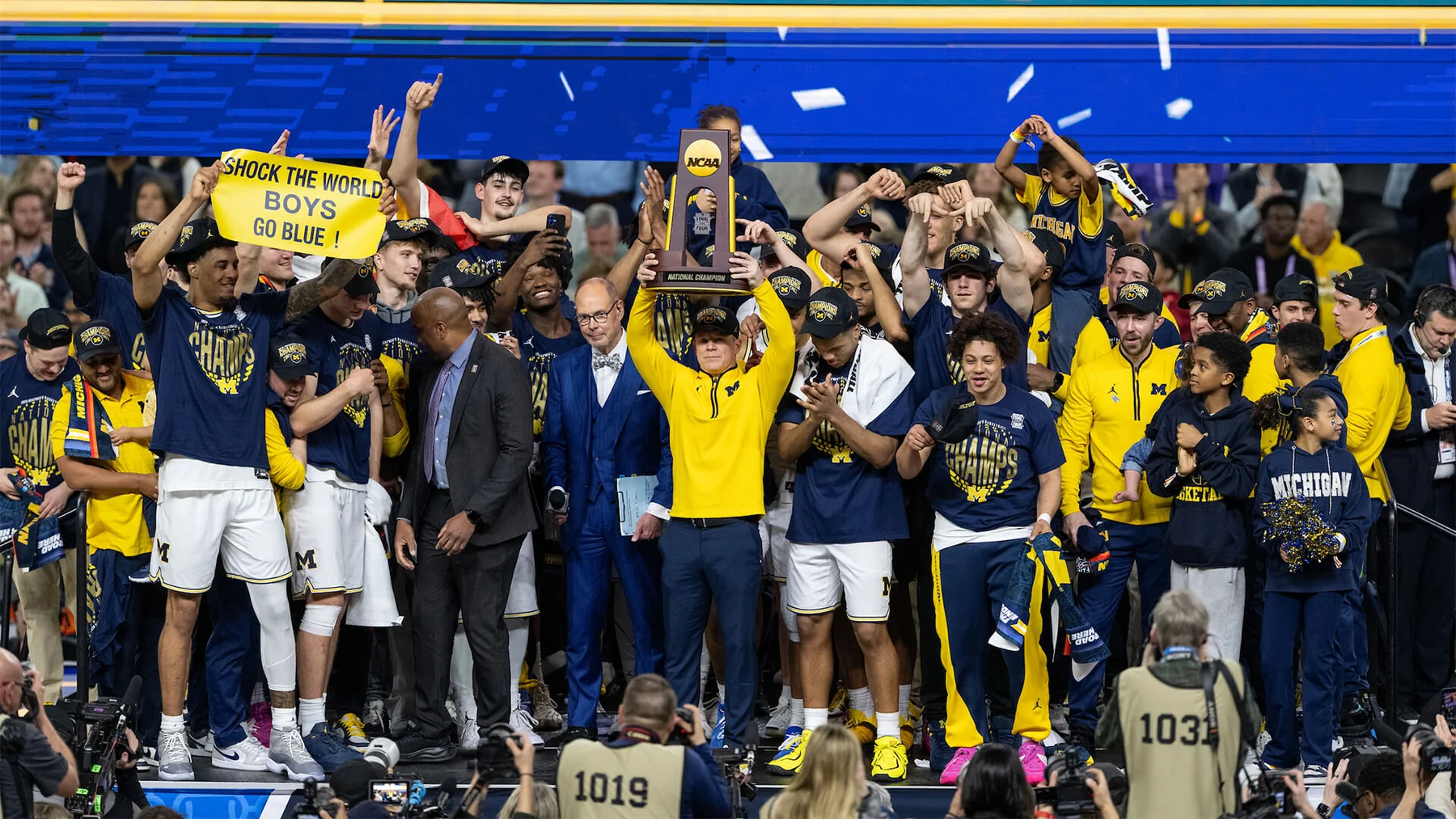
Michigan gained eight points for the 2026 run. Its second title added five. Its seventh official Final Four added two. Its first trip in the 2020–2026 era added one. Had the Wolverines reached the semifinal and lost, the appearance and the new era would have raised them from 20 to 23. Winning the championship instead brought the total to 28 and gave them the tiebreaker over Ohio State.
The result also shows how this ranking can move after a deep run. A program that already has a Final Four in the newest block would gain two points for another return and seven if it won the final. For a program entering the block for the first time, those returns would be worth three and eight. UConn added two points for reaching the 2026 final, because its titles in 2023 and 2024 had already secured the era bonus. To follow Michigan’s next attempt, see the Michigan men’s basketball schedule. This edition takes its last result from the completed April tournament.
Sign in with Google to join the discussion.