The short answer depends on which wins you mean
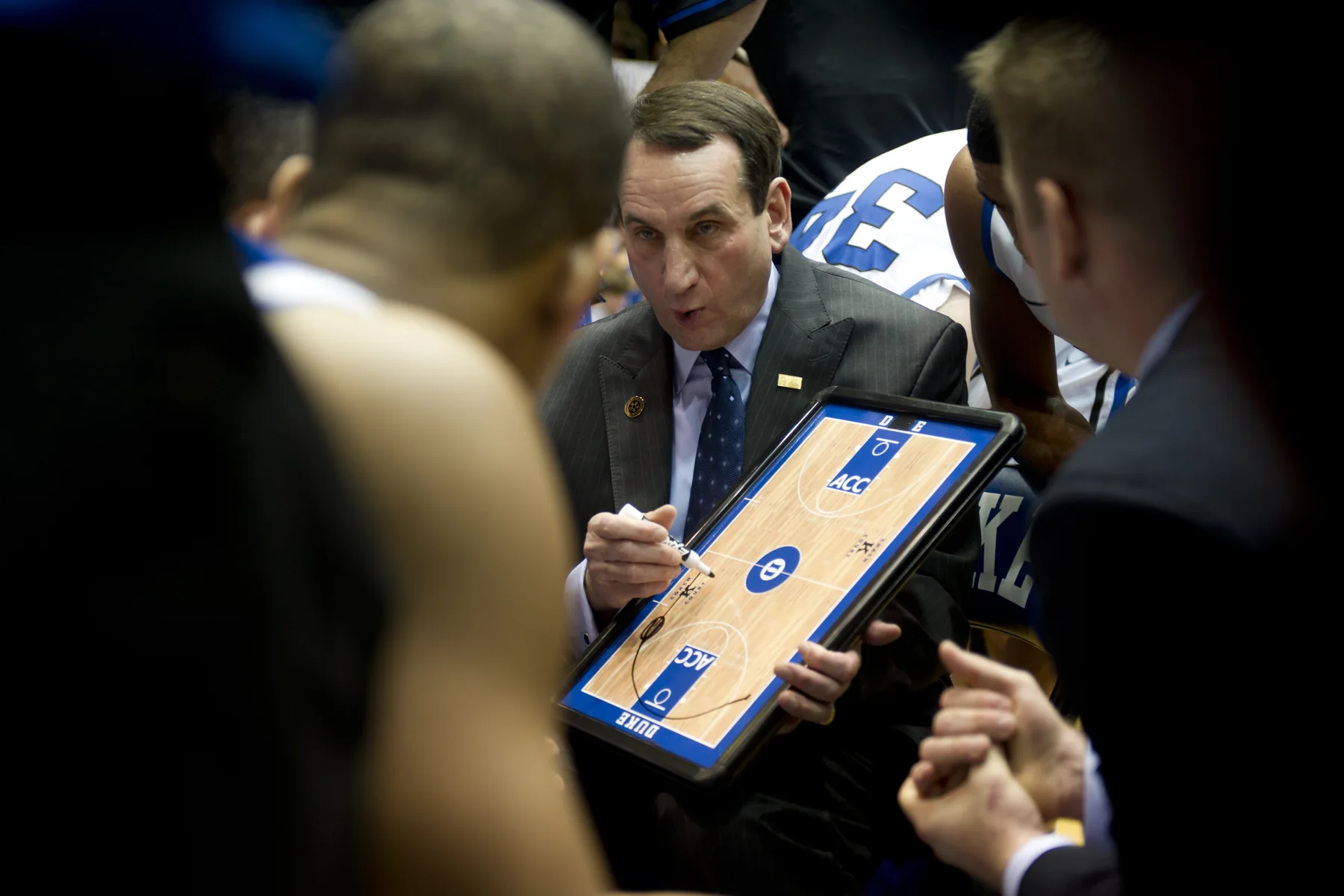
John Wooden owns the men's Division I record for NCAA championships with 10 at UCLA. Mike Krzyzewski owns the records for NCAA Tournament wins with 101 and Division I men's head-coaching wins with 1,202 across Army and Duke. Those are three answers to three different questions. A serious comparison has to name the category before naming the coach.
Championships
Wooden: 10
Tournament wins
Krzyzewski: 101
Career wins
Krzyzewski: 1,202
Championship leader
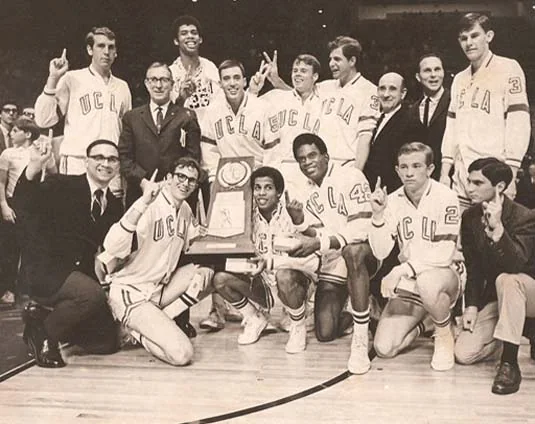
Wooden won NCAA titles in 1964, 1965, every year from 1967 through 1973, and again in 1975. Ten championships in 12 seasons remains the defining peak of the men's tournament. It is also distinct from UCLA's program total of 11: Jim Harrick coached the Bruins to the 1995 title, twenty years after Wooden retired.
A championship count asks how many seasons ended with the coach cutting down the final net. It does not add conference titles, Helms selections, NIT championships or runner-up finishes. Using that strict NCAA men's Division I definition, Wooden leads Krzyzewski by five titles.
Tournament-win and career-win leaders
Krzyzewski won 101 NCAA Tournament games, a record built across 36 appearances, 13 Final Fours and five national championships. That figure counts individual tournament victories, not successful seasons. A championship in the modern 64- or 68-team structure normally requires six wins from the first round; a Final Four season adds four or five without necessarily producing a title. Tournament wins therefore reward both depth of runs and repeated qualification.
Coach K's 1,202 career victories are broader still. They include regular-season, conference-tournament and NCAA postseason wins during five seasons at Army and 42 at Duke. Duke credits him with a 1,202-368 career record, including 1,129 wins at Duke. The 101 March victories sit inside the 1,202, not beside them as an additional total.
That distinction resolves most apparent contradictions. Wooden is the championship leader. Krzyzewski is the men's Division I career-win and NCAA Tournament-win leader. A fan can reasonably value one record more, but the numbers should not be blended into a homemade “wins” statistic. Titles measure ultimate conversion, tournament victories measure sustained March advancement, and career victories measure longevity plus excellence across the full calendar.
Men's coaches with the most NCAA championships
Only six coaches have won at least three official NCAA men's Division I titles through 2026. The list is short enough to remember, but the gaps are more revealing than the order. Wooden's 10 are double Krzyzewski's five; Coach K is one ahead of Adolph Rupp; Rupp is one ahead of Jim Calhoun, Bob Knight and Roy Williams.
| Coach | Official titles | Championship years |
|---|---|---|
| John Wooden | 10 | 1964, 1965, 1967-73, 1975 |
| Mike Krzyzewski | 5 | 1991, 1992, 2001, 2010, 2015 |
| Adolph Rupp | 4 | 1948, 1949, 1951, 1958 |
| Jim Calhoun | 3 | 1999, 2004, 2011 |
| Bob Knight | 3 | 1976, 1981, 1987 |
| Roy Williams | 3 | 2005, 2009, 2017 |
Wooden, Krzyzewski and Rupp
Wooden's UCLA championships came in 1964, 1965, 1967-73 and 1975. Krzyzewski won with Duke in 1991, 1992, 2001, 2010 and 2015, spanning multiple roster and tactical eras. Rupp's Kentucky teams won in 1948, 1949, 1951 and 1958. That top tier covers the tournament's postwar growth from small, selective fields into the national event fans recognize now.
The timing matters. Wooden could not accumulate as many tournament-game wins per title because the bracket was shorter, yet he converted entries at a rate no modern coach has approached. Krzyzewski navigated larger fields and more rounds, building a March record across four decades. Rupp's four titles came before at-large access and national seeding resembled today's system. Each total is official; the route behind it was not identical.
The three-title group
Calhoun won all three at UConn in 1999, 2004 and 2011. His first title established UConn as a champion; his last came with a team that needed five Big East tournament wins before winning six NCAA games. Knight won at Indiana in 1976, 1981 and 1987, with the undefeated 32-0 team in 1976 remaining the last perfect men's national champion through 2026. Williams won North Carolina's titles in 2005, 2009 and 2017 after previously taking Kansas to championship games.
Several coaches sit on two official titles, including Branch McCracken, Henry Iba, Phil Woolpert, Ed Jucker, Denny Crum, Dean Smith, Billy Donovan, Jay Wright, Bill Self and Dan Hurley. That group illustrates how difficult the jump from two to three is. Hurley won consecutively in 2023 and 2024, while Wright did so in 2016 and 2018; neither sustained a Wooden-style annual run because the modern tournament creates six elimination points and constant roster turnover.
Vacated results must stay out of an official leaderboard. Rick Pitino coached Kentucky to the 1996 championship and Louisville to the court result in 2013, but the NCAA later vacated Louisville's participation and title. He therefore has one official championship in this accounting. That is not an editorial penalty; it is the governing record used for every coach in the table.
How John Wooden built a ten-title record
The most useful way to understand Wooden's total is as several championship teams connected by one program standard. UCLA's first Wooden champion in 1964 had no starter taller than 6-foot-5 and created pressure with a punishing zone press. Later teams played through Lew Alcindor, who became Kareem Abdul-Jabbar, and then Bill Walton. The 1975 champion was less overwhelming, lost three games and still survived overtime against Michigan and Louisville before beating Kentucky. Wooden did not simply keep one unbeatable lineup together; he kept teaching winning basketball as the roster changed.
Seven straight championships
UCLA won every NCAA title from 1967 through 1973. Across the broader 1964-75 run, the Bruins went 335-22, won four championships with perfect records and produced an 88-game winning streak. The seven-title sequence also included a tournament-specific streak of 38 consecutive victories. Those numbers describe more than star power. One off night ends a season, so maintaining spacing, entry angles, defensive pressure and emotional control mattered every March.
The personnel cycles were distinct. Alcindor drove the first three titles of the seven-year streak. The 1970 and 1971 teams continued winning after he left, with forwards Sidney Wicks and Curtis Rowe carrying larger roles. Walton then became the interior hub of the 1972 and 1973 unbeaten champions. Wooden's teams could press, run and feed a generational center, but their repeatable advantage was preparation: players understood where the next pass and rotation should be before pressure arrived.
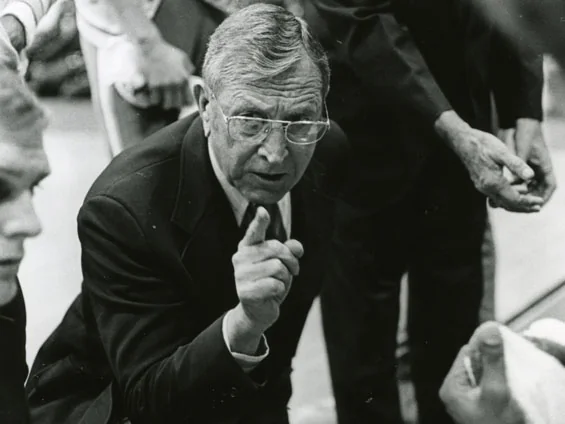
The streak finally ended in the 1974 national semifinal, when NC State beat UCLA in double overtime. That loss makes the 1975 response more instructive. UCLA did not glide through the bracket; it beat Michigan in overtime, Drake by three and Louisville by one in overtime. The Bruins then defeated Kentucky 92-85 in Wooden's last game. His tenth title was evidence of adaptability, not an extension of the Walton-era invincibility.
Why UCLA has eleven titles but Wooden has ten
Coach leaderboards and school leaderboards answer different questions. Wooden coached UCLA to its first 10 NCAA championships: 1964, 1965, 1967-73 and 1975. Jim Harrick coached the 1995 Bruins to the program's 11th. That team went 32-1 and beat Arkansas in the championship game, with Ed O'Bannon producing 30 points and 17 rebounds.
The distinction prevents a common counting error. Every title belongs in UCLA's institutional total, but only the seasons coached by Wooden belong in his personal total. The same rule applies across the sport: a program can accumulate championships under multiple leaders, while an individual coach carries only the official titles won as head coach. UCLA therefore leads schools with 11, and Wooden leads coaches with 10. Both statements are true because the unit of measurement changes.
The NCAA Tournament wins leaderboard
An NCAA Tournament win is credited each time a coach's team advances by winning a tournament game. The record therefore rewards both longevity and depth. A coach who reaches four Final Fours can collect far more wins than a coach with the same number of appearances and mostly first-weekend exits. It also differs from championship count: Wooden won 10 titles but 47 tournament games because his brackets required fewer rounds.
Coach K's 101-win benchmark
Krzyzewski finished 101-31 in NCAA Tournament games. His record came from 36 bids, 13 Final Fours and five championships, an unusually productive mix of access and conversion. He passed Dean Smith for first place with his 66th tournament win in 2005, then added 35 more before retiring after Duke's 2022 Final Four run.
The shape of 101 matters. Coach K did not reach it by winning five titles alone; those championship runs contributed roughly a quarter of the total. Duke repeatedly survived the first weekend and turned favorable seeds into regional runs. A six-win champion is valuable to this leaderboard, but so is a Final Four team that wins four games. Krzyzewski kept generating both across multiple roster eras, from veteran lineups in the early 1990s to one-and-done talent late in his career.
That durability explains why the record is difficult to chase. Even a coach averaging three tournament victories every season would need nearly 34 tournaments to reach 101. Missing the field, losing an opener or retiring early makes the required pace steeper. The benchmark is a record of repeated March opportunity converted into wins, not merely a proxy for five trophies.
Williams, Smith and the modern active chase
Roy Williams is second with 79 tournament wins across Kansas and North Carolina. Dean Smith is third with 65 at North Carolina. Williams' total includes nine Final Fours and three championships; Smith's includes 11 Final Fours and two. They reached similar territory through long careers in which deep runs appeared across different generations rather than in one short peak.
Through the completed 2026 tournament, Tom Izzo is the nearest active coach at 61 official NCAA Tournament wins. Michigan State lists his tournament record as 61-27 and his active streak at 28 consecutive appearances. That combination is the chase formula: qualify every year, avoid early exits and periodically add four or five wins with a Final Four run. Izzo remains four behind Smith and 40 behind Krzyzewski, gaps that show how different the podium levels are.
Fans should check whether a chart uses official or on-court totals before comparing active coaches. NCAA vacation decisions remove games from official records, while some data providers preserve every result played. John Calipari, for example, appears much higher on charts that restore vacated UMass and Memphis tournament results than on NCAA-adjusted lists. This article uses adjusted figures for the historical ranking. The figure can change each March, so the date matters as much as the number; the complete 2026 bracket and results shows the most recent set of wins included here.
Career wins are a different record book
Career wins count the entire schedule. A November neutral-site game, a conference road win, a league-tournament semifinal and an NCAA Tournament victory each add one. That makes the category an excellent measure of sustained winning, but a poor substitute for March performance. A coach can build a huge total through 30-plus games every season without matching another coach's championship conversion.
Division I and all-college scope
Krzyzewski is the men's Division I leader at 1,202-368. His total combines 73 victories in five seasons at Army with 1,129 in 42 seasons at Duke. He passed his mentor Bob Knight with win No. 903 in 2011, reached 1,000 in 2015 and recorded his final victory against Arkansas in the 2022 Elite Eight. That last detail is useful: his 101st tournament win and 1,202nd career win were the same game.
The phrase “college basketball record” still needs a scope label. Herb Magee won 1,144 games across 54 seasons at the institution now known as Thomas Jefferson University, primarily in Division II. His total belongs in an all-divisions men's conversation even though he did not coach a Division I schedule. Comparing only Division I coaches answers one question; comparing every NCAA classification answers another. NAIA-only or mixed-association careers can introduce a further rules boundary, so a responsible list states which organizations it includes.
Program context matters as well. Krzyzewski coached 47 seasons at two Division I schools and averaged almost 26 wins per year. Magee remained at one institution for his entire head-coaching career. Their accomplishments show different forms of endurance, and neither should disappear because a headline uses “all-time” too loosely. Fans browsing current men's college basketball teams should treat division, institution and season count as part of every career-wins row.
Why vacated wins and classifications matter
The NCAA records book notes that Committee on Infractions actions can adjust regular-season and tournament records. That creates two common totals: an on-court count that preserves what happened in the arena and an official count that removes specified results. Both may appear in otherwise credible references. The mistake is not choosing one convention; it is switching conventions between coaches without disclosure.
Jim Boeheim and John Calipari are prominent examples because vacated results can move their ranking. A chart that restores those games may be useful for discussing games physically coached, while the NCAA's adjusted chart is the correct source for an official record claim. The same consistency rule applied to the vacated 2013 Louisville title earlier in this article.
Classification also changes the competitive and scheduling environment. Division I teams generally play larger national schedules and can accumulate games through conference and NCAA tournaments. Division II and Division III have their own championship structures; the NAIA is a separate association. Raw wins remain wins, but schedule length, postseason access and affiliation affect opportunity. For a clean answer, use “men's Division I career wins” when citing 1,202, then widen the lens deliberately when discussing all-college coaching careers.
How to compare great coaches across eras
A useful historical comparison starts by resisting one magic number. Titles identify the highest peak. Tournament wins capture repeated advancement. Career wins measure full-season longevity. Winning percentage describes efficiency but can favor shorter careers or different schedules. Final Fours show elite consistency without requiring the last two single-elimination games to go perfectly. Put the measures beside one another and the shape of a career becomes clearer.
Bracket size and opportunity
The first NCAA tournament in 1939 had eight teams. It grew to 16 in 1951, 32 in 1975 and 64 in 1985; an opening game took the field to 65 in 2001, and the First Four made it 68 in 2011. Beginning in 2027, 76 teams will enter, with a 12-game Opening Round reducing the bracket to the familiar field of 64.
That history changes counting opportunity. Wooden's UCLA champions in the late 1960s did not need six tournament wins. Krzyzewski coached in an era when a standard champion won six, creating more chances to accumulate tournament victories but also more chances to be eliminated. An Opening Round team in 2027 could play a seventh game on the way to the title, while a protected contender entering the 64-team first round still faces six.
The fair conclusion is not that one era was easy and another hard. Early fields were smaller and more selective, access rules differed, and leading teams sometimes entered later rounds. Modern fields require more elimination wins, but seeding gives top teams theoretically favorable openers. Tournament-win totals need that opportunity note; championships remain championships because every winner completed the path assigned in its season.
Peak dominance versus sustained contention
Wooden's 10 titles in 12 seasons represent a peak no other men's coach has approached. Krzyzewski's 101 tournament wins, 36 bids and 13 Final Fours represent a different kind of control over March across four decades. A fan emphasizing the best concentrated run will naturally begin with Wooden. A fan emphasizing adaptation, larger brackets and sustained relevance will find Coach K's case unusually strong.
The best comparison uses ratios and totals together. Titles per tournament appearance asks how often a coach finished the job, but it can punish coaches for qualifying with rebuilding teams. Tournament winning percentage captures game-level conversion, but a bye or shorter bracket changes the opponent path. Final Fours per appearance reduces some title-game randomness, yet it still depends on bracket depth. Career wins reward remaining excellent long enough for tactics, recruiting and roster rules to evolve.
Context should also be basketball-specific. Wooden's teams had to survive single-elimination variance without the transfer portal, modern seeding system or three-point line. Krzyzewski moved from four-year roster cores to the one-and-done era, reworking offense and switching schemes around new personnel. Those are real differences, not numerical corrections that can be reduced cleanly to a multiplier.
What the records can and cannot prove
The records prove their named claims. Wooden has the most official men's Division I NCAA championships as a head coach. Krzyzewski has the most official men's NCAA Tournament wins and men's Division I career wins. Roy Williams, Dean Smith and Izzo occupy defined places on the tournament-win list through 2026. Those statements are verifiable.
They cannot prove that one coach would beat another with equal rosters, that a 1968 team would solve 2026 spacing, or that longevity matters more than peak dominance. They also should not become predictions about the next game. Coaching history tells us who repeatedly created winning conditions; it does not remove shooting variance, opponent quality or injuries from a live matchup. Use the current men's college basketball scores when evaluating what is happening now.
For a balanced personal ranking, decide the weights before looking at the names: championships, tournament advancement, full-career wins, efficiency and era adaptability. Then apply the same official-record convention to every candidate. The result may still reflect taste, but the reasoning will be visible. That is a stronger basketball argument than collapsing 10 titles, 101 tournament wins and 1,202 career wins into one misleading leaderboard.
Sign in with Google to join the discussion.