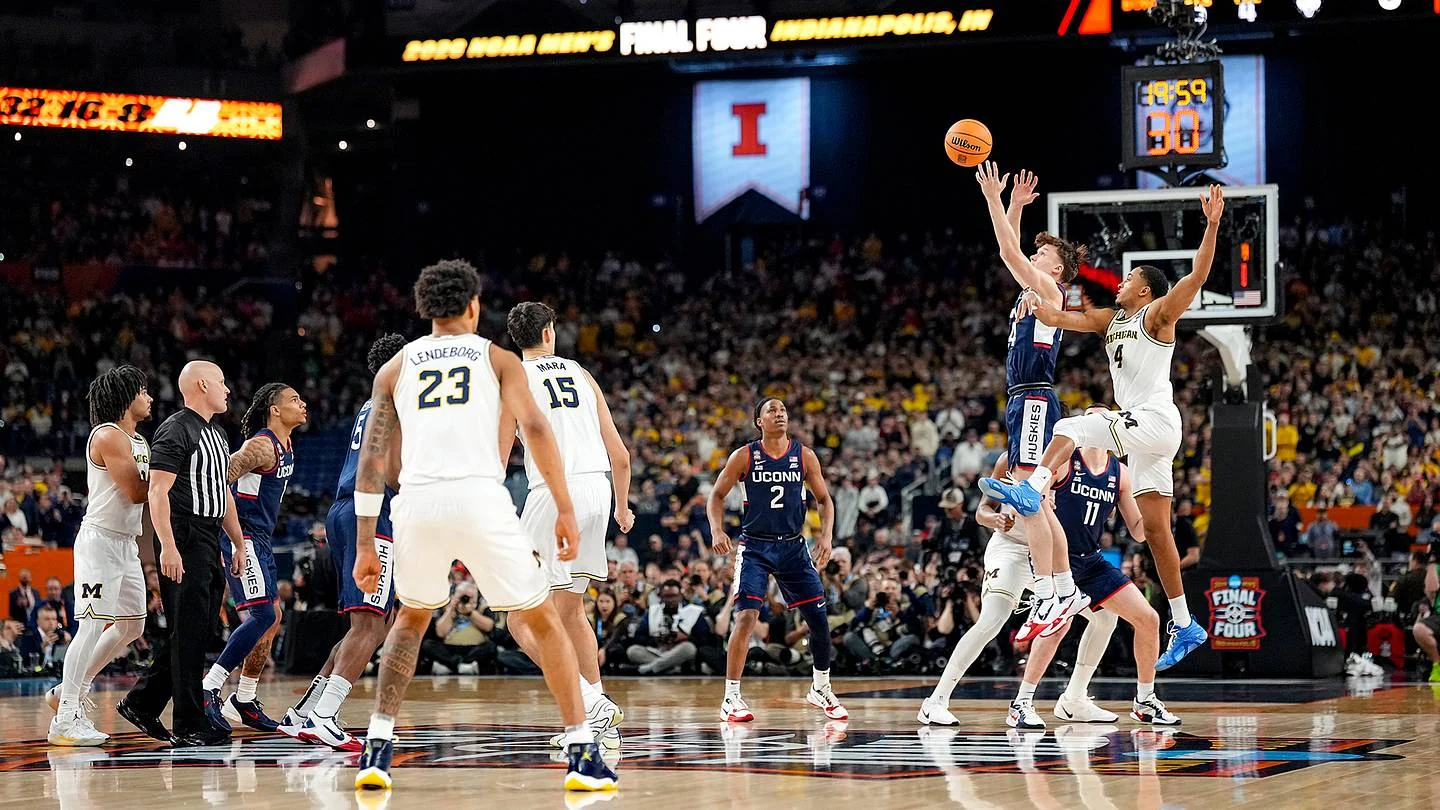
Michigan won the 2026 national championship
Michigan is the 2026 NCAA men's basketball champion. The No. 1-seeded Wolverines beat No. 2 UConn 69-63 on Monday, April 6, at Lucas Oil Stadium in Indianapolis, finishing 37-3 and giving coach Dusty May his first national title. The final score belongs at the top of any bracket recap, but it does not fully describe the pivot Michigan made to win. A team that had reached 90 points in five straight tournament games accepted a possession-by-possession fight, scored only 69 and still controlled the championship's decisive minutes.
Championship game result
Elliot Cadeau led Michigan with 19 points and left Indianapolis as the Final Four's Most Outstanding Player. Yaxel Lendeborg, playing through knee and ankle trouble, scored 13, while Morez Johnson Jr. added 12. Michigan made only two three-pointers all night. The Wolverines instead created pressure downhill, earned free throws and converted 25 of 28 attempts. That 89.3 percent performance mattered in a six-point game far more than the aesthetics of their perimeter shooting.
UConn remained within reach because its defense forced Michigan away from the free-flowing attack that had overwhelmed earlier opponents. Yet the Huskies endured their worst shooting night of the season. Michigan's length made clean finishes difficult, and the Wolverines did not give away the title at the line. Freshman Trey McKenney's three with 1:50 remaining created a nine-point cushion and functioned as the closing shot, even though UConn continued competing to the horn.
Champion
Michigan
Final score
69-63 over UConn
Record
37-3
The title in historical context
This was Michigan's second NCAA men's championship and its first since the 1989 team beat Seton Hall in overtime. The 37-year gap included championship-game losses in 1992, 1993, 2013 and 2018, with the two Fab Five appearances later vacated. The 2026 group ended that sequence and delivered the Big Ten's first men's basketball title since Michigan State in 2000.
UConn's loss stopped a bid for a third championship in four seasons under Dan Hurley. The Huskies finished 34-6, reached their third title game in that span and again showed why their program has become March's modern standard. Michigan did not beat a fading finalist; it beat an opponent that had already survived Duke by one point and handled Illinois in the national semifinal.
The lasting image is not of Michigan reproducing its highest-scoring basketball. It is of a deep, transfer-built roster finding another route when the original one narrowed. Tournament champions eventually face a night when their first option fails. Michigan's second banner came because its defense, free-throw shooting and composure traveled when the threes did not.
The completed 2026 bracket by region
The 68-team field produced two No. 1 regional champions, one No. 2 and one No. 3. Michigan won the Midwest, Arizona won the West, UConn came through the East and Illinois emerged from the South. That distribution made the Final Four strong without being chalk: three of the four regional top seeds failed to reach Indianapolis, and each surviving team arrived by a visibly different route.
| Region | Champion | Elite Eight result |
|---|---|---|
| East | No. 2 UConn | UConn 73, Duke 72 |
| West | No. 1 Arizona | Arizona 79, Purdue 64 |
| South | No. 3 Illinois | Illinois 71, Iowa 59 |
| Midwest | No. 1 Michigan | Michigan 95, Tennessee 62 |
East and West region results
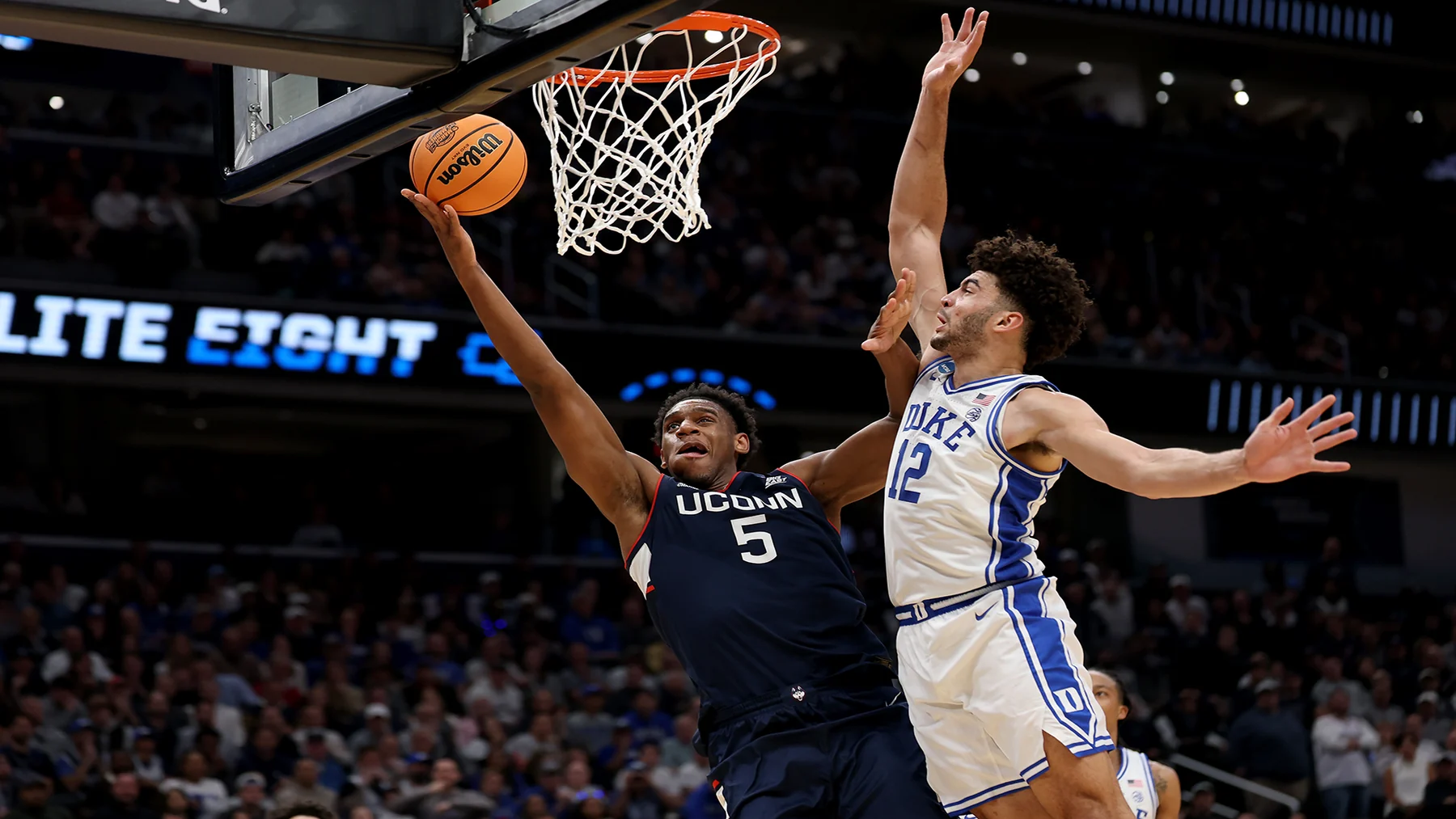
In the East, No. 2 UConn beat No. 1 Duke 73-72 in Washington. Duke had advanced past Siena, Ohio State and St. John's, while UConn moved through Furman, UCLA and Michigan State. The regional final turned from a likely Duke escape into the tournament's signature finish when Braylon Mullins hit a long three with 0.4 seconds left. The score belongs in the bracket; the larger result is that UConn converted a 19-point first-half deficit into another Final Four trip.
The West ended with No. 1 Arizona beating No. 2 Purdue 79-64 in San Jose. Arizona's second weekend announced its ceiling: the Wildcats scored 109 against Arkansas in the Sweet 16, then won the regional final through defense and interior force rather than another track meet. Freshman Koa Peat scored 20 against Purdue and was named the region's Most Outstanding Player. Arizona returned to the Final Four for the first time in 25 years.
South and Midwest region results
The South became the bracket's Big Ten corridor. No. 9 Iowa upset defending champion Florida in the second round and continued through Vanderbilt and Nebraska. No. 3 Illinois beat Penn, then handled Houston in the Sweet 16 before ending Iowa's run 71-59. The Illini closed the regional final on an 8-0 run and reached the Final Four for the first time since 2005. Seed alone understates Iowa's impact: removing Florida altered the region before the favorites could meet.
Michigan's Midwest path was the most emphatic. The Wolverines beat Howard, Saint Louis, Alabama and Tennessee, scoring at least 90 in each round. Against Tennessee, a 21-0 first-half burst turned a 16-14 deficit into a 35-16 advantage. Yaxel Lendeborg scored 27, Elliot Cadeau handed out 10 assists and Michigan won 95-62—the largest Elite Eight margin of this bracket.
For readers checking an individual first-round or second-round score, the NCAA's completed printable bracket is the cleanest canonical record. The regional summary above explains how the bracket arrived in Indianapolis without turning the article into 67 disconnected score lines. For live-season results rather than this historical tournament, use the site's current men's college basketball scores page.
How the Final Four was decided in Indianapolis
The national semifinals produced the same outcome through opposite textures. UConn turned Illinois into a physical half-court contest and won 71-62. Michigan attacked Arizona's size and transition defense so aggressively that the anticipated heavyweight matchup became a 91-73 rout. By Monday, the championship pairing was a test between UConn's proven ability to grind and Michigan's unmatched ability to change speeds.
UConn shut down Illinois
UConn reached its third national title game in four seasons by denying Illinois the clean offensive rhythm that had carried the Illini through the South. Tarris Reed Jr. supplied 17 points and 11 rebounds, giving the Huskies an interior anchor on both ends. Braylon Mullins scored 15, including another late three, while the offense created 21 assists and made 12 of 33 from deep.
The 71 points were not an explosion, and that was the point. UConn's defense made Illinois play against set bodies and contested space rather than flowing into easy early-clock advantages. The Huskies had already survived the high-variance finish against Duke; in Indianapolis they reduced variance, protected the paint and trusted their physicality. Illinois stayed close enough to make every empty possession matter, but UConn kept the game on terms that favored its frontcourt and tournament experience.
Michigan survived Arizona
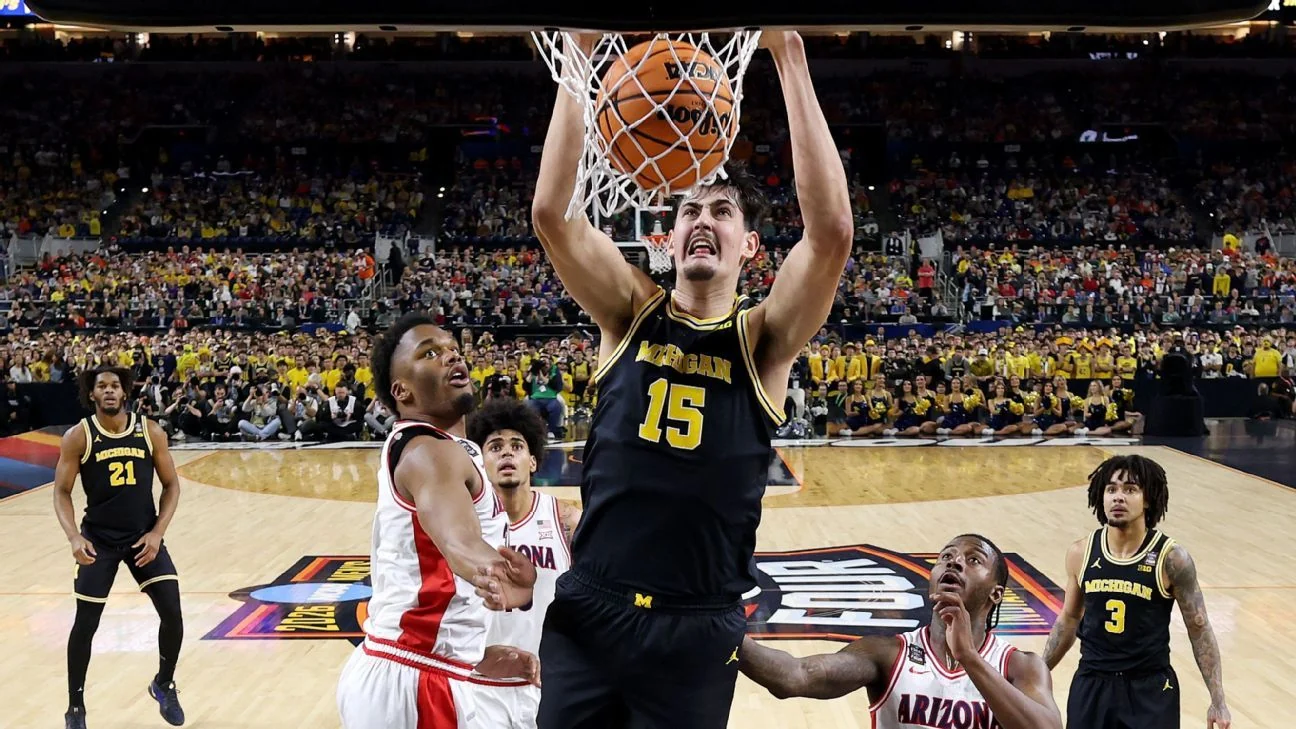
“Survived” describes the stakes, not the score. Michigan was ahead by double digits 5:31 into the game and never allowed Arizona to make the semifinal competitive. Aday Mara delivered a career-high 26 points with nine rebounds, turning seals, rim runs and deep catches into a finishing clinic. Cadeau scored 13 and recorded 10 assists. Michigan registered nine dunks and repeatedly converted the first advantage into a better second one.
The defensive plan was just as important. Arizona attempted relatively few threes during the season, so Michigan packed the paint and challenged the Wildcats to beat that choice from outside. The Wolverines' size erased some of Arizona's preferred interior creation, then fueled transition opportunities the other way. It was a matchup-specific decision, not a universal template.
The only meaningful setback was Lendeborg's lower-body injury after landing on a foot. He played just 14 minutes but still scored 11, and his status immediately became the championship game's central personnel question. Michigan's depth prevented the semifinal from turning when he left; his willingness to play two nights later helped the Wolverines finish the job. That sequence captured the roster's tournament value: stars raised the ceiling, but size and usable options across the rotation kept one injury from collapsing the structure.
The games that reshaped the bracket
Not every upset has equal structural impact. A first-round surprise can disappear two days later; a regional-final swing changes the Final Four itself. The most consequential 2026 results either removed a favorite from a vulnerable region or showed a surviving team could win a game that appeared lost.
UConn's one-point escape against Duke
UConn's 73-72 win over Duke is the tournament's defining single-game reversal. The Huskies trailed by 19 in the first half and still trailed by three inside the final 10 seconds. Silas Demary Jr. made one free throw, Duke tried to advance the ball instead of being fouled, and a deflection created a loose-ball scramble near midcourt. Mullins recovered it and hit from roughly 35 feet with 0.4 seconds left.
The shot deserves its place in March lore, but the comeback was built before the heave. UConn's defense kept Duke from converting control into separation, while the Huskies continued generating paint touches and second chances. A one-possession game left room for one extraordinary event. The result sent UConn to Indianapolis, removed the overall No. 1 seed and turned a young guard who had missed his first nine threes with Alex Karaban into the closer.
Early-round upsets with lasting consequences
High Point delivered the first major bracket break, beating No. 5 Wisconsin 83-82 for the program's first NCAA Tournament victory. No. 11 VCU followed by erasing a 19-point deficit and beating No. 6 North Carolina 82-78 in overtime. Those wins demolished millions of perfect brackets, though neither team reached the second weekend. Their value was immediate: they reminded viewers that late-game execution and availability—in North Carolina's case, playing without leading scorer Caleb Wilson—can outweigh the seed number.
Texas produced the more durable underdog run. The No. 11 Longhorns came through the First Four, beat BYU and then eliminated No. 3 Gonzaga 74-68 to reach the Sweet 16. That path required three wins before the tournament's second weekend, a useful distinction when comparing “how far” an opening-round team traveled.
The South changed most dramatically when No. 9 Iowa beat defending champion and No. 1 seed Florida 73-72. Alvaro Folgueiras hit the winning three with 4.5 seconds left. Iowa then beat Vanderbilt and Nebraska before Illinois stopped the run in the Elite Eight. Florida's exit did more than create a headline: it removed the region's top seed and allowed a nine seed to carry confidence and matchup continuity into Houston. That is why a complete bracket is more than winners advancing on lines; every result changes the style of the next problem.
Why Michigan's tournament formula held up
Michigan did not win merely because it was big, fast or transfer-heavy. The Wolverines won because those traits fit together. They could put multiple finishers around Cadeau, protect the rim without surrendering every rebound, and replace one scoring source with another. Their first five opponents faced a team that broke 90; UConn faced a team willing to win at 69. That range is the championship formula.
Size, depth and shared creation
Lendeborg, Mara and Johnson gave Michigan three large frontcourt pieces with different uses. Lendeborg connected actions as a scorer, rebounder, defender and passer. Mara supplied vertical size, touch and rim protection. Johnson brought physical rebounding and finishing. Their minutes could overlap without every possession becoming a post-up because Cadeau organized tempo and delivery, while wings spaced, cut and defended.
The leading performance changed by round. Lendeborg scored 27 against Tennessee. Mara scored 26 against Arizona. Cadeau scored 19 in the championship game. That is not a trivia pattern; it shows why opponents could not remove one player and solve Michigan. Cadeau's 10 assists in the semifinal turned the frontcourt's size into efficient catches rather than crowded possessions.
Winning different kinds of games
The five-game scoring streak could have become a trap. After averaging a historic pace through the semifinal, Michigan encountered a UConn defense prepared to turn every catch into contact. The Wolverines shot poorly from three and did not force the game back toward their previous box scores. They defended, attacked the foul line and converted 25 of 28 free throws.
That adaptability appeared earlier, too. Against Tennessee, Michigan's 21-0 run came from stops feeding pace. Against Arizona, the Wolverines packed the paint on defense and exploited Mara's interior advantage. Against UConn, where open rhythm shots were scarce, Cadeau carried more direct creation and McKenney supplied the late perimeter blow. May did not demand the same player or action deliver every time.
The lesson is narrower than “build through the portal” or “play three bigs.” Every contender recruits talent; not every contender creates complementary roles. Michigan's transfer starters arrived with experience from North Carolina, UAB, UCLA and Illinois, but the tournament value came from how their skills were arranged. Six games remain a small sample vulnerable to shooting luck and health. Within that sample, Michigan repeatedly created a second winning path when the first was taken away. That is the most repeatable quality visible in the champion's bracket.
What the 2026 tournament leaves behind
Michigan's championship closed more than a season. It closed the 68-team era. Beginning in 2027, the men's tournament expands to 76 teams and replaces the First Four with a larger Opening Round. That future change makes a precise 2026 record valuable: results should be remembered within the format actually played, not retrofitted into the bracket that followed.
The last 68-team bracket before expansion
The 2026 tournament placed eight teams in the First Four, advanced four winners into the 64-team bracket and required the eventual champion to win six games from the first round onward. Texas added two victories in Dayton and the first round before reaching the Sweet 16, which is why a First Four run can contain more wins than another team reaching the same labeled round.
In 2027, 24 teams will play 12 Opening Round games before the field becomes 64. The Thursday-Friday first round and the familiar six-win championship path from that point remain. When comparing future opening-stage runs with Texas in 2026, count games and entry position instead of assuming the labels describe identical paths.
The site's printable schedule tool is for current planning, while this article freezes the 2026 result. Fans preparing for the expanded tournament can also use the 2027 NCAA Tournament ticket guide once that local article is available.
How to use these results without rewriting history
Use the official completed bracket for exact game-level lookup and this recap for meaning. Michigan beat UConn 69-63; UConn beat Illinois 71-62; Michigan beat Arizona 91-73. Those facts are fixed. Judgments about the best game, strongest region or most influential roster choice are editorial conclusions and should remain labeled as such.
Do not turn one champion into a universal law. Michigan's size and portal construction worked because the pieces passed, defended and accepted changing roles. UConn's run showed continuity and tournament toughness can still bring a team within one game of another title. Iowa, Texas, High Point and VCU showed why elimination basketball resists clean modeling, even in a first round whose average margin was unusually large.
The honest final reading is both simple and layered: Michigan was the champion, the 69-63 final is the answer, and the path matters because the Wolverines had to win fast, slow, healthy and hurt. That combination—not a slogan about seeds or roster acquisition—is what the completed 2026 bracket records.
Sign in with Google to join the discussion.