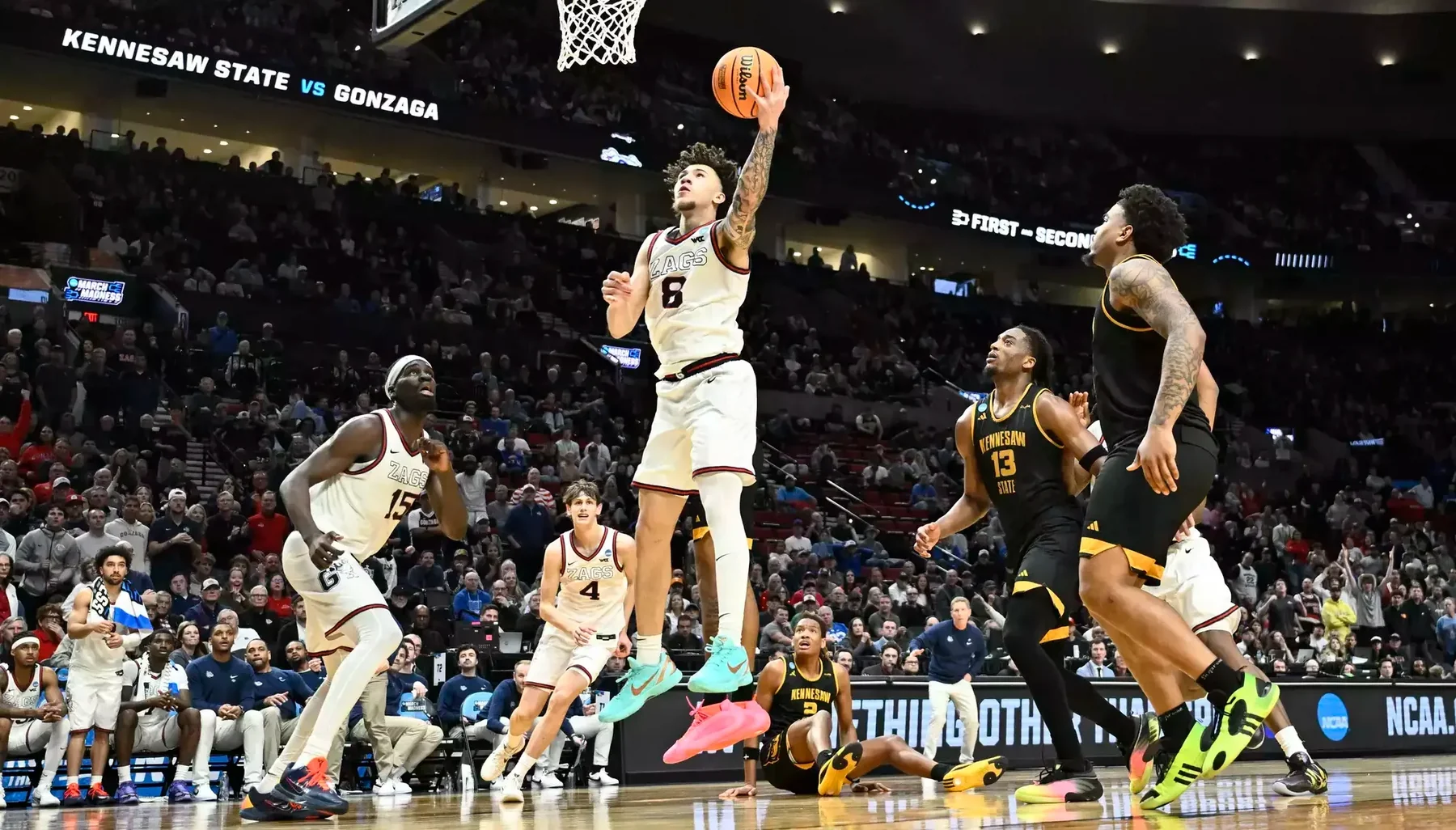
Start with the sport, not just the school name
Notre Dame can appear in ACC basketball standings while remaining independent in football because a university's conference arrangements do not have to be identical across sports. The name on the jersey identifies the school. The sport and the season identify which conference schedule and championship rules apply. For a basketball fan, that distinction explains more than a map of conference logos ever could.
Notre Dame's own athletic scheduling guidance makes the distinction explicit: football is independent, hockey belongs to the Big Ten, and the other sports compete in the ACC. Those are different arrangements within one athletic department. It is therefore perfectly consistent to discuss an Irish basketball team's ACC record without treating a football game against an ACC opponent as a league contest.
Three questions make conference news easier to read. First, is the announcement about the university's principal conference membership or a particular sport? Second, does the league actually sponsor that sport? Third, when does the arrangement take effect? An affiliate joins for specified competition; that label does not move every team on campus. The Pac-12's July 2026 launch announcement, for example, separately identified full members and affiliates in sports including baseball and wrestling. A list of participating schools can therefore change when the sport changes.
For men's basketball, start with the basketball conference directory, then check the team's current schedule. Look for which results count toward its league race, which opponents it plays repeatedly, and which conference tournament appears at the end. Treat football information as a separate check. That approach prevents a common error: carrying a familiar fall affiliation into the winter without checking whether it applies.
This guide uses the 2026 football season and 2026-27 men's basketball season as its reference point. It explains confirmed arrangements, rather than assuming that a report of talks means a move has happened. Conference identity can shape a schedule, but it does not tell you how well a basketball team defends, rebounds or executes late in a possession. Membership and basketball strength are different questions.
Notre Dame's ACC basketball schedule does not make its football team an ACC member
Notre Dame is not an ACC basketball guest. Its men's team competes for the same league objectives as its conference opponents. The 2026-27 ACC schedule assigns each team 18 conference games. Notre Dame's repeat opponents include Boston College, its primary partner, and Wake Forest, its variable partner for that season. Those home-and-away matchups are part of the basketball league structure.
That matters when assessing a team's progress. A second meeting gives an opponent another look at its ball-screen coverage, rebounding assignments and preferred late-clock actions. A fan tracking Notre Dame should therefore distinguish a repeat ACC opponent from a one-off nonconference game. The conference label tells you which standings are affected; the actual matchup tells you what the basketball test looks like.
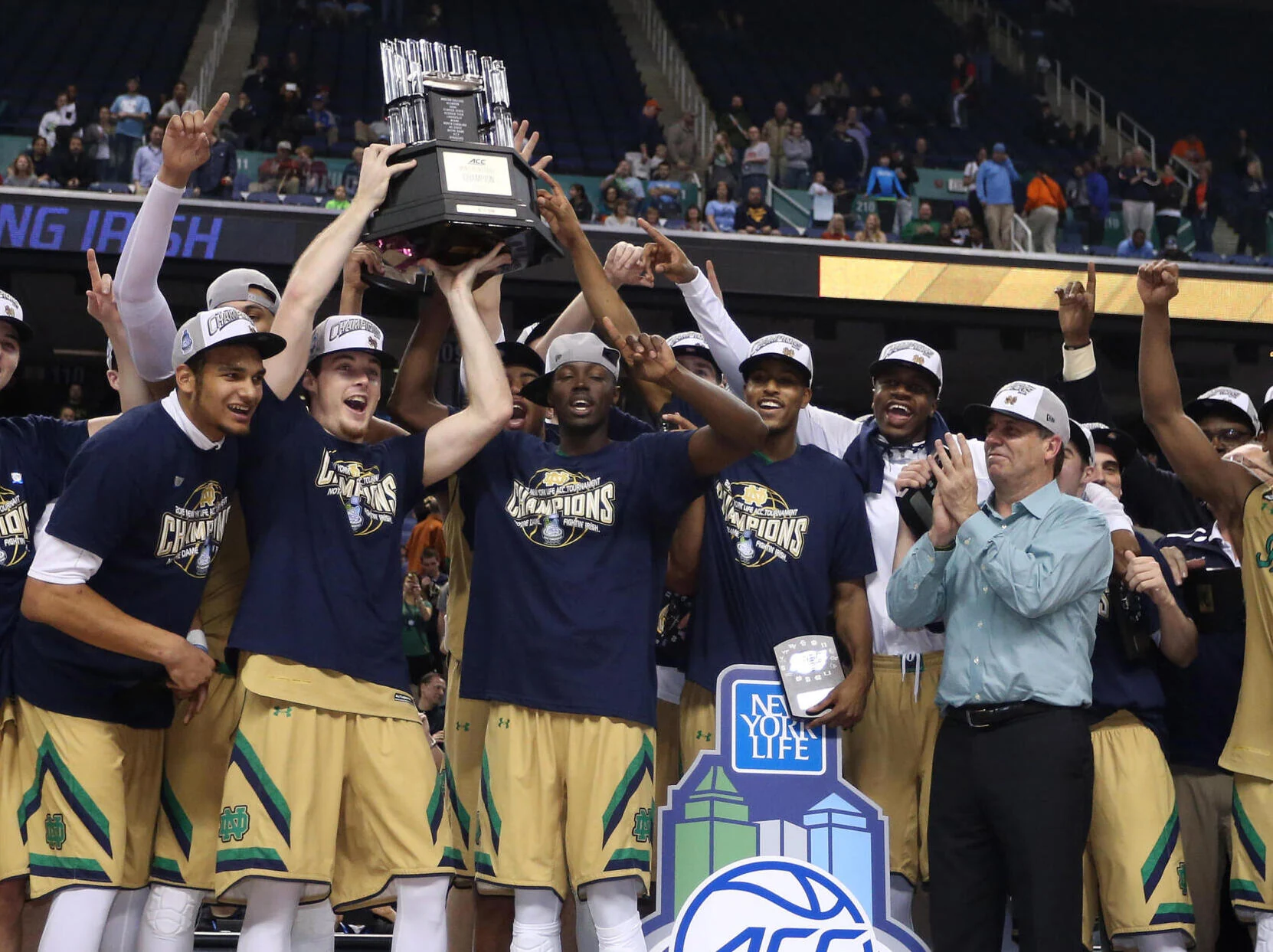
The Irish have also won the league's men's tournament. In the 2015 championship game against North Carolina, Notre Dame won 90-82 behind 24 points from Jerian Grant and 20 from Pat Connaughton. A 26-3 second-half run changed the game. That example puts a concrete basketball result behind the affiliation: the Irish were pursuing an ACC trophy through the ACC tournament, not borrowing a conference label for publicity.
Football has a separate arrangement. Notre Dame's original ACC announcement described preserving football independence alongside an agreement to play ACC opponents. Scheduling a group of schools is not the same thing as joining their football standings. Read the current football schedule for the actual opponents rather than assuming every year's count must match a shorthand description of the original deal.
There is one historical wrinkle worth recognizing when searching old results: Notre Dame did compete in the ACC's 2020 football season. The league records a 9-0 conference record and an appearance in its championship game. That archived table is valid for 2020; it is not evidence of permanent football membership. Keep the season attached to the statement, and the apparent contradiction disappears. Basketball affiliation, a football scheduling agreement and a particular historical football season answer three different questions.
UConn's BIG EAST return gave basketball and football different paths
UConn's return to the BIG EAST became official on July 1, 2020. For men's basketball, that meant a conference identity rooted in opponents and tournament history that longtime Huskies fans already knew. It did not place the football team into a matching BIG EAST football schedule. UConn's own October 2026 football game notes still list its affiliation as NCAA FBS / Independent.
The 2026-27 BIG EAST basketball schedule provides a useful contrast. Eleven teams play a double round robin: each school faces the other ten twice, producing 20 conference games per team and 110 across the league. UConn opens its league schedule by hosting Georgetown on December 23. The conference tournament is scheduled for March 10-13 at Madison Square Garden. Those are basketball-specific obligations and opportunities.
A double round robin also gives a fan a clear way to compare results. A disappointing first meeting does not disappear, but the return game can reveal whether the team has adjusted its defensive assignments or found better shots against a familiar opponent. Read those games as part of UConn's BIG EAST race. Its football independence neither changes those standings nor explains a basketball loss.
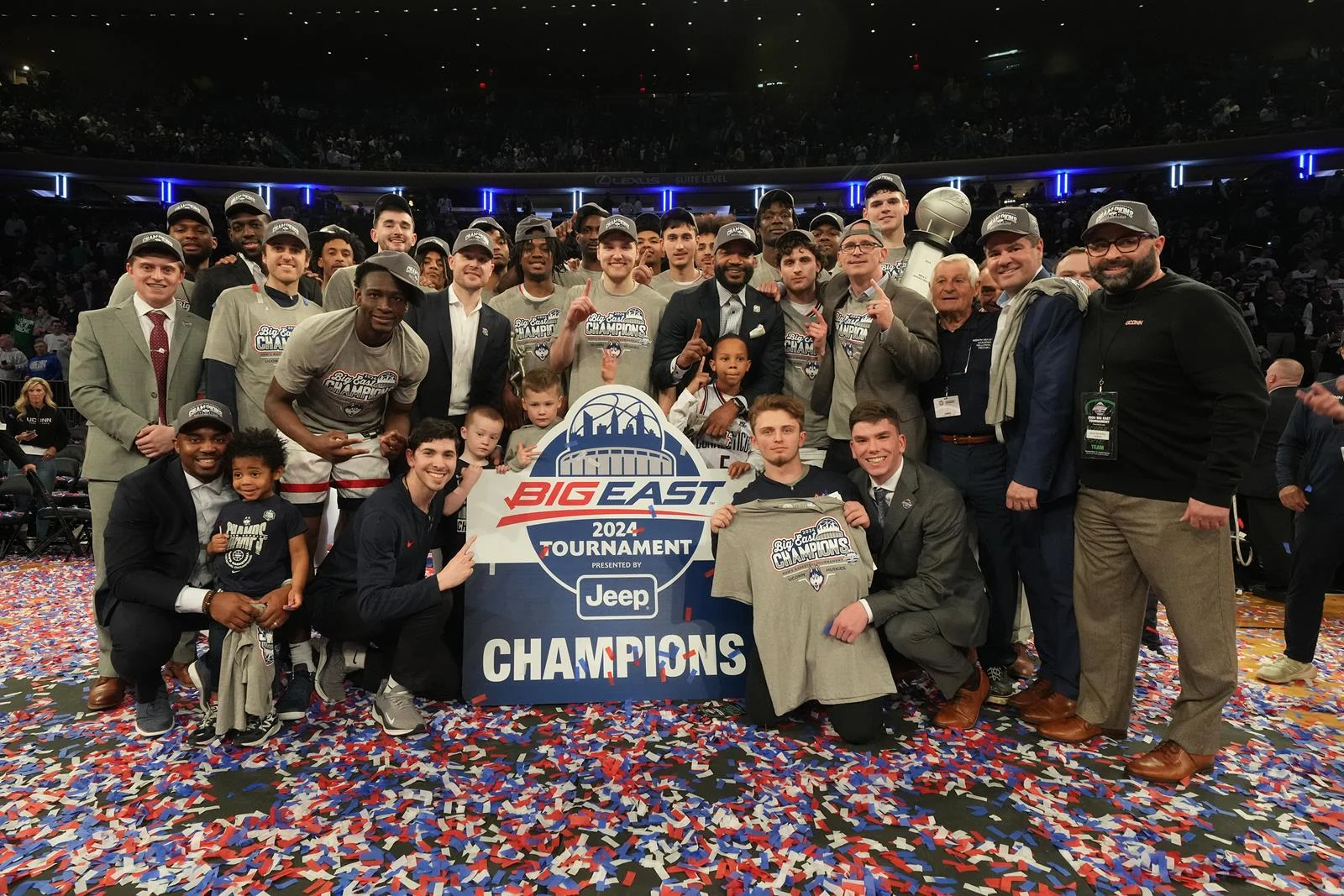
The 2024 BIG EAST final shows what the conference connection looks like on the floor. UConn beat Marquette 73-57 at Madison Square Garden. Donovan Clingan delivered 22 points and 16 rebounds, while Tristen Newton added 13 points and 10 assists. Interior production and playmaking supplied the basketball explanation; the league structure supplied the stage and trophy. Calling UConn a basketball power does not require assigning its football team to that same competition.
For current dates and viewing details, use our UConn basketball schedule guide. When realignment speculation appears, separate an expression of interest, an invitation, an accepted move and its effective date. Only the confirmed arrangement for the season answers where a team is playing now. That discipline is especially useful for UConn, whose basketball affiliation can be discussed alongside football ambitions without either discussion establishing a completed change.
Gonzaga shows why even one conference can have two membership maps
Gonzaga adds another distinction: a school can belong to a conference without supplying a football team at all. When the reconfigured Pac-12 launched in July 2026, Gonzaga was among its full members. The league's 2026 football announcement lists eight programs; its 2026-27 men's basketball competition contains nine. The extra basketball member is not an error in the standings. The two sports have different participant lists.
For Gonzaga fans, the change is concrete. The school's first Pac-12 basketball schedule includes 16 league games, split evenly between home and road. A fan who remembers Gonzaga's West Coast Conference seasons needs to update the basketball schedule being followed. Searching for a Gonzaga football opponent will not explain that transition, because basketball membership does not create a football program.
The league's basketball scheduling rules also answer questions that a football membership map cannot. The Pac-12 says no men's team will have three consecutive conference road games or four road games within a five-game stretch. That is useful when reading the demands of Gonzaga's winter. Count the gaps between games, where the next opponent plays, and whether a team returns home between trips. Those details give more useful context for recovery and preparation than simply calling the new conference geographically convenient or inconvenient.
This is also why the phrase full member needs care. It describes the university's relationship with the conference; it does not promise that the school fields every sport the conference organizes. Conversely, seeing an affiliate in one sport does not establish that its men's basketball team has moved. A sport-by-sport list is the reliable way to resolve the question.
Our Pac-12 basketball guide covers the new league's teams and season context. Use it to orient yourself, then judge Gonzaga's games through basketball evidence: opponent quality, lineup availability, road execution and the balance of the schedule. A change of conference changes the framework around those tests. It does not establish the results in advance, and it does not make the football and basketball versions of the conference interchangeable.
Football-only memberships are the reverse case
Army demonstrates the arrangement in reverse. Its July 2024 announcement states that the football program joined the American Athletic Conference in football only. That final phrase is decisive. It does not move the men's basketball team into the American's basketball standings. Army and Navy remain familiar opponents in Patriot League basketball while their football programs compete in the American.
The basketball rivalry is easy to verify on a current schedule. Navy's October 2026 television announcement lists men's games against Army in West Point on January 23, 2027, and in Annapolis on February 20. The February meeting is the Star Game. The same release discusses the Patriot League basketball postseason. Follow those basketball dates and their venues rather than trying to derive them from the famous football rivalry.
That separation also improves how you evaluate the teams. A football result does not tell you whether Navy can protect the ball against Army's pressure or whether Army can limit second-chance opportunities on the basketball court. Nor does football conference membership establish a basketball team's postseason position. Start with the men's results and the competition those results belong to. The school connection makes both sports worth following; it does not make their evidence interchangeable.
For the NCAA men's tournament, the selection process has its own automatic-qualification and at-large routes. A conference tournament can provide a basketball pathway to the field, while at-large consideration evaluates a basketball team's record and supporting evidence. A football league's profile is not a substitute for that work. When discussing a team's chances, name the basketball conference and the basketball results you mean.
Keep the different cases separate. Notre Dame combines ACC basketball with independent football. UConn combines BIG EAST basketball with independent football. Gonzaga participates in Pac-12 basketball without a football team. Army and Navy pair Patriot League basketball with American football. These are not four examples of one identical contract. They are four useful reminders that a university can participate in sport-specific arrangements. Reading the limiting words in an announcement often resolves the confusion before any deeper history is necessary.
Build two schedules without losing the university connection
Once the affiliation question is settled, following both sports becomes a planning task. Keep the university as the shared starting point, then maintain separate basketball and football views. A UConn fan can care about both teams without expecting the same conference opponents, venues or television arrangements. A Notre Dame fan can follow the ACC basketball race while reading the football schedule as an independent's season.
Begin with the sport and year. Basketball's 2026-27 label spans two calendar years, while a football schedule may be labeled 2026 even when its postseason continues into January. Next identify the opponent and whether the basketball game belongs to conference play. This helps separate a league rematch from a nonconference test and prevents an old season's affiliation from slipping into a new watch list.
Then check the venue. Use the arena listed for the actual game, especially when a school plays across more than one home venue or participates in neutral-site events. UConn's official men's basketball schedule publishes those details alongside its dates. A familiar university name is not enough to book the right journey. The practical question is where this particular game will be played.
For the winter side, our men's college basketball TV schedule brings together announced viewing information. For the fall side, CollegeFootballSchedule.net's college football schedule lets you browse games by week, team, conference and TV channel. It is a related site from the same project as this one. Its value here is straightforward: you can look up the university's football games separately, using the affiliation that applies to football, while keeping your basketball schedule in its proper context.
Finally, read the time-zone label and confirm the channel or streaming service for each game. The football homepage labels its listed kickoff times ET; do not assume that every sports page uses the same clock. Recheck the school or broadcaster when details change or remain unannounced. Save the specific games you want to watch, rather than treating a conference name as a complete viewing plan. That preserves the campus connection while respecting the different competitions its teams actually play.
Sign in with Google to join the discussion.