Where the 2027 title race stands in November
Florida and Michigan State have already played games that test two of the strongest early cases for the 2027 men’s basketball title. Duke, Arizona, Illinois and defending champion Michigan round out this look at six credible contenders through games completed on November 20. For each team, the useful question is how it can keep generating good possessions when a capable opponent takes away the first option. Illinois answered that question for a night at Cameron Indoor Stadium. Florida had to ask it again in Las Vegas.
The November 16 AP poll placed Florida first, Michigan State second, Duke fifth, Illinois tenth, Arizona twelfth and Michigan tied for eighteenth. That version of the poll reflected Michigan State’s 79–73 Champions Classic win over Duke in Chicago. It preceded Illinois’s 99–78 road win at Duke and Houston’s 86–76 win over Florida at Players Era. Use the poll to place those results in time. The six teams here are an editorial shortlist, with Houston and UConn among the other programs capable of making a title case.
The distinction between Chicago and Durham matters. A neutral-site game and a game in an opponent’s gym expose teams to different conditions. The more transferable evidence is what the visitors or the neutral-site winner did after an opponent forced a change. Can the lead guard give up the ball and get it back in a useful spot? Can somebody else turn a tilted defense into a good attempt? Can the group protect a lead with defensive rebounds through two or three empty offensive trips? Each is a more concrete question than how high a team should be ranked this week.
The site’s preseason ranking snapshot records the questions that existed before any of these games. November adds real evidence, but the schedule still gives different teams different tests. Give the most weight to recurring answers against credible opponents in different settings. Give a single hot shooting performance enough weight to change what you watch next. That is a useful starting point for a title discussion with most of the season still ahead.
What Florida and Michigan State have put on film
Florida and Michigan State both have stretches on the tape where a key advantage disappears against quality opposition. How each team finds a way back into those possessions will tell us more about its title ceiling than adding another wide home win to the ledger.
Florida and the second-chance battle
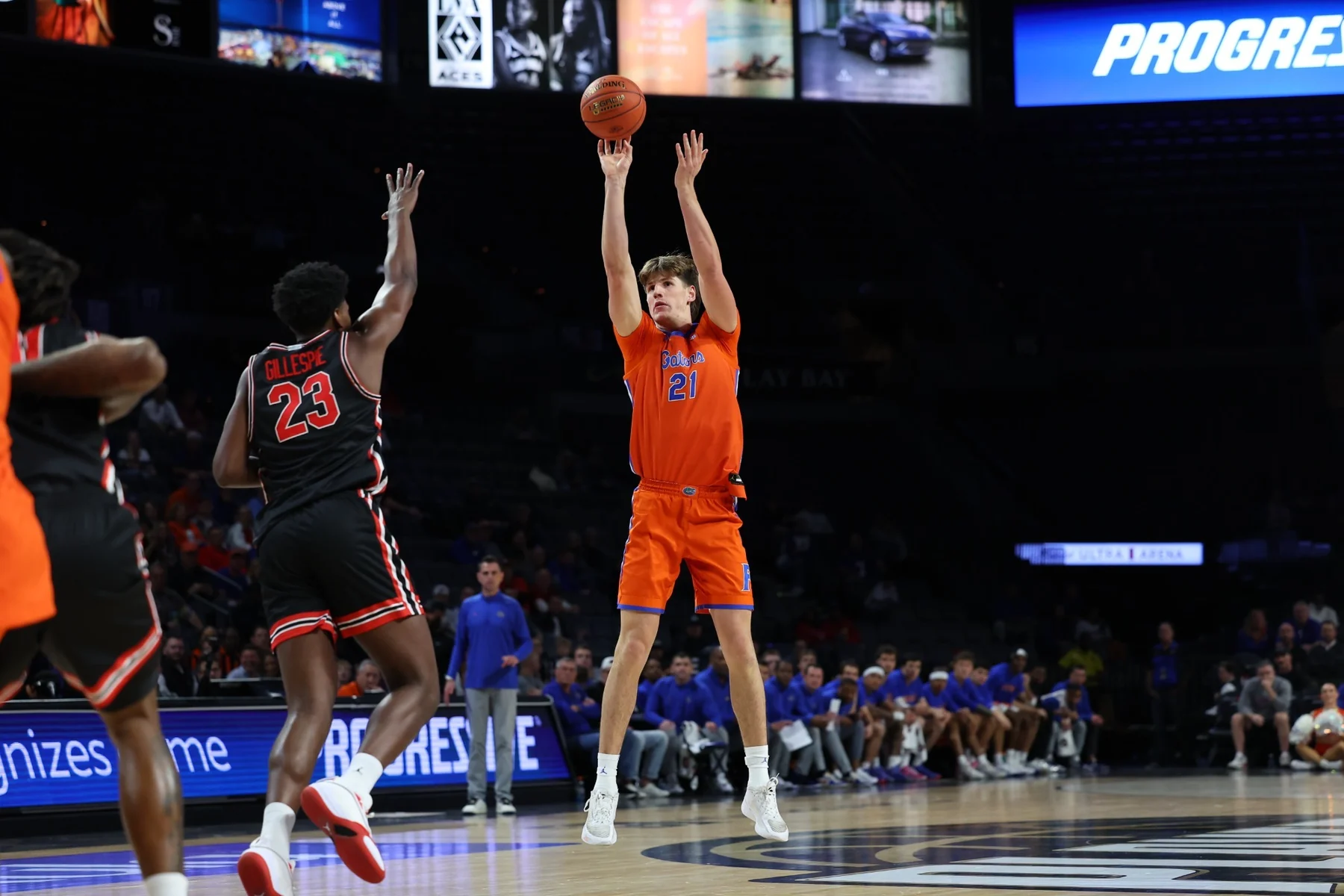
Florida hit 15 threes and shot 50 percent overall in its 86–76 loss to Houston. The Cougars still won the paint scoring 44–18, took 27 free throws to Florida’s nine and collected 13 offensive rebounds to the Gators’ nine. When the first shot missed, Houston had more chances to recover possession. When Florida’s defense had to handle the next drive or box out through contact, the cumulative work mattered more than the headline shooting split.
The Gators beat West Virginia 85–72 the following day. Alex Condon posted 17 points, six rebounds and four blocks, and Thomas Haugh scored 22. That is evidence of a useful response under compressed tournament scheduling. It leaves a more demanding question open. Can Florida close the lane and finish possessions with a defensive board when it faces an opponent as physical inside as Houston? A game in which the threes only fall at an ordinary rate would give a cleaner look at what the frontcourt can keep stable. That is the matchup to put next to the Vegas tape when it comes along.
Michigan State under pressure from ranked opponents
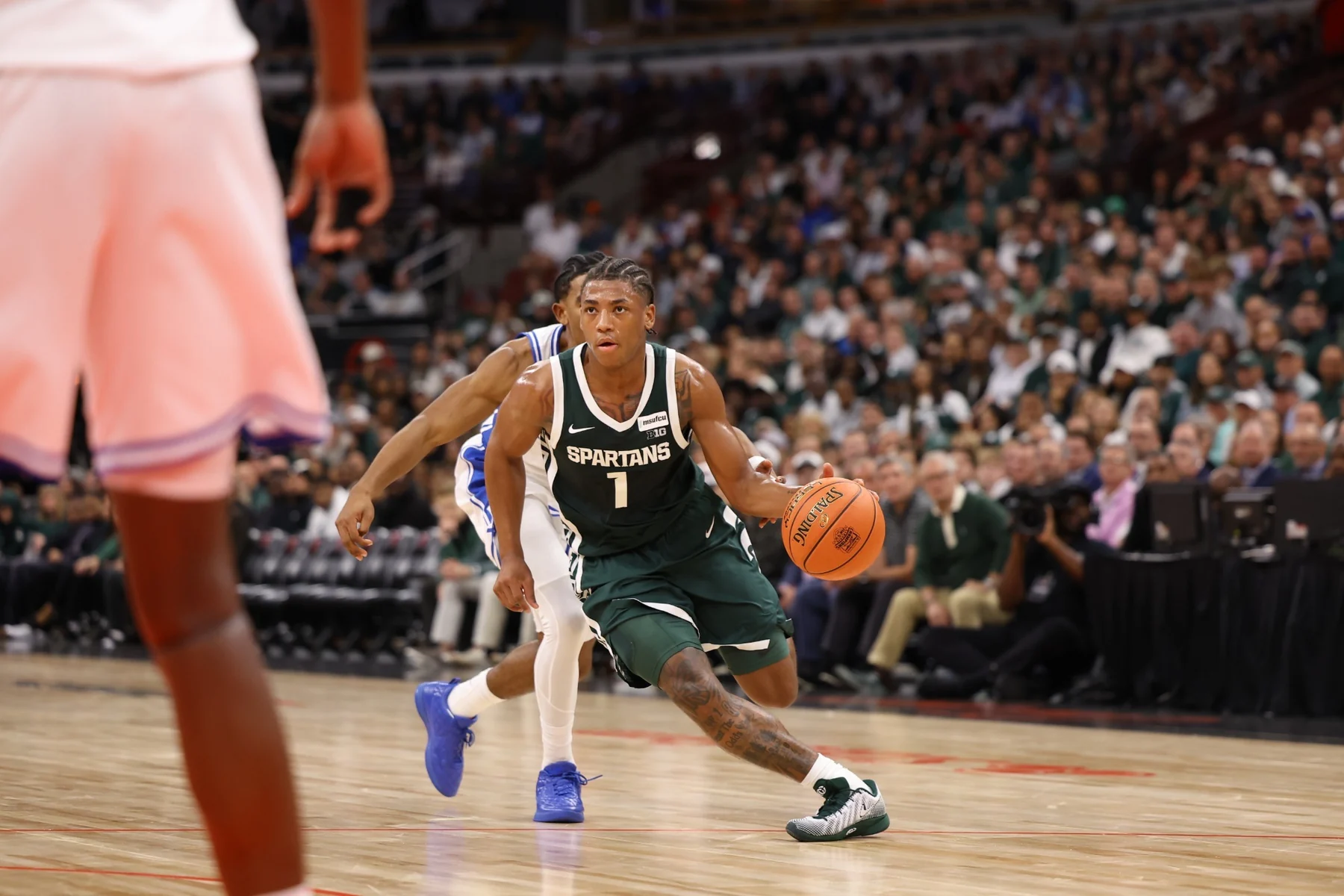
Jeremy Fears Jr. had 18 points, 11 assists and seven rebounds in the 79–73 win over Duke. Jordan Scott added six blocks. The combination illustrates how a floor general and a defender who can alter shots can control different parts of a game. If a frontcourt stop turns into a clean outlet, the next attack has a chance to get organized before the defense can set its help.
At Tennessee, the Spartans made nine of 50 shots in a 61–46 loss even though they committed only seven turnovers. Fears made 16 free throws and had zero field goals. Low turnovers kept possessions alive. Tennessee made so many of the resulting attempts difficult to turn into points that ball security barely changed the outcome. On the next tape, watch what happens when Fears makes the first pass and has to let a teammate drive the possession forward. An early catch on the move can change the quality of a second action. A static swing that sends the ball back to Fears late in the clock asks him to solve the same defense with less time.
How Duke and Arizona create enough good shots
Duke and Arizona offer two different views of the same problem. A deep offense has to produce useful shots for more than one lineup, including an uncomfortable stretch on a night when the first action loses its edge. Look at shot distribution alongside the final score and the points each player contributed.
Duke and the value of a second creator
Duke went 9-of-40 from three against Illinois. Those 40 attempts accounted for most of its 64 field-goal tries. Joaquim Boumtje Boumtje still scored 17 points and made eight free throws, and Caleb Foster supplied 15 off the bench. Deron Rippey Jr. logged seven assists in 14 minutes without making a shot. The box score shows several different ways players contributed to offense. It also shows that Duke went long stretches relying on a form of scoring that was yielding a low return that night.
The next step is a connection between those roles. If Rippey makes the defense turn its head, the receiver can use the advantage to touch the paint or force another help decision while there is time to reset. If Foster comes in with a second viable route to the rim, Boumtje Boumtje has a better chance to receive the ball while the low defender is moving. The 40 attempts contain a mix of looks and game states. The question to carry forward is whether Duke can put pressure on the defense through several actions even when a double-digit deficit tempts it to chase points from the arc.
Arizona against an organized half-court defense
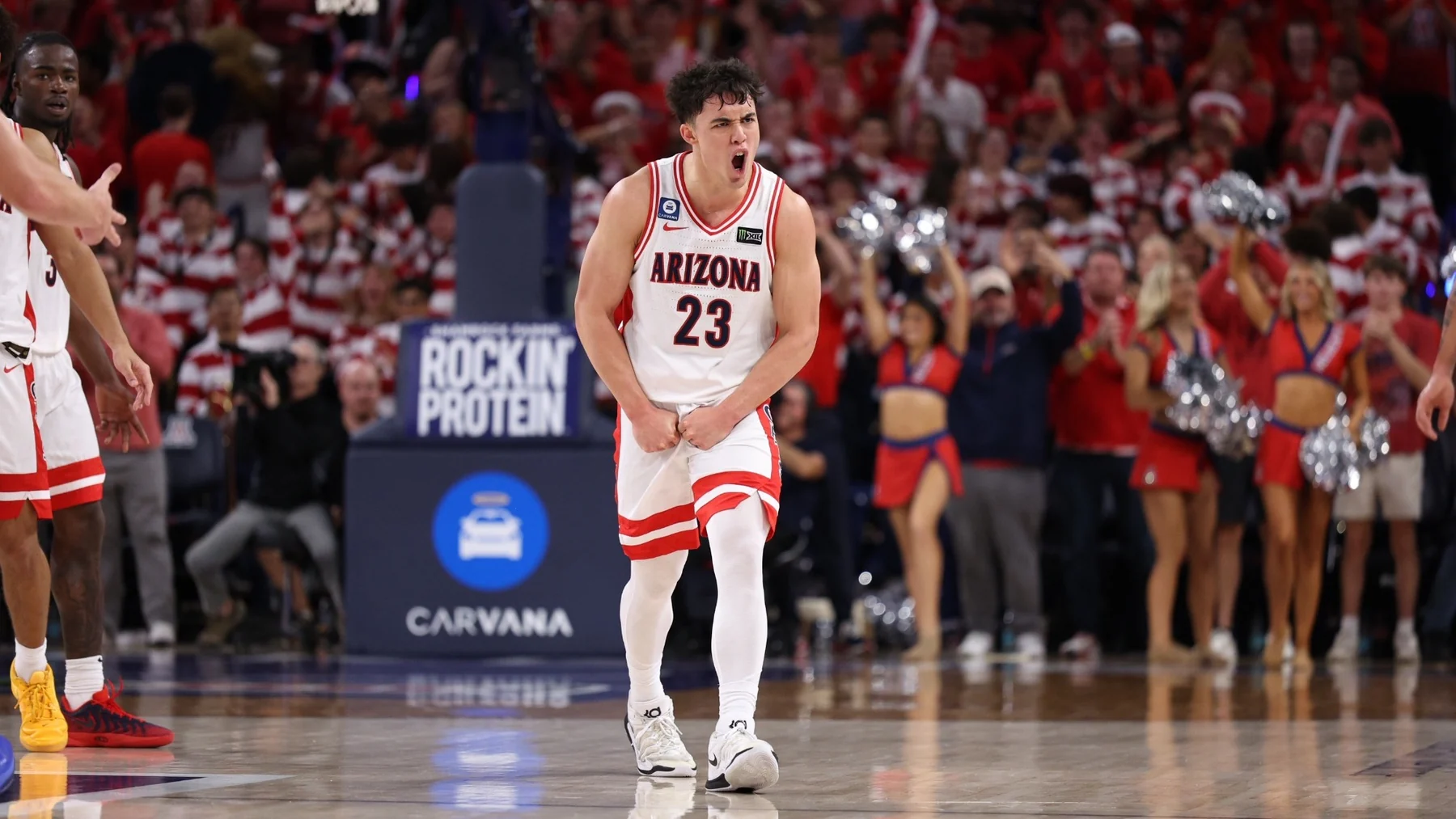
Arizona beat UConn 85–79 in Tucson after leading 47–29 at halftime. Ivan Kharchenkov had 20 points with seven assists, Motiejus Krivas scored 18 with 12 rebounds and Derek Dixon made four threes. Arizona hit 10 of 22 threes despite committing 15 turnovers to UConn’s 10. The previous road win at Auburn looked different. The Wildcats scored 40 paint points, won the boards 49–37 and got 16 points, 12 rebounds and four assists from Krivas.
Those two results give Arizona multiple avenues into productive offense. A team that can create from a frontcourt catch and punish a defender for helping toward the ball keeps more choices available late in the clock. UConn’s 50-point second half also shows how quickly a cushion can narrow. Watch the Wildcats’ next tight game for catches inside the arc, help moving out of position and players making a quick next pass under control. Sustaining those sequences after a timeout or a run by the opposition would build a stronger March case than another single high shooting percentage.
Where Illinois and Michigan can gain ground
Illinois and Michigan belong in this discussion for different reasons. Illinois already produced a decisive road win using advantages that survived cold perimeter shooting. Michigan has the title and returning playmakers, with November evidence that its best offense can come from several places. Each team still has to show it can sustain that offense when an opponent strings good defensive possessions together.
Illinois after the Duke test
Andrej Stojakovic scored 46 at Duke and Quentin Coleman added 27. Two career scoring nights can make the performance feel impossible to repeat. The way Illinois reached 99 points is more revealing. The Illini went 6-of-32 from three, reached the line 39 times and grabbed 18 offensive rebounds. Those extra possessions produced 19 second-chance points. A defense that survives the first shot still has to find and block out the guards and wings crashing behind it.
Illinois’s 84–78 loss at Texas Tech a week earlier puts a limit on what to infer. The Red Raiders built a 49–29 halftime lead and scored 15 first-half points off Illinois turnovers. The difference between the two road tests was the chance to control when a possession ended. When Illinois gets an attempt up and has players in position to pursue a miss, it can win on a cold shooting night. When its offense hands the opponent the ball before a shot or foul, the recovery path is narrower. Revisit both games when the Illini meet longer perimeter defenders who get into the first passing lane.
The defending champion’s new measuring stick
Michigan beat UConn 69–63 for the 2026 championship. Their November rematch in Boston went the other way, 85–77. Michigan trailed 43–30 at halftime before Trey McKenney scored all 22 of his points in the second half. J.P. Estrella finished with 19 points and nine rebounds. A group that finds offense through both a perimeter scorer and a frontcourt finisher has something to build on. Getting to that combination earlier would make the Wolverines more convincing against this caliber of opponent.
Elliot Cadeau’s 17 points and 10 assists in the subsequent 84–70 home win over Marquette offer an example of how the offense can function when he has outlets at different levels. Through four games, Michigan had 82 assists on 132 made field goals. Some of that production came against a different level of opposition. Watch whether the assisted opportunities survive earlier ball pressure and greater size, and whether McKenney and Estrella can sustain the offense on a night when the first pass never creates a clean look. The combination would make Michigan much harder to steer toward one kind of shot.
The November games that can change this shortlist
Thanksgiving week has three useful checks on this shortlist. The opening opponents below were confirmed on November 21, and the listed tips are Eastern time. Later Maui and Players Era meetings depend on bracket results. That distinction matters when you plan what to watch and when you compare the quality of the opponents a team eventually faced.
- Colorado State vs. Arizona, Monday, November 23, 11:30 p.m. ET on ESPN2. Arizona opens the Maui Invitational in Lahaina. Its win over UConn showed several starting scorers contributing in different ways. In Maui, watch who keeps those actions connected when the rotation changes. A guard getting the ball inside early can help a second unit avoid a whole shift of one-pass possessions. The bracket gives teams three games in three days, so the second and third outings can reveal how much of Arizona’s best offense survives with a different lineup facing a different coverage.
- Michigan vs. Creighton, Tuesday, November 24, 5:30 p.m. ET on ESPN. The Wolverines open Players Era 16 at T-Mobile Arena in Las Vegas. They share a half of the bracket with Miami and TCU and have a scheduled break in tournament play Wednesday. The next opponent depends on both openers. Against Creighton, look for how Michigan gets from Cadeau’s first paint touch or outlet pass to its next real advantage. The shot that a second or third player creates when the opening action stalls is the possession worth tracking.
- Michigan State vs. Arkansas, Thursday, November 26, 4:30 p.m. ET on CBS and Paramount+. Little Caesars Arena is a different environment from the Spartans’ true road loss in Knoxville. Watch what a second Michigan State handler does after Fears gives up the ball, especially if the first pass away from pressure goes sideways. An immediate drive, cut or clean feed inside gives the Spartans several ways to turn that possession into points.
Check the weekly schedule for the relevant date and use the men’s college basketball TV guide to confirm the listing before tip. After the games, compare the quality of the possessions each team generated when a preferred action was unavailable. That is the information most likely to move a team on this list.
How the 76-team bracket changes a contender’s path
The 2027 men’s NCAA tournament expands to 76 teams. The March 16–17 Opening Round in Dayton and Wichita features the 12 lowest-seeded automatic qualifiers and the 12 lowest-seeded at-large teams. Twelve winners advance to a 64-team First Round. From that point the champion still has to win six games. An Opening Round entrant would have to win seven in all. The first two main-bracket rounds run March 18–21, and the national semifinals and championship are April 3 and 5 in Detroit.
For November title contenders, the first practical concern is earning a route through the field that gives them room to play their own game. A No. 1 seed’s pod contains the No. 16, No. 8 and No. 9 seeds. A No. 4 seed opens against a No. 13 and shares a pod with the No. 5 and No. 12. Those groups give a useful sense of what a better seed can buy in the first weekend. The actual difficulty depends on who lands in the group and the styles those opponents play. The college basketball bracketology guide explains the process that determines the bids and seeds.
Start with the matchup evidence when you update a November opinion. Florida’s game against Houston gives you a benchmark for how the Gators handle pressure at the rim and on the glass. Michigan State’s trip to Tennessee gives you a benchmark for games in which Fears keeps the ball safe but quality shots are scarce. If a team has since found a way to beat the same kind of defense, give that evidence more weight than a run of wide wins against opponents that presented a different problem.
Look for an answer that persists when the circumstances change. A second creator who can rescue a trip after a timeout, a lineup that can rebound without giving up its floor spacing and a reserve who can defend through a starter’s foul trouble each add a concrete capability. By Selection Sunday, compare those capabilities with the actual opponents and sites, then ask how the team is likely to win its closest game. November identifies the questions worth tracking. Conference play and the bracket determine which ones a contender eventually has to answer.
Sign in with Google to join the discussion.