The Senate vote changes the debate, not today’s basketball rules
The Protect College Sports Act has passed the Senate, but it is not federal law as of October 1, 2026. The September 28 vote was 77–22, and the legislation now goes to the House of Representatives. For men's basketball fans, that distinction comes before every argument about transfers, NIL money or television. A Senate headline does not establish that a particular player can compete tonight, or that a new transfer restriction already applies to him. The official passage announcement states the next legislative step explicitly.
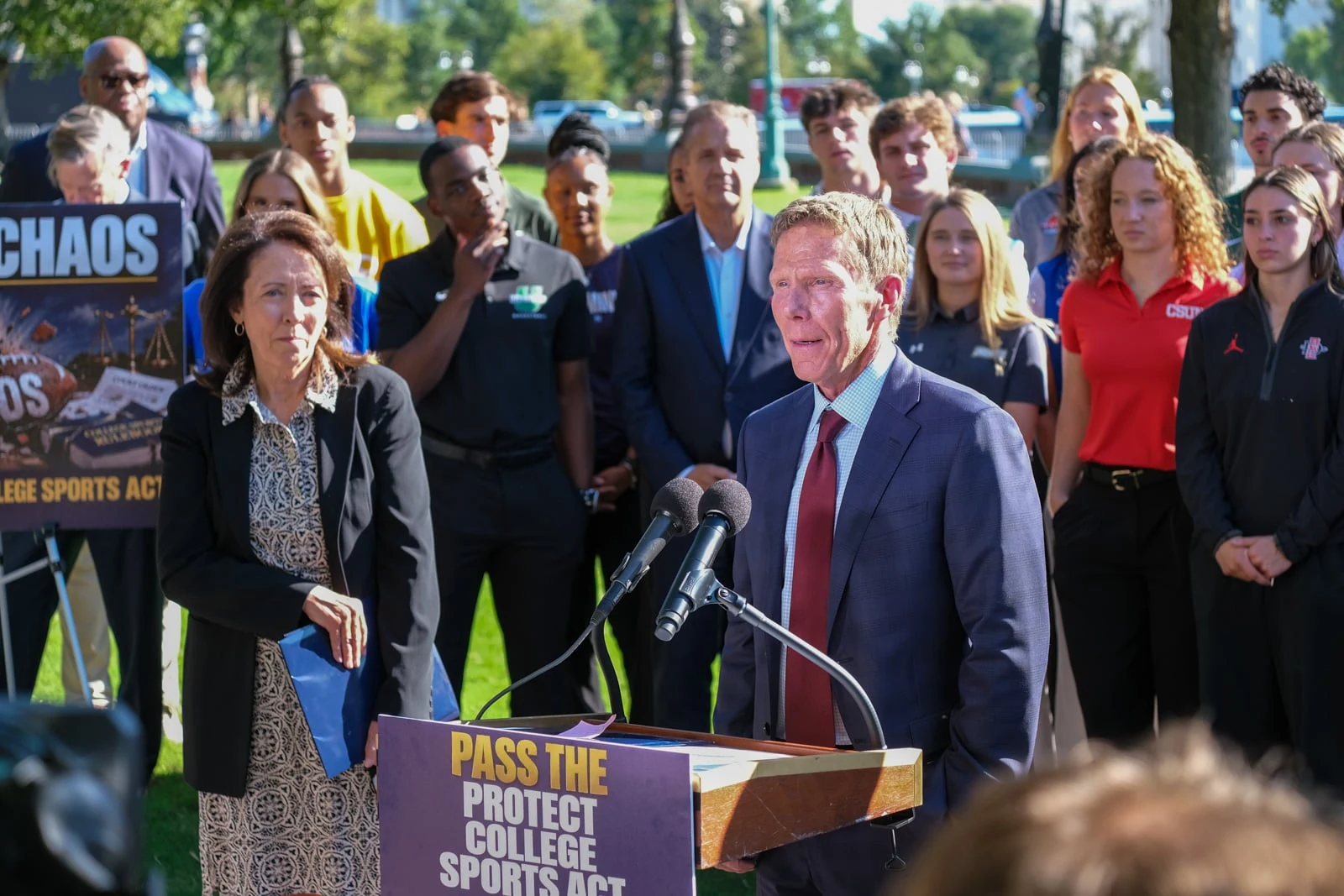
The bill's authors present it as a way to establish national rules for an increasingly unsettled system. Basketball has a direct stake in that argument: Gonzaga coach Mark Few participated in the September 14 Capitol event supporting the legislation. That is a documented coach's involvement, rather than evidence that every coach or fan agrees. The proposal combines restrictions that could affect roster construction with benefits that could protect athletes. Evaluating only one side leaves out much of what people are arguing over.
Consider an illustrative offseason decision: a coach needs an experienced point guard, and a recruit has already changed four-year schools once. The coach's questions would include the player's individual status, the applicable rules when the move occurs and any relevant exception. Reading that Congress is discussing transfers answers none of those questions by itself. Our 2026–27 eligibility guide provides the wider context; prospective legislation must be kept separate from a current case.
There is also a date trap. The Senate took several procedural votes before final passage, including adopting the substitute on September 24. Those steps are listed separately in the committee's vote chronology. A September 17 document is useful background, but subsequent amendments matter. This explanation checks the September 28 Congressional Record alongside current official summaries.
The useful fan question is therefore what would change if this framework becomes law. That allows a discussion of continuity, athlete freedom and viewing access without declaring an outcome that Congress has not completed. It also keeps preseason predictions grounded: legislative momentum is relevant background, but a rotation still depends on the actual available players.
Transfer restrictions would change how coaches rebuild a roster
A basketball roster can lose its organizer, perimeter stopper and primary rebounder in the same offseason. Replacing those roles requires more than collecting recognizable names. A transfer's availability and remaining time to compete determine whether he is a solution for the coming season or a longer project. The proposed framework would make those questions especially significant for experienced players who have already changed schools.
One ordinary transfer comes with important exceptions
The Senate-passed text permits one move between four-year institutions without an eligibility delay. Ordinarily, a second move would cost eligibility during the first academic year after transfer. Additional moves without that delay are permitted for a discontinued sport, a departing head coach, sexual assault or harassment associated with the institution, or pursuit of a graduate degree. Those distinctions appear in Section 112 of the Congressional Record and the committee's explanation. Calling it an absolute ban on changing schools twice misses the exceptions.
Here is the basketball implication, rather than a legal prediction: a wing seeking a larger role after two seasons as a reserve might face a different calculation from a graduate guard or someone whose coach leaves. A team trying to replace its starting scorer would have to evaluate that difference before counting the player in a projected rotation. Conversely, a returning player might stay because he likes his development plan, because his alternatives carry more difficulty, or both. A stable roster alone would not tell fans which explanation applies.
The athlete's perspective also matters. Better continuity can help supporters learn a lineup and can let teammates build defensive communication. Yet a crowded backcourt can leave a player short of the minutes he needs to develop. The argument over restrictions concerns that tension. The NCAA's current transfer resources emphasize the actual process and school compliance review; a proposed federal framework should not be substituted for that review.
A five-year window is a separate eligibility question
Section 113 sets a maximum five-calendar-year period beginning with the earlier of initial full-time enrollment or the academic year following the athlete's nineteenth birthday. It also provides specified absence exceptions and preserves other conditions. That is a timing framework, not automatic clearance for every fifth-year applicant. The NCAA's current age-based explanation likewise warns that its continuous window does not guarantee everyone five available years; other eligibility requirements remain.
In practical terms, a hypothetical center who misses games through injury raises a different question from a guard changing campuses. Fans need the relevant dates and applicable exception before estimating either player's remaining opportunity. Neither a redshirt label nor a new jersey supplies those facts. Separating the clock from the transfer decision makes a depth chart more useful and keeps eligibility arguments from becoming interchangeable slogans.
A retention fund could reward continuity without guaranteeing parity
One of the most consequential basketball ideas in the bill is a financial incentive to retain players. The proposal allows qualifying institutions to exceed the underlying revenue-sharing cap by up to $22.5 million annually for athletes who have spent at least one full competitive season there. An additional amount of up to $5 million is linked to NIL spending on non-revenue sports. The official retention-fund explanation gives a potential $27.5 million maximum addition; it does not announce a payment to every athlete.
The season-at-the-school condition is visible in Section 114 of the operative text, checked against the Senate's September 28 Record. The committee's September revision also ties access to uniform academic-progress and graduation benchmarks. Retention therefore has conditions beyond a coach saying he wants a player back.
Permission to spend is different from a basketball payroll
A spending allowance across an institution's relevant programs should not be read as the amount available for its men's basketball roster. Nor does a larger legal allowance create the cash to use it. The College Sports Commission distinguishes capped institutional payments from third-party NIL activity in the current system. Those categories help fans ask better questions than simply adding every headline dollar figure to a team's supposed payroll.
The following is an editorial basketball example. Suppose a returning point guard has learned which angle the team's center prefers on a ball screen. Keeping both players could preserve the timing of the offense, the guard's reads against a trap and the center's defensive calls. Money aimed at retention could support that continuity. The potential value comes from their shared basketball experience; it would not prove that either player is more talented than every available newcomer.
At the same time, programs with different resources might respond very differently to a higher ceiling. One might afford to protect an experienced starting group. Another might need to choose which returning player receives a better offer. The bill's incentive could change those conversations while leaving the underlying resource gap substantial. That is why promising competitive parity from the fund alone would go further than the evidence.
For fans, useful information would include whether the school actually intends to spend, how it allocates the available money across sports and what player agreements really provide. An anonymous valuation is not a signed agreement, and a permissible maximum is not an audited expense. Basketball analysis should then return to fit: keeping a ball handler does not solve weak rebounding, and paying a scorer does not create the defensive communication a lineup needs.
Athlete protections matter after a player leaves the rotation
Discussion of the proposal often starts with a star's next destination. But a backup forward who cannot earn a starting spot still has a contract, a degree plan and a body that absorbs the demands of the season. Those interests do not disappear when his minutes fall. Examining the athlete protections alongside the restrictions gives fans a fuller basis for judging the legislation.
Agents and written agreements would face clearer requirements
The proposal requires state registration and NCAA certification for agents, caps relevant agent fees at 5% and prohibits misleading NIL representations used to induce enrollment or a transfer. NIL agreements must identify key terms, including the athlete's duties and compensation. These are described in the committee's athlete-protection explanation.
An illustrative $100,000 endorsement agreement makes the percentage easier to understand: 5% equals $5,000. That calculation says nothing about a particular player's market value or the terms of any real deal. For a recruit comparing opportunities, written payment schedules and promised responsibilities would matter more than a dramatic valuation posted online. For a fan, knowing that an agreement exists is different from knowing it has paid out.
Clearer documentation could help a basketball program plan, but it would not decide whether a transfer fits its offense. A coach still needs to assess passing decisions, shooting range and defensive effort. Financial clarity and basketball evaluation answer different questions. The bill should be judged on what the proposed safeguards actually cover, rather than on a promise that paperwork will settle every recruiting disagreement.
Medical and degree support extend beyond the final buzzer
The proposal protects degree-completion assistance for up to ten years after eligibility and bars scholarship loss because of injury or athletic performance. Its Division I medical requirements cover out-of-pocket costs for sports-related injuries or illness during participation and for five years after eligibility. The passage announcement identifies that medical scope. Degree assistance is not ten extra years on the court, and the medical provision is not unlimited coverage of every expense forever.
Imagine a player whose rehabilitation outlasts his final college season. His team's next recruiting class would not answer who pays his eligible bills or how he finishes his studies. These benefits therefore deserve attention even when they do not improve the next projected starting five. That is a basketball-centered reason to consider the proposal's long-term treatment of athletes, rather than viewing them solely as available roster slots.
The final amendment process matters here too. The Durbin–Baldwin amendment, adopted 96–1, protects state-law claims involving specified safety harms. Baldwin's account explains why those rights were preserved. Broadly declaring that the bill eliminates all athlete lawsuits would overlook that amendment and the distinctions between different types of claims.
The television proposal targets local access, with conditions
For a fan juggling subscriptions, the bill's local-viewing provision may be its most immediately appealing idea. Section 204 would require the covered pooled-media entity to make at least one non-exclusive local-outlet option commercially available for each participating school's football or basketball game, as a condition of its exemption. The option concerns viewing without charge in the school's local designated market area. The Senate-passed text also allows an appropriate free offering from a national rights holder to satisfy the requirement.
That proposal needs its conditions attached. Participation in the media pool is voluntary, existing contractual rights are preserved, and national or regional agreements can still be negotiated. The September contract revision and the committee's conditional-media overview reinforce that distinction. It would be a mistake to translate the proposal into an immediate announcement that every college basketball game is free nationwide.
Why a national fan should keep checking the actual broadcaster
Imagine two supporters of the same team. One lives near campus, while the other moved across the country after graduating. A local-market option could be relevant to the first viewer without answering the second viewer's access question. The location of the game is another separate fact: the proposal concerns the participating institution's market, so the phrase “home market” should not be casually rewritten as “home games only.”
There are practical details a fan would still need before tipoff: which outlet carries the game, which area can receive that offering, whether an account is needed and whether the listing has changed. Those are questions for the actual service announcement. A legislative summary supplies a proposed framework, not a channel number or a working stream. Our TV schedule remains the place to begin checking a particular matchup.
The roster story and the viewing story meet here. A returning backcourt only becomes part of a fan's routine when the supporter can follow its games. Easier access could make it simpler to watch a developing team through a season rather than discover it in March. That is an editorial possibility, not a demonstrated audience outcome from a law that has not been enacted. The provision's value should be assessed against its actual market coverage and implementation, not a headline promising the disappearance of every paywall.

What basketball fans should watch in the House debate
The disagreement is broader than whether people enjoy roster continuity. Supporters argue that enforceable national rules would stabilize college athletics. Senator Chris Murphy counters that restricting athlete compensation while leaving large spending on coaches and facilities untouched fails to address the full cost problem. Senator Cory Booker emphasizes athlete voice and accountability. Their September 28 remarks and Booker's statement document those positions. They are arguments from opponents, not court rulings establishing the bill's effects.
The sponsors' case for stability deserves the same discipline. Fewer disputed rules might make roster planning easier, but ease for an institution and a fair deal for a player are separate measures. Fans can value experienced teams while still asking whether a reserve has reasonable opportunities to move, whether safeguards are enforceable and whether schools fund the benefits they promise. Agreement on one goal does not settle every provision.
Affordability is another concrete issue. Senator John Kennedy proposed a 4% annual cap on ticket-price increases; his office reports that the Senate rejected it 42–54. The rejected ticket amendment is not a protection contained in the Senate-passed bill. A supporter budgeting for conference games should therefore not assume the legislation supplies that price limit. This documented dispute addresses an actual fan cost without claiming that all fans share one position.
During House consideration, watch the language that survives, the implementation dates attached to it and the institutions covered. Then separate three practical questions: can the player compete, has the school committed money, and can the supporter watch the game? Each requires its own evidence. A positive answer to one does not automatically answer the other two.
For the upcoming season, continue following official roster announcements, individual eligibility decisions and the real broadcast listings. Use our scores and TV listings for the games themselves. The PCSA debate is consequential because it could reshape future decisions around those games. Until Congress completes the process, the most useful coverage explains the proposal's tradeoffs while keeping today's confirmed basketball information distinct.
Sign in with Google to join the discussion.