
Start with the contest you are trying to win
The first rule of bracket strategy is simple: you are trying to outscore the entries in your pool, not predict every tournament game correctly. A highly accurate bracket can finish second because it shares the same champion with the leader and misses one semifinal. A less accurate bracket can win because its distinctive Final Four pick survives. The objective is relative, so the best entry depends on who you must beat and how the contest awards points.
Accuracy and pool equity are different goals
Game prediction asks which team is more likely to win. Pool strategy asks which complete set of picks gives you the best chance to finish first. Most of the time those goals point in the same direction: choose the stronger team. They separate when public pick rates become lopsided. If Team A has a 55% chance to win a region but appears in 80% of your opponents' Final Fours, Team B may offer useful leverage at a real probability cost. The decision is not “favorite or upset” in isolation; it is probability compared with popularity.
Basketball
Estimate advancement
Contest
Map the scoring
Pool
Choose leverage
That does not mean a bracket should be contrarian everywhere. Every unnecessary upset sacrifices expected points. The longest publicly verified perfect start reached 49 games in 2019, and millions of entries fail much earlier. A perfect bracket is a storytelling device, not a practical target. Your job is to absorb inevitable misses where they do limited damage while remaining alive for the high-value outcomes that can move you past a pool.
Single elimination adds unavoidable noise. A 70% favorite still loses roughly three times in ten if that probability is well calibrated. One cold shooting night, early foul trouble or a late loose ball can overturn months of evidence. Better strategy improves the quality and fit of decisions; it does not turn estimated probabilities into guarantees.
The three inputs every bracket needs
Build the entry from three layers. First, estimate basketball strength and matchup probability. Use seeds, efficiency, opponent quality, player availability and style to decide how likely each team is to advance. Second, read the pool rules. Round values, upset bonuses, tiebreakers and whether picks can be changed after an Opening Round result determine where points are concentrated. Third, estimate the field you are playing against: pool size, favorite teams, likely public champion and whether multiple entries are allowed.
Those layers should be handled in that order. Basketball probability prevents reckless selections. Scoring converts game outcomes into bracket value. Opponent behavior identifies where a reasonable alternative can create separation. Skip the first layer and “leverage” becomes guessing. Skip the second and you may optimize low-value first-round games while neglecting the champion. Skip the third and you may submit the same safe bracket as everyone else in a large contest.
A good bracket is therefore a portfolio of linked decisions. Each team picked into the Sweet 16 must also survive its earlier games; every champion pick occupies six connected slots from the Round of 64 in a standard path. Treat the page as one system, not 63 independent coin flips. That mindset is the foundation for every rule that follows.
Let scoring rules and pool size set your risk
Read the rules before studying a single matchup. ESPN's standard Tournament Challenge scale awards 10 points per correct Round-of-64 pick, then 20, 40, 80, 160 and 320 through the championship. Other pools may express the same structure as 1-2-4-8-16-32. Private contests can add seed bonuses or use flat scoring. Those are not cosmetic differences; they change the value of being right in each part of the bracket.
Why later rounds usually dominate the score
In a doubling system, every round offers the same maximum total. Thirty-two first-round games at 10 points equal 320; one championship pick is also worth 320. Yet the later rounds are more fragile because one eliminated team destroys every future slot assigned to it. Pick a champion that loses in the second round and the damage includes the Sweet 16, Elite Eight, Final Four, title-game and champion points that team can no longer earn.
That linked payoff is why champion selection deserves more time than choosing a fifth 12-over-5 upset. A correct champion in ESPN's scale earns 630 points along a standard six-win path: 10+20+40+80+160+320. It also preserves the opponent picked into the title game until the final. Early-round accuracy builds a floor, but late-round coherence creates the ceiling.
The completed 2026 tournament bracket illustrates this dependency. An entry backing Michigan to win did not receive only the final-game value; it collected each correct Michigan advancement along the way. Treating each round as a separate prediction misses how one strong title path compounds.
Small pools reward restraint
In a pool of eight or 12 people, you do not need a bracket nobody else could imagine. You need to be somewhat better than a small group. Start close to the highest-probability bracket, choose one or two thoughtful regional differences and avoid eliminating multiple title contenders for entertainment. If six colleagues select the same champion, one reasonable alternative can separate you; forcing a double-digit seed into the Final Four usually adds more failure probability than needed.
Pool composition matters more than raw head count. An office pool filled with casual fans may cluster around famous programs and local teams. A group of dedicated college-basketball viewers may distribute picks across efficient contenders. In either case, identify the likely shared choices. A small pool rewards being correct more often because there are fewer entries to leap.
Large pools require selective leverage
In a national contest or a pool with hundreds of entries, the safest chalk bracket is likely to be duplicated. Finishing above average is not the same as finishing first. You need some outcomes that are both plausible and less popular than their probability warrants. The right place to differentiate is usually a regional winner, finalist or champion—not dozens of low-value opening games—because later rounds carry more points and fewer selections remain alive.
Use leverage selectively. Suppose two teams have similar title probabilities, but one is picked as champion twice as often. The less popular contender may be the better large-pool choice. That inference depends on credible probability and popularity estimates; it is not permission to choose an inferior team merely because the logo is unusual.
Upset-bonus formats shift the calculation. If a No. 12 victory earns base points plus the seed difference, a live underdog becomes more valuable than under straight scoring. Flat one-point-per-game pools shift weight back toward opening-round accuracy. Write the exact round values and bonuses at the top of your worksheet. Your risk profile should be a response to those rules, not a personality test about whether you “love chaos.”
Build a probability baseline before choosing upsets
Do not begin by circling the underdogs you like. Begin with a baseline bracket that reflects the most likely winner of every game, then decide where pool incentives justify a change. The baseline exposes the actual cost of each contrarian choice. Without it, an entry can become a collection of stories with no stable title path.
Use seed history as a prior, not a verdict
Seeds contain useful information. Through 2026, No. 12 seeds were 58-106 against No. 5 seeds since the field expanded in 1985, a 35.37% win rate. That makes a 12-over-5 result plausible, not mandatory. By contrast, No. 16 seeds were 2-158 against No. 1 seeds, a much stronger warning against chasing the rarest upset merely because UMBC and Fairleigh Dickinson proved it can happen.
The rate is a prior: your belief before analyzing the particular teams. Move away from it only for basketball reasons. A No. 12 that protects the ball, rebounds its misses and can defend without fouling may deserve a higher estimate against a vulnerable No. 5. A No. 12 dependent on transition against an opponent that controls tempo may deserve less than the seed-line average. The number disciplines the story; the matchup refines the number.

Avoid the opposite error of treating every game on a seed line alike. Committee seeds summarize a full résumé and help place teams in a bracket. They do not directly tell you whether a lead guard is limited, whether a small lineup can finish possessions against an elite offensive-rebounding team, or whether a favorite's shot profile is unusually volatile. History is the starting point, not a verdict printed beside the school name.
Think in advancement probability
Every bracket slot asks a cumulative question. If a team has a 70% chance to win its opener and, conditional on advancing, a 60% chance to win the next game, its simplified Sweet 16 probability is 0.70 × 0.60, or 42%. It is not 60%. The team has to survive both events. Continue multiplying conditional probabilities through the region and apparently small differences in each round produce large differences in title odds.
This is why bracket paths matter. A team may be slightly weaker in a neutral power rating but draw a favorable first weekend and a regional opponent whose style it handles well. Another contender may face an underseeded opponent immediately. You are predicting the path actually printed, not a generic ranking of the 76 teams entering from 2027 onward.
Opening Round teams create one more branch but do not change the method. The 2027 tournament will use 12 Opening Round games before returning to the standard 64-team first round. If your platform requires a pick before those matchups, estimate each possible winner's next-game probability separately. Do not assign one forecast to a placeholder when the two teams have different styles.
You do not need a sophisticated model to gain discipline. Write rough win probabilities beside uncertain games: 55-45, 65-35, 80-20. Then carry the likely winners forward and revisit only the choices where a small probability sacrifice buys meaningful pool leverage. Thinking in ranges is more honest and more useful than labeling every pick a “lock” or an “upset special.”
Break down each matchup like a basketball editor
Once the baseline is built, watch and read the matchup rather than hunting for a magic stat. Start with opponent-adjusted offensive and defensive efficiency so that a fast team is not rewarded simply for playing more possessions. Then ask how each side creates shots, protects possessions and finishes stops. Upsets become credible when the underdog has a repeatable route to winning those exchanges.
Shot profile and three-point variance
Three-point shooting can compress a talent gap because each make is worth more and percentages fluctuate in a one-game sample. But “shoots many threes” is incomplete analysis. Check whether the underdog creates assisted, catch-and-shoot attempts or survives on guarded pull-ups. Check whether the favorite allows those shots by scheme, loses shooters in transition or deliberately protects the rim and concedes above-the-break attempts.
Also inspect the two-point game. A favorite that dominates the rim can withstand ordinary perimeter variance; an underdog that cannot finish or draw fouls may need an unsustainably hot night. Conversely, a smaller team with five-out spacing can pull a rim protector away from the basket and change the favorite's normal defensive structure. The useful question is not who has the better season three-point percentage. It is whose preferred shots are likely to be available in this matchup.
Treat a late hot streak carefully. Ten games contain information about lineup changes and health, but shooting percentage can swing on a modest number of attempts. Give more weight when the shot quality, role and rotation have changed; give less when the argument is merely that a team is “due” to stay hot.
Turnovers, pace and possession control
Turnovers end possessions before a shot and often produce transition chances. Compare the underdog's offensive turnover rate with the favorite's ability to force mistakes. A small-conference guard who controlled the ball against passive defenses may face a different problem against length and pressure. On the other side, a veteran backcourt that rarely gives the ball away can remove one of a favorite's easiest scoring sources.
Pace affects the number of opportunities for the stronger team to express its advantage. Fewer possessions can increase outcome variance, but slow tempo is not automatically good for an underdog. A team that uses 25 seconds and then takes a poor shot is not controlling the game; it is shrinking its own scoring margin. Look for an underdog that can execute late in the clock, defend without breakdowns and avoid live-ball turnovers.
Research on tournament upsets has identified effective possession measures, extra scoring chances and assist-to-turnover relationships among useful matchup features. That supports a possession-based view without promising a formula. Estimate who can decide the pace and whether the other team remains efficient when denied transition.
Rebounding, rim pressure and foul risk
A defensive stop is not finished until the rebound is secured. Offensive rebounding gives an underdog extra attempts and can create kick-out threes after the defense collapses. It can also expose that team to transition if too many players crash. Compare offensive-rebound strength with the opponent's defensive-rebound weakness, then consider lineup size rather than reading one national rank alone.
Rim pressure connects shooting and fouls. Teams that reach the paint force rotations, create drop-offs and earn free throws. A favorite with one indispensable center may be vulnerable if the underdog can attack that player repeatedly and generate foul trouble. The reverse is also true: an undersized upset pick can lose its starting frontcourt and preferred spacing when it cannot defend the post without fouling.
Free-throw percentage matters most after access is established. A team cannot exploit excellent foul shooting if it rarely reaches the line. Check free-throw attempt rate, rim volume and the opponent's foul tendency together. Late-game reliability is useful, but it is one piece of a possession battle rather than a clutch label.
Availability and matchup-specific context
Verify who is actually expected to play. A lead guard's mobility, a rim protector's minutes limit or a recently shortened rotation can change every full-season average. Distinguish confirmed reporting from speculation and check again near bracket lock. If status remains uncertain, lower confidence rather than pretending to know the outcome.
Consider geography and rest without turning them into destiny. Travel distance, crowd balance and an Opening Round turnaround can affect preparation, yet talented teams routinely overcome them. The 2027 Opening Round adds more teams arriving through an extra game, so evaluate whether that live action sharpens a cohesive group or taxes a thin rotation before the first round.
Finish by writing one sentence for each non-chalk pick: “This team can win because…” The reason should name an interaction—ball security against pressure, offensive rebounding against a weak glass team, spacing against drop coverage—not tradition, mascot or vague momentum. Then check current men's college basketball scores and recent results for evidence that the personnel and roles behind the argument still exist.
Spend your upset budget where it can pay off
An upset budget is not a quota. Do not decide that every bracket needs exactly seven first-round surprises. It is a limit on how much probability you are willing to trade for differentiation. Spend it where the underdog has a credible basketball path, the public is overlooking that path and the downstream damage is manageable.
Separate plausible upsets from decorative chaos
No. 11 seeds have won 62 games against No. 6 seeds since 1985, and several have reached the Final Four. That history supports taking strong 11 seeds seriously. It does not imply that every 11 should advance or that one first-round edge lasts for four rounds. The probability of one upset can be respectable while the probability of an entire Cinderella run remains small.
Rank candidate upsets into tiers. Tier one contains near-coin-flip games where seed and team quality disagree. Tier two contains underdogs with a specific route—turnover pressure, offensive rebounding, five-out spacing—but a clear overall disadvantage. Tier three is spectacle: a team needs several low-probability events at once. In straight scoring, use most of the budget in tier one, a small amount in tier two and almost none in tier three.
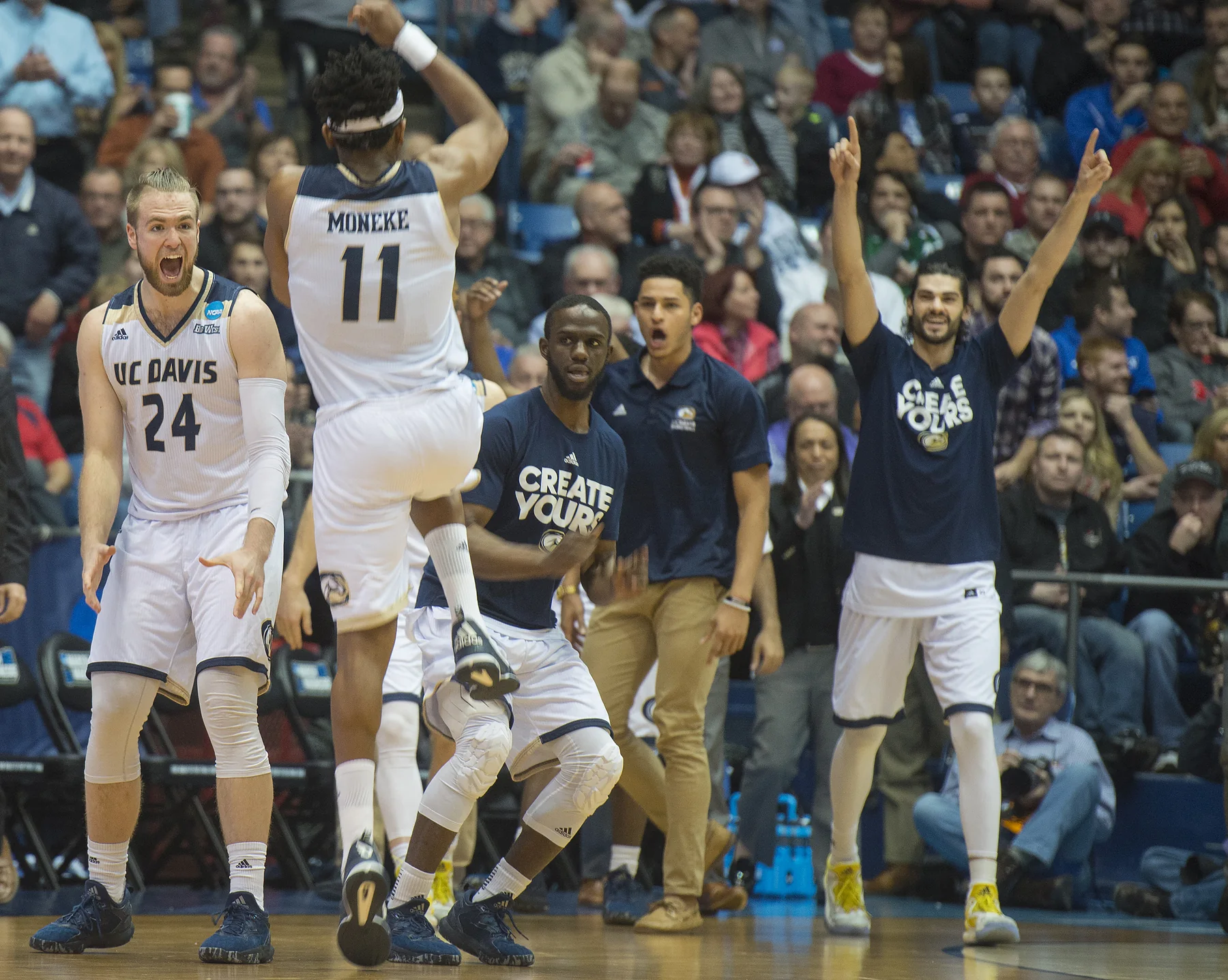
Avoid decorative chaos: picks included only to make the bracket look bold. A No. 14 seed with no answer for the favorite's rim size does not become attractive because another No. 14 won three years ago. Ask whether you would still make the pick if nobody could see your entry. If the answer is no, it is probably theater rather than analysis.
Keep each region internally coherent
Every upset changes the next matchup. If you select a No. 12 over a No. 5, evaluate that No. 12 against the likely No. 4 or No. 13 next. The underdog may exploit the first opponent's turnover problem but face a disciplined defense that erases the same advantage two days later. Advance teams only as far as the matchup case survives.
Regional coherence also prevents contradictory logic. You cannot argue that a favorite is vulnerable because of weak defensive rebounding, then send it to the Elite Eight without explaining why the later opponents cannot attack the glass. You cannot pick two adjacent Cinderellas to meet and assume both had an easy path; one eliminates the opponent you may have used to justify the other's run.
Make a second-round pass after finishing the opening games, then a Sweet 16 pass after choosing regional semifinalists. This catches the common mistake of researching first-round names intensely and auto-advancing the survivor by momentum. The bracket does not award bonus probability because a pick was clever once.
Protect the champion and Final Four backbone
Use a higher evidence threshold as the points rise. Villanova won the 1985 championship as a No. 8 seed, the lowest-seeded men's champion of the seeded era. No. 11 teams have made the Final Four, but none has won the title. History does not ban a deep long shot; it shows how extraordinary six consecutive wins are.
Your champion should be able to win in multiple environments: fast or slow, against switching or drop coverage, on a poor shooting night and after an opponent removes the first option. Depth, ball handling, two-way efficiency and lineup flexibility matter more over six games than one upset-friendly trait. A team chosen because it can bomb threes past one favorite may not be built to survive the next five styles.
Popularity belongs in the final decision. In 2026, roughly one quarter of NCAA Bracket Challenge entries chose Duke as champion. Fading such a popular pick could create major leverage, but only a comparably strong alternative made strategic sense. The solution was not to choose a random double-digit seed. Preserve a credible Final Four backbone, make one or two differentiated late-round choices appropriate to pool size, and let carefully researched first-round upsets add points without detonating the entire structure.
Finish the bracket with a repeatable workflow
The final edge is procedural. Many entries are damaged by a forgotten tiebreaker, an injury learned too late or a regional path that no longer matches the writer's own reasoning. Build a repeatable sequence and stop making wholesale changes when deadline emotion arrives.
Make a regional coherence pass
Read each region from the first round to the regional champion without looking at the other three. For every Sweet 16 team, confirm that you selected it through two actual matchups. For every Elite Eight team, ask whether its style still works against the opponent your bracket created. For each regional winner, check that the team has enough ball handling, half-court scoring and defensive flexibility to survive different games.
Then compare the four regional champions. A Final Four should not be four independent “best teams” if the semifinal pairings create different probabilities. Re-evaluate those matchups and the title game. If changing an early pick alters a later opponent, update the entire path rather than leaving the old winner in place mentally.
Keep notes short: one reason for each upset, one concern for each Final Four pick and one fallback if late availability changes. The discipline makes it easier to distinguish new information from nerves. A final bracket should be explainable, not endlessly editable.
Diversify multiple entries without randomizing
If the rules allow several entries, give each a defined thesis. Entry A can be the highest-probability baseline. Entry B can keep most early picks but use a less popular, similarly strong champion. Entry C can express one alternative region where your matchup analysis supports a different finalist. This creates distinct ways to win without turning every sheet into unrelated guesses.
Do not flip every 8-vs-9 game solely to make entries look different. Those low-leverage changes add visual variety but may not change who wins the pool. Diversify the branches that carry points: regional champions, finalists and champion. Retain a shared core where your evidence is strong, especially heavy favorites and clear matchup edges.
Correlations matter. Two entries with different champions but the same losing finalist are not as independent as they appear. If a central upset removes the team that both brackets need, both can fail together. Build coherent alternative paths, not one master bracket with random cells reversed.
Use the final 30-minute checklist
Thirty minutes before your platform's lock, stop reading generic prediction lists and verify only decision-changing information. Check official or reliable team reporting for injuries, suspensions and announced availability. Confirm the bracket version, Opening Round handling and lock time. Beginning in 2027, 12 Opening Round games feed the field of 64, so do not assume every platform treats those games or placeholders identically.
Next, audit mechanics: every slot filled, champion selected, total-score tiebreaker entered and no duplicate entry accidentally submitted. Estimate a tiebreaker from expected possessions and scoring efficiency; it is usually a secondary separator, but leaving it blank creates a preventable loss. Save or screenshot the confirmed entry if the platform permits.
Finally, make one basketball pass. Count the low-seed teams you advanced beyond one round. Confirm that each has a second-matchup case. Recheck the champion's route for the toughest style conflict. Compare the champion's public popularity with your pool-size plan. If those answers still make sense, submit and stop tinkering.
After picks lock, use the site's printable schedule tool to organize viewing rather than rewriting the entry in your head. The value of a structured process is not that every choice wins. It is that when a surprise arrives, you know whether it was a reasonable risk, a missed matchup or simple single-game variance. That feedback makes next year's bracket better.
The complete method is compact: know the rules, build probabilities, analyze interactions, allocate a limited upset budget, protect late-round value and verify the entry. Follow it consistently and your picks will be more coherent, more defensible and better suited to the pool you actually entered—even though March will always keep the final word.
Sign in with Google to join the discussion.