Count the men's basketball programs, not every Division I school
The state index below covers 365 Division I men's basketball programs returned by the NCAA's men's basketball directory when checked on November 13, 2026. It is a 2026–27 location guide: each school appears once, under its listed state or Washington, D.C. This is the population behind the map and table, rather than a count of every NCAA member, every team playing college basketball or only the schools selected for March Madness.
The NCAA also projects 365 Division I men's basketball teams in its 2026–27 sport-sponsorship summary. That publication identifies a July 29, 2026 information cutoff for the projections. The agreement is useful, but the dates remain different. A projected sponsorship table should not be described as a fresh November headcount simply because its total matches a later directory check. The state list uses the directory snapshot and retains that checking date.
Be equally careful with the word “school.” Institutional Division I membership and sponsorship of this particular sport are related questions, not interchangeable filters. Duke's institution entry, for example, lists men's basketball and women's basketball as separate sponsored sports. A men's location guide should not mix the two team populations or count both programs as two men's entries. The same care matters when a broad NCAA search produces information about another division or a different sport.
Separate membership, reclassification and tournament eligibility
A program's appearance in a Division I men's directory does not by itself answer every postseason question. Reclassification is a membership process. Eligibility for a particular championship depends on the applicable status and rules, while selection concerns which eligible teams actually receive places. Those distinctions are especially useful when you find a newer program on a map and wonder why its postseason discussion sounds different from that of a long-established conference opponent.
For regular-season viewing, begin with the school's announced men's schedule and current basketball affiliation. For a tournament question, check the specific season's eligibility and selection information separately. Do not infer a championship entitlement from a familiar opponent list, a conference logo or a dot on a map. A location guide helps you find the program; it cannot turn that geographic fact into a seed, a bid or an exception to a competition rule.
If you need the broader distinction among D1, D2 and D3, the NCAA basketball introduction provides that framework. Keep the narrower label here attached to every comparison: men's basketball, Division I, 2026–27, with the source checked in November. That makes a state count useful and prevents it from quietly changing meaning when you compare another list.
Find Division I men's teams by state
Choose a state abbreviation in the schematic index, then use its row to find the schools and institution cities. Each school name opens its NCAA institution profile, where you can check the official location and sponsored sports. The list uses the NCAA's institutional names, which can be longer than a team's familiar sports name. Counts are programs in the checked men's D1 population, not campuses, arenas or teams in every division.
This is a schematic state index, not a map to scale. Alaska and Hawaii are placed separately for readability, and Washington, D.C. has its own entry. Tile positions do not show exact borders, road distances or campus coordinates. The location reference is the school and city in the table, together with its official profile link. Use those details to choose a place to investigate, then check the actual game venue before planning a journey.
On smaller screens, scroll the schematic index sideways to reach every state.
California has 26 programs in this snapshot, Texas 25, New York 22 and North Carolina 19. These counts describe the breadth of the location list. They do not establish which state plays the best basketball or how strong its leading team is this season. A single excellent program and a large collection of programs answer different questions; geography should not quietly become a national power ranking.
Alaska's zero also needs the sport label. It does not mean Alaska has no NCAA basketball. Alaska Anchorage's official profile lists men's basketball in Division II while listing some other sports in Division I. This is precisely why a general NCAA school map or a list built around another sport can produce a misleading answer to a men's D1 basketball question. The empty D1 entry is a scope statement, not a judgment about the basketball played there.
State counts are also different from the number of nearby options. New York's many entries do not all belong to one convenient local trip; a state's borders can include widely separated campuses. Conversely, a traveler near a state line may find an out-of-state school more practical than another school within the same state. Start with the institution city, then investigate the arena and transport for the particular game rather than treating a shared state label as a travel promise.
Once you have identified a school, use the team directory to reach its schedule. Search a familiar sports name if the formal institution name looks different. The table is designed to answer “Where should I look?”; the schedule answers who is playing, on which date and at which announced venue. Keeping those steps separate makes the full national list useful even when you only want one evening of basketball.
Read the map through campuses and cities
A state is a useful first filter, but the school and institution city make the location meaningful. Read those fields together before opening a schedule or considering a trip. The city column follows the NCAA institution address, so it identifies the school's listed home rather than certifying the entrance for every basketball event. That distinction becomes important when a program uses a larger off-campus arena, plays a special neutral-site game or has more than one campus.
Keep Washington, D.C. separate from Washington state
The District of Columbia has four entries here: American, George Washington, Georgetown and Howard. They are not counted as Maryland or Virginia programs merely because nearby communities are part of the same wider metropolitan area. Georgetown's NCAA institution address is Washington, D.C. The University of Washington, by contrast, has its institution address in Seattle, Washington. A search containing only “Washington basketball” has not yet identified the same geography or the same program.
This is more than a naming nicety when you compare viewing options. A local schedule search needs the particular school, date and venue, not just a city word that appears in several team names. Likewise, a state summary should leave the D.C. total visible on its own line. Moving those four schools into a neighboring state's count would distort the directory even if a traveler could cross that boundary during a visit.
A school name is not always a location
Miami University in this list is the Ohio institution whose official address is Oxford. The University of Miami entry is the Florida institution whose official address is Coral Gables. Their familiar basketball identities are the RedHawks and Hurricanes, respectively. A bare “Miami” search can therefore lead to a perfectly valid team in the wrong state. Add the institution, state or nickname before drawing conclusions from a game listing.

Use the same habit with a school's broader place identity. A well-known city in a sports brand can differ from the municipality written in an official address. That does not make either label an error; they serve different purposes. The institution city helps distinguish schools. The event address tells you where to arrive. The arena's own visitor information supplies the final practical details.
For a clean comparison, keep three items together: the full school identity, its state or district, and the announced basketball venue. This prevents an attractive map from doing more work than it can support. It can organize the national landscape and reveal places to investigate, but it cannot resolve an ambiguous school name or replace a venue check simply by putting a familiar label in the right region of the country.
Conference membership draws a different map
The state index answers where a program is based. A conference list answers which league organizes part of its competition. Stanford remains in the California row while playing ACC men's basketball. UConn remains a Connecticut institution while playing in the BIG EAST. Conference membership can change the opponents on a schedule without moving the campus to a different part of the country.
The ACC's official 2026–27 schedule announcement illustrates why those layers should stay separate. Its 18-game format identifies California–Stanford as a primary pairing and Stanford–Syracuse as a variable pairing for that season. The first pairing makes intuitive geographic sense; the second shows why a league schedule cannot be reconstructed from a state map alone. Dates, home and away designations and the rest of the calendar still determine the actual travel sequence.
For a fan, the practical question is the schedule surrounding the game. Is your team beginning a road stretch, returning home or playing an isolated away date? How much time separates the meetings you want to attend? A conference label does not answer those questions, and a straight line between campuses does not establish a realistic itinerary. Read the announced dates before imagining a two-game trip or assuming that nearby league members appear on consecutive nights.
Sport-specific membership adds another layer. UConn's current NCAA profile lists men's basketball in the BIG EAST while its football team is listed separately as an FBS independent. Following the football map would therefore produce the wrong basketball grouping. The existing guide to different basketball and football conference affiliations explains that distinction in more depth. For this location guide, the point is to attach the sport to the school rather than assume one university has a single answer for every team.
Use the basketball conference directory after the state index when you want to follow the competition around a school. The two views complement each other: geography can reveal an appealing campus visit, while membership explains recurring opponents and the league season. Neither is a ranking of team strength. A larger geographic footprint does not by itself prove a stronger conference, and a local matchup does not become a conference game merely because the campuses are close.
Keeping both views open also makes a schedule easier to read. Identify the opponent's actual location, check whether the game is home, away or neutral, then look at the surrounding dates. That supplies meaningful context for the evening you are following without inventing travel distances, recovery time or an automatic competitive disadvantage from the map.
Use geography to plan a college basketball trip
Choose the game before arranging the journey. A campus that looks convenient on a state map may not host the particular event you want, and a team's home schedule can use more than one building. The useful sequence is school, opponent, date, venue and announced tip, followed by the school's current visitor information. A location list is the beginning of that process rather than a substitute for it.
Check the actual arena before choosing a route
UConn is a concrete example. Its institution entry belongs in Storrs, Connecticut, but the men's 2026–27 home schedule uses both the campus venue and PeoplesBank Arena in Hartford. The October 21 naming announcement identifies the campus building as M&T Bank Center at Gampel Pavilion; fans will still encounter the familiar Gampel name. The name changes the label you may see on a listing, while the difference between Storrs and Hartford changes where you need to arrive.
The school's current schedule lists the November 13 Ohio State meeting in Hartford. That is the event detail to check, rather than assuming “UConn home” means the institution address in Storrs. The earlier venue-split announcement also counted preseason games in its building totals. Read that scope before turning an announcement into a regular-season-only count or using it to infer the location of a different meeting.
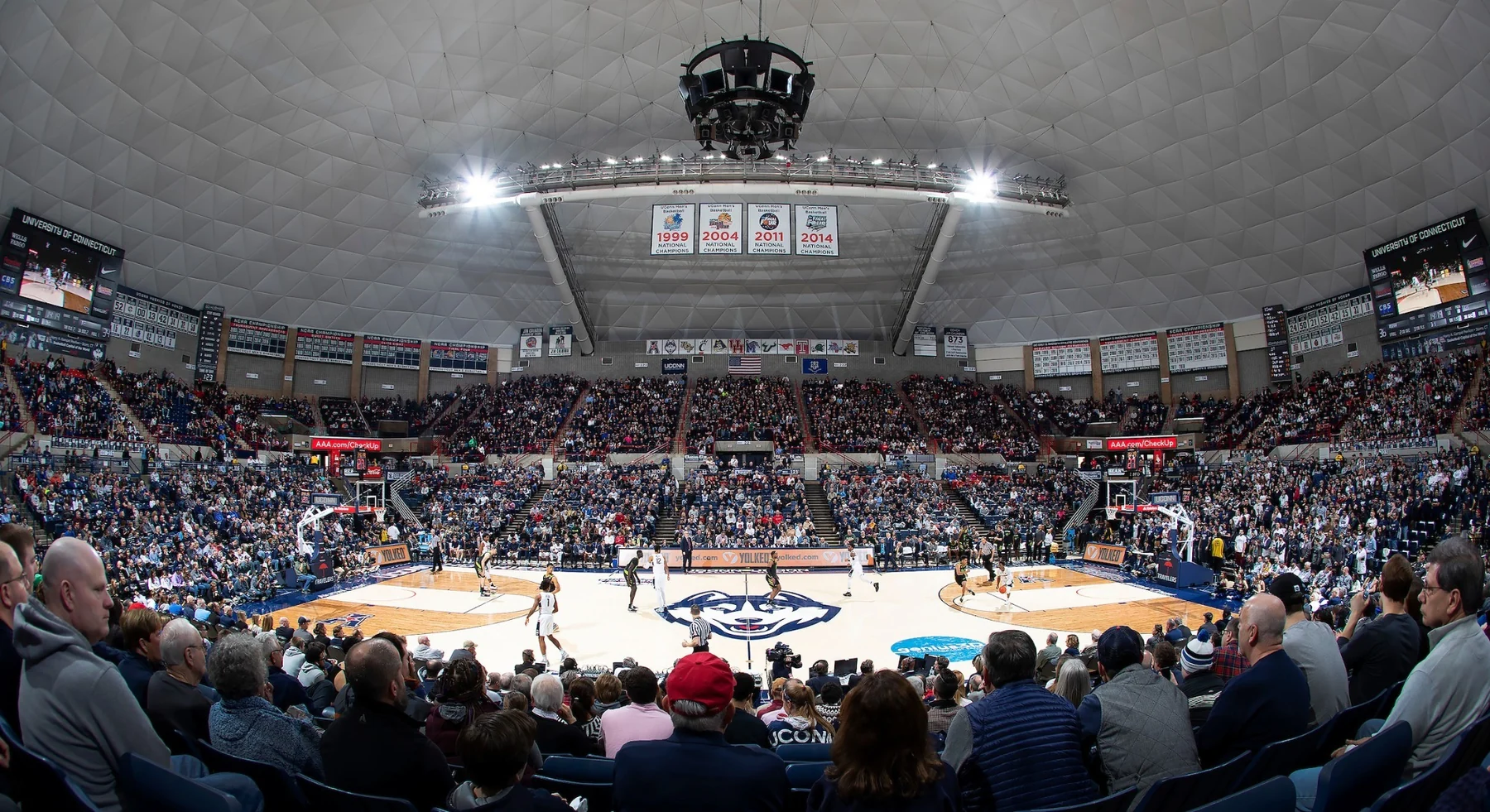
After identifying the building, use the men's basketball visitor page for entrances, campus access and event instructions. Duke's Cameron Indoor Stadium has its own school-provided facility and game-day information, for example. A general university address or an old guide for a different sport does not establish the details for your basketball ticket. Check the information for the event you will attend.
Build travel around the announced tip
Keep the date and time zone together when comparing games. A local tip time viewed from another region is not automatically the time displayed on your phone's calendar. Recheck an announced time before committing to a tight connection, and leave room for arrival and getting into the venue. If two games appear possible on the same day, verify the real route and schedule rather than estimating from adjacent state tiles.
The games today page and weekly schedule help you narrow the choices. The TV schedule supplies another way to follow a game when attending would make the trip impractical. Whether you go to one arena or build a longer visit, anchor the plan in the particular event. Shared geography makes a possibility worth exploring; the verified venue and timetable make it a workable basketball evening.
Keep the state list tied to the correct season
A campus location can stay fixed while the basketball classification changes. That is why an older map should not be treated as a current membership list merely because its place names remain recognizable. Start with the academic year and sport, then check what changed. A new institution entry, a reclassification, a conference move and an arena rename are separate developments with different effects on the state index.
Saint Francis University in Pennsylvania provides a specific 2026–27 example. The university announced its planned shift from Division I in March 2025, with the move beginning in the 2026–27 academic year. Its official transition material describes Division III reclassification, and the NCAA's current sponsored-sports entry lists men's basketball in Division III. That is a change in the basketball population, not a move of the school out of Loretto or out of Pennsylvania.
Read the sport row alongside the institutional transition label rather than assuming every field on a directory page means the process is complete. A university can be in a reclassification stage while its current competition is described under the destination division. The practical lesson for a fan is to use the current basketball listing and season-specific school announcement together. An old Division I opponent list is not enough to settle the new season's classification.
An arena rename has a different effect. UConn's October 2026 announcement changes the name associated with its campus basketball home; it does not create another university for Connecticut's total. A conference change likewise belongs in the affiliation view without moving the school's state entry. Keeping those layers separate prevents a location guide from acquiring an extra team every time a familiar school appears under a new label.
When returning to the map, preserve the full season and checking date beside the count. Use the team directory for the next scheduled game and the conference directory for current league context. If the question is about a particular championship, check that competition's eligibility and selection information independently. The state index tells you where the scoped programs are based; the season's basketball decides what they accomplish.
Sign in with Google to join the discussion.