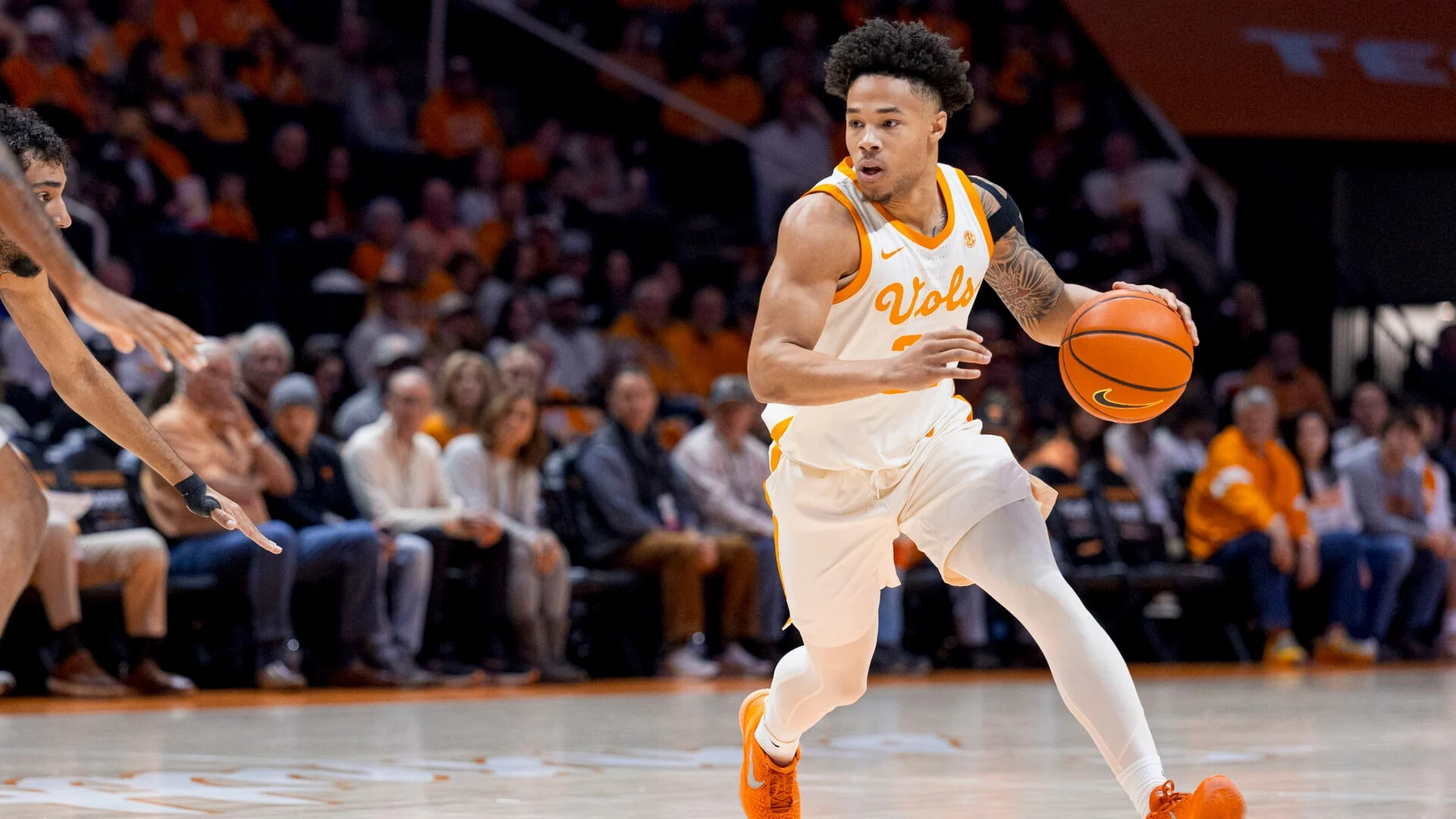
Tennessee's season opener and exhibitions serve different purposes
Tennessee opens its 2026–27 men's basketball regular season against Wofford on November 3 at Food City Center. The school's finalized listing has a 6 p.m. Eastern start on SEC Network. The Volunteers begin SEC play against Vanderbilt on January 2. Those two opening dates frame a schedule that includes significant home games, a Las Vegas event and December changes of venue.
This is the Tennessee Volunteers men's schedule in Knoxville. A search for “UT basketball” can also lead to Texas, and the Lady Vols have a separate schedule. Before using a fixture or television result, check the team, opponent and building together. That small distinction prevents a surprising number of missed appointments.
For the complete changing list, use the Tennessee team schedule. The analysis here focuses on how the major stretches connect and what they reveal about a Rick Barnes team. It is a companion to the fixtures, with all times identified as Eastern unless a local conversion is explicitly provided.
Wofford starts the record that counts
The preseason contains two separate events: a home exhibition against Xavier on October 15 and an October 20 exhibition at Duke. Tennessee lost the Xavier game 86–70. That is a real result from an exhibition, not a defeat to add to the regular-season record. At this guide's October 20 research cutoff, the Duke game should still be treated as the scheduled exhibition, not assigned a result in advance.
Exhibitions can be informative without carrying the same meaning as the opener. A coach can leave a new combination on the floor to learn how it responds, even if another lineup might offer a better immediate answer. A fan should watch the handling of pressure, the communication after a defensive switch and the response to a mistake. Those details can carry forward even when the score belongs to a different category.
Wofford begins the competitive record that the rest of the season builds on. The opening home stretch gives Tennessee a chance to establish a reliable first action and a coherent bench plan. Watch how the team creates a useful shot when its initial option is denied, and whether defensive possessions end with a rebound. A comfortable margin alone cannot tell you whether those habits are in place.
Keep exhibition, nonconference and SEC games labeled separately on your own calendar. It makes both the viewing plan and the later discussion of Tennessee's record more accurate.
Michigan State and Florida State bring major tests to Knoxville
Two nonconference dates give Knoxville supporters particularly clear reference points: Michigan State visits November 17 and Florida State arrives December 1. The current listings place both on ESPN2, with a 9 p.m. Eastern start against Michigan State and a 7 p.m. Eastern tip against Florida State. Neither requires a neutral-site ticket or a trip to the opponent's campus.
Their positions on the calendar differ. Michigan State comes during the opening run of home games, before Coastal Carolina on November 20 and the departure into the Thanksgiving event. Florida State follows the Las Vegas games and forms Tennessee's SEC/ACC Challenge assignment. The same building therefore hosts two tests under different preparation conditions.
Against Michigan State, the useful question is whether the opening home dates have created a stable way to attack a set defense. Tennessee needs to move from an initial action into the next choice without using the entire possession to recover its spacing. A difficult made jumper can win a possession while concealing a process that is harder to repeat. Watch the quality of the available attempts as well as the points.
Defensive rebounding is another lens that travels across opponents. When Tennessee forces a miss, does it end the possession cleanly, or does a second chance erase the value of the initial defense? The responsibility is shared: the player nearest the ball is not always the one whose missed assignment created the opening. Watching the action before the rebound produces a better assessment than counting one player's total alone.
Florida State presents a different schedule question because Tennessee will have just spent Thanksgiving dealing with changing opponents. The challenge is to arrive home with the same clarity rather than treating a return to Knoxville as an automatic reset. Barnes may have new information about the bench, guard combinations or defensive coverages from the event. Look for which adjustments appear in the next home game.
For a fan choosing limited dates to attend, these two games offer a useful pair. You can watch the team before and after its first major neutral-site sequence without changing venues yourself. They also separate a late evening appointment from an earlier one, a practical difference when planning transport, dinner or work the following morning.
No October guide can guarantee the eventual postseason value of either opponent. Their records and performance will develop during the season. The immediate attraction is concrete: two recognizable programs at Food City Center, at useful points for judging whether Tennessee's possession habits are becoming more consistent.
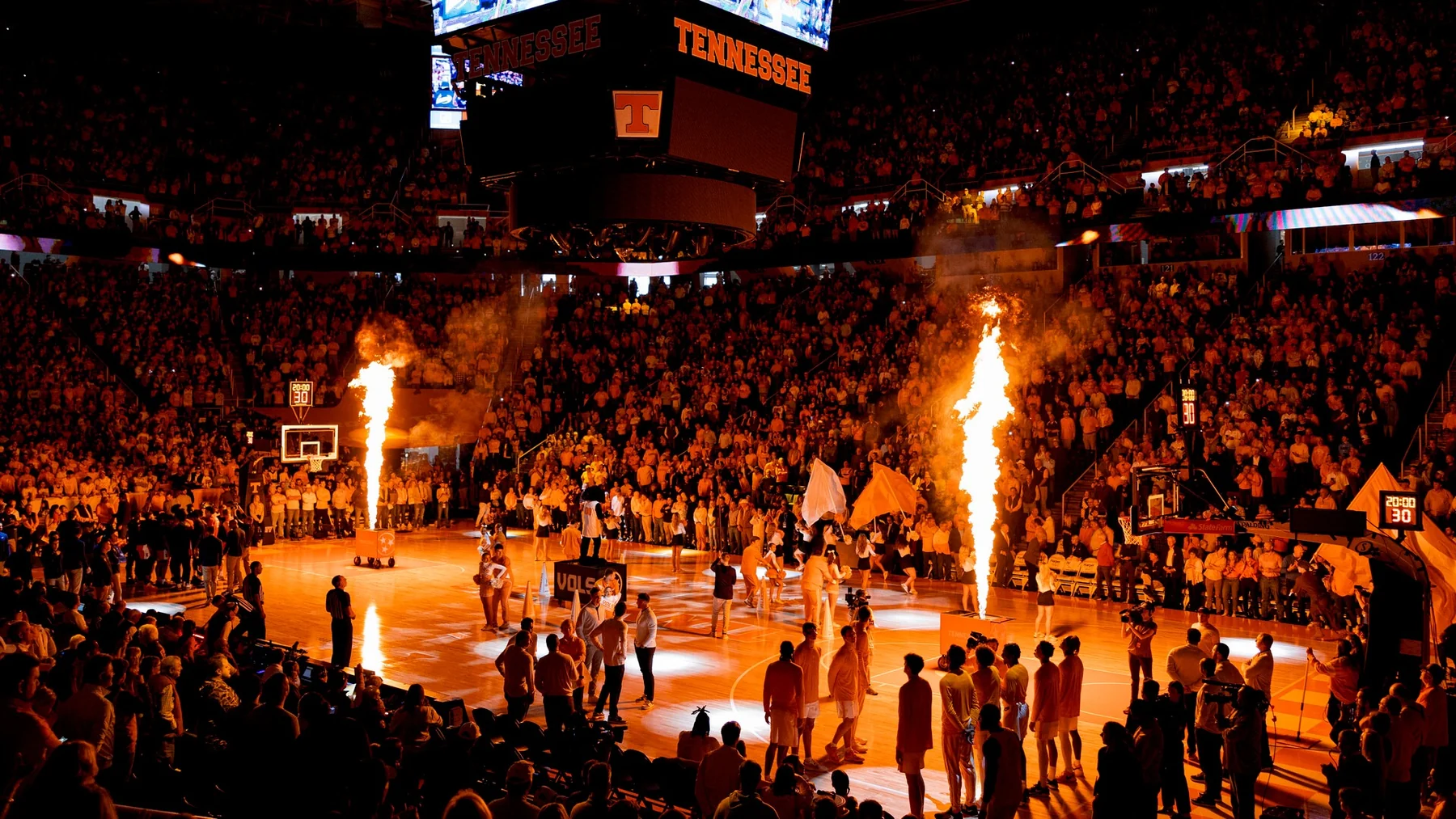
The Players Era bracket requires a flexible Thanksgiving plan
Tennessee's Las Vegas event is the part of the schedule where a single fixed calendar entry is least useful. The Volunteers enter the Players Era Men's Championship on November 24, with later opponents and times shaped by results. The school lists Michelob ULTRA Arena for Tennessee's games, so do not assume a ticket for another Las Vegas basketball building is the right one.
Maryland is fixed, later opponents depend on results
Maryland is the confirmed November 24 opponent, at 3 p.m. Eastern on ESPN. That is noon in Las Vegas. Tennessee's November 26 opponent will be Iowa State or San Diego State. The school explains that the winner's-bracket slot is 1:30 p.m. Eastern and the consolation slot is 9 p.m. Eastern. Those are 10:30 a.m. and 6 p.m. local starts.
The November 27 game also depends on the developing bracket. Keep the opponent and precise tip open until the event resolves them. There is a further conditional possibility: Tennessee's nonconference announcement says a team winning its first three games advances to a fourth game on November 28 against the unbeaten team from the other bracket. That fourth date is a possibility to accommodate, not a guaranteed Tennessee fixture.
For travel, this means your booking decision and your basketball prediction should be separate. If you want to be available for the entire possible run, allow for the conditional final. If you are attending only one session, verify the arena, day and session attached to the ticket. A tournament name alone does not establish what that admission covers.
Short preparation makes the bench important
The basketball attraction is the changing preparation problem. A team cannot spend the same amount of practice time rehearsing every possible opponent. It needs actions that remain usable when the next defense has a different shape. Watch how Tennessee reaches its second option after the first pass or ball screen is stopped.
The bench has a practical role in that environment. Useful reserve minutes preserve defensive assignments and the quality of the next offensive possession. They are not simply a way to rest a scorer. If a lineup change causes repeated confusion about who handles the ball or who rebounds after help defense, the opponent can benefit even without forcing an obvious individual mismatch.
Keep the evaluation tied to possessions rather than assuming every late miss reflects travel or fatigue. Shot selection, opponent coverage and the available lineup are competing explanations. The event can show Tennessee's adaptability, but its final record still needs to be read alongside the actual opponents and the bracket route the Volunteers took.
December switches from Knoxville to Nashville to Purdue
The December 1 Florida State game begins a run of three substantially different settings. Tennessee then faces NC State at Bridgestone Arena in Nashville on December 6 and travels to Purdue on December 11. A home game, an in-state neutral event and a true road date should be understood as different tests, even though all appear close together on the same schedule.
A neutral game and a true road game ask different questions
The NC State meeting is listed for 7 p.m. Eastern on ESPN. Nashville is in the Central time zone, so an attending fan should plan for a 6 p.m. local tip. The game is part of The Bad Boy Mowers Series, not an extra Food City Center date. Its ticketing, arrival route and arena instructions belong to that event.
A regional neutral game can attract plenty of Tennessee support without reproducing the team's normal home environment. The building, routines and sight lines differ. The basketball question is how the Volunteers establish an organized start before the crowd gives them any momentum. A useful first possession does not have to score, but it should reveal that the players know where the next option is.
Purdue is a different assignment because Tennessee visits West Lafayette. The current listing is 8 p.m. Eastern on FOX. There is no one-hour local conversion to apply there. For remote viewers, this also means changing networks from the ESPN route used for the Nashville game. Check your access before the evening starts rather than discovering the switch at tipoff.
The road setting makes communication particularly interesting. Watch the response to an opposing run: does Tennessee continue to reach a good shot, or does it speed into a difficult attempt before the offense is arranged? At the other end, a completed defensive possession requires the rebound as well as the initial stop. These details show whether the team's structure survives an uncomfortable stretch.
Each of the three games is five calendar days after the previous one. That provides more space than consecutive tournament dates, but it does not guarantee four full practice days between games. The public calendar cannot tell you exactly how Barnes divides recovery, travel and preparation. Use the interval as context, not as an automatic explanation for performance.
Tennessee returns home for Morehead State on December 16 and Marist on December 20 before the December 29 nonconference finale against Norfolk State. The early-December sequence therefore offers a concentrated chance to compare the same team across three environments, then watch which lessons appear when the Volunteers return to their home routine.
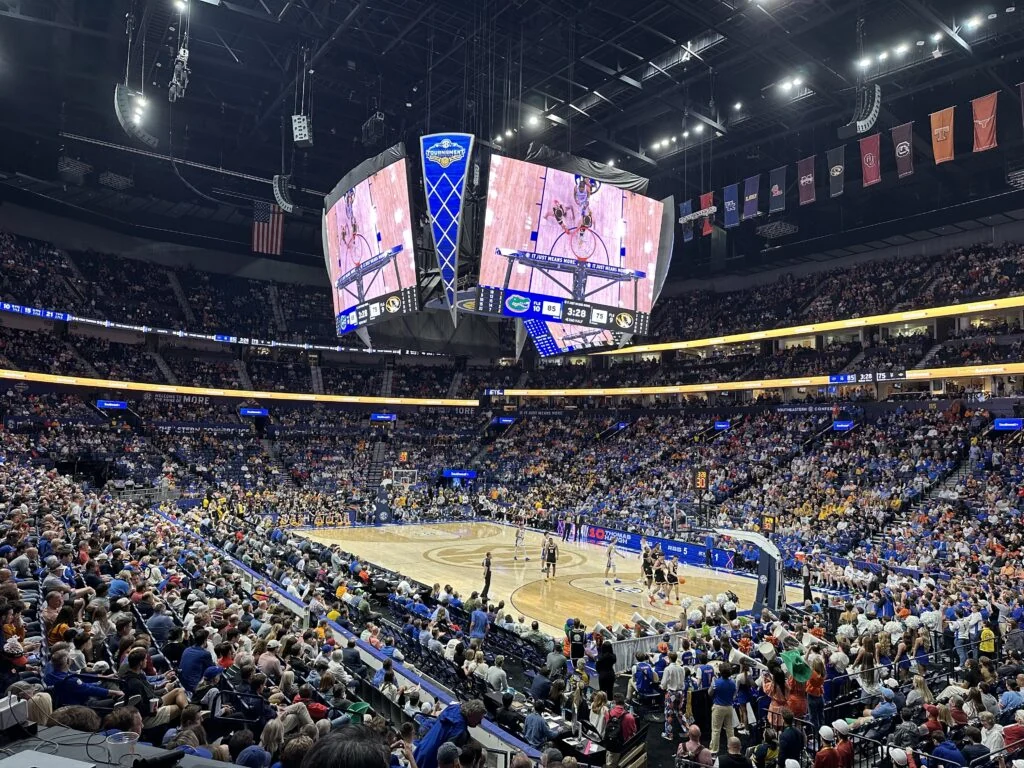
The SEC schedule turns quickly from rivalries to road work
Tennessee's conference season begins January 2 and ends March 6 on the current finalized slate. The opening does not provide an extended home runway: after Vanderbilt visits, the Volunteers play at Auburn on January 6 and at LSU on January 9. The first three league results therefore come from two different conditions, with more away games than home games.
Vanderbilt opens and closes the league slate
The Vanderbilt pairing bookends the conference schedule, with the January 2 meeting in Knoxville and the March 6 finale in Nashville. These are league games, distinct from the December NC State neutral event at Bridgestone Arena. Do not turn the word “Nashville” into a venue assumption: an away game at Vanderbilt and a separate showcase require different event details.
The early Auburn-LSU trip is useful for judging how Tennessee responds when its home rhythm is interrupted. Track whether the guards still begin actions promptly, whether help defense creates manageable next assignments and whether the team finishes stops with rebounds. A road margin alone cannot identify which of those pieces failed or held up.
There is a larger interval between the January 16 Arkansas home game and January 23 trip to Kentucky. Read that gap alongside the denser weeks instead of treating the entire SEC schedule as one unchanging grind. A larger calendar interval offers different preparation possibilities, but the exact practice plan remains a coaching decision.
Kentucky twice and the February road sequence
Tennessee visits Kentucky on January 23 and hosts the return game on February 13. Those two settings allow a more specific comparison than simply asking which rival looks better in October. Look for how each team reacts to the first meeting: a different defensive assignment, a changed ball-screen response or a new source of initiation can reshape the next game.
The February stretch also sends Tennessee to Missouri on February 6 and Oklahoma on February 10 before the Kentucky home date. Later come trips to Ole Miss on February 17 and Texas on February 27. These away games place repeated demands on communication, while the home dates against Kentucky, Alabama and South Carolina offer contrasting conditions within the same month.
The current schedule still leaves alternatives on a few entries. Florida on January 30 has an 8 or 8:30 p.m. Eastern listing, and the Texas trip has a 6 or 6:30 p.m. Eastern option. Preserve those alternatives until a final update selects one. A television guide should help fans avoid missing a start, not create precision that the source has not supplied.
Conference position and postseason stakes will become clearer as results arrive. For now, the most useful plan is to watch selected home-away pairs and compare the actual adjustments, keeping opponent quality and venue distribution attached to any judgment about Tennessee's record.
TV, time zones and tickets for following the Vols
The finalized Tennessee announcement uses Eastern time throughout. That is convenient for Knoxville viewers, but it needs interpretation when you attend a game in another zone. Nashville is one hour behind Knoxville; Las Vegas is three hours behind. A time printed on a school schedule and a local arena's event clock may therefore look different without describing different appointments.
Always check which game a time belongs to, too. The Nashville showcase is a doubleheader, so its event-start time can refer to the first matchup rather than Tennessee's. The school currently lists the NC State game at 7 p.m. Eastern. The arena page has displayed a different time-zone label, so confirm the school's game time and the event's current session instructions near December 6 before finalizing your arrival.
Television access changes across the schedule. Much of the regular season uses ESPN-family channels, while the December Purdue trip is on FOX and the Duke exhibition is listed on ACC Network. Several home games use SEC Network+. The college basketball TV schedule is a useful companion when the event moves away from the channel you used last time.
A slash or “or” between channels is a choice awaiting selection, not an instruction to watch all of them. Preserve the alternatives until the listing narrows. Likewise, SEC Network+ is a digital event label, distinct from the linear SEC Network channel. Check the actual event and your access in the ESPN service. Avoid buying a subscription solely because its name sounds similar to the listing.
For attending fans, start with the correct building. Food City Center home dates, the Las Vegas event, the Nashville neutral game and the road trip to Purdue have different arrival and ticket details. The January and March Vanderbilt meetings are home-and-away league games, with the latter at Vanderbilt's Memorial Gymnasium. They should not be confused with the Bridgestone showcase.
Before leaving, review the date, local tip, arena, session and mobile-ticket instructions together. A tournament pass and a single-session ticket may provide different access. An event headline may include more games than the admission you purchased. Use the venue and ticket seller's current terms rather than assuming your usual Tennessee home-game routine transfers automatically.
Then keep the schedule flexible where the source remains flexible. Las Vegas has conditional opponents and a possible additional final; a few SEC games retain network or time alternatives. Marking those uncertainties now makes the later update easier. The confirmed dates already provide a strong viewing plan: compare Tennessee before and after Thanksgiving, watch the December venue changes, and use the SEC home-away pairs to judge how the team's habits develop.
Sign in with Google to join the discussion.