Florida leads the official 2026–27 SEC men's basketball preseason media poll, followed by Texas, Arkansas, Tennessee and Alabama. Released October 12, the order gives fans a current answer to the ranking question before the regular season begins. It predicts conference finish; it is not an AP national poll or a table of games already played.
This guide uses information checked through October 14, 2026. After the full sixteen-team order, it examines the returning production, transfers and basketball connections behind the leading expectations. The analysis identifies questions to watch rather than presenting future scores, lineups or final standings as facts.
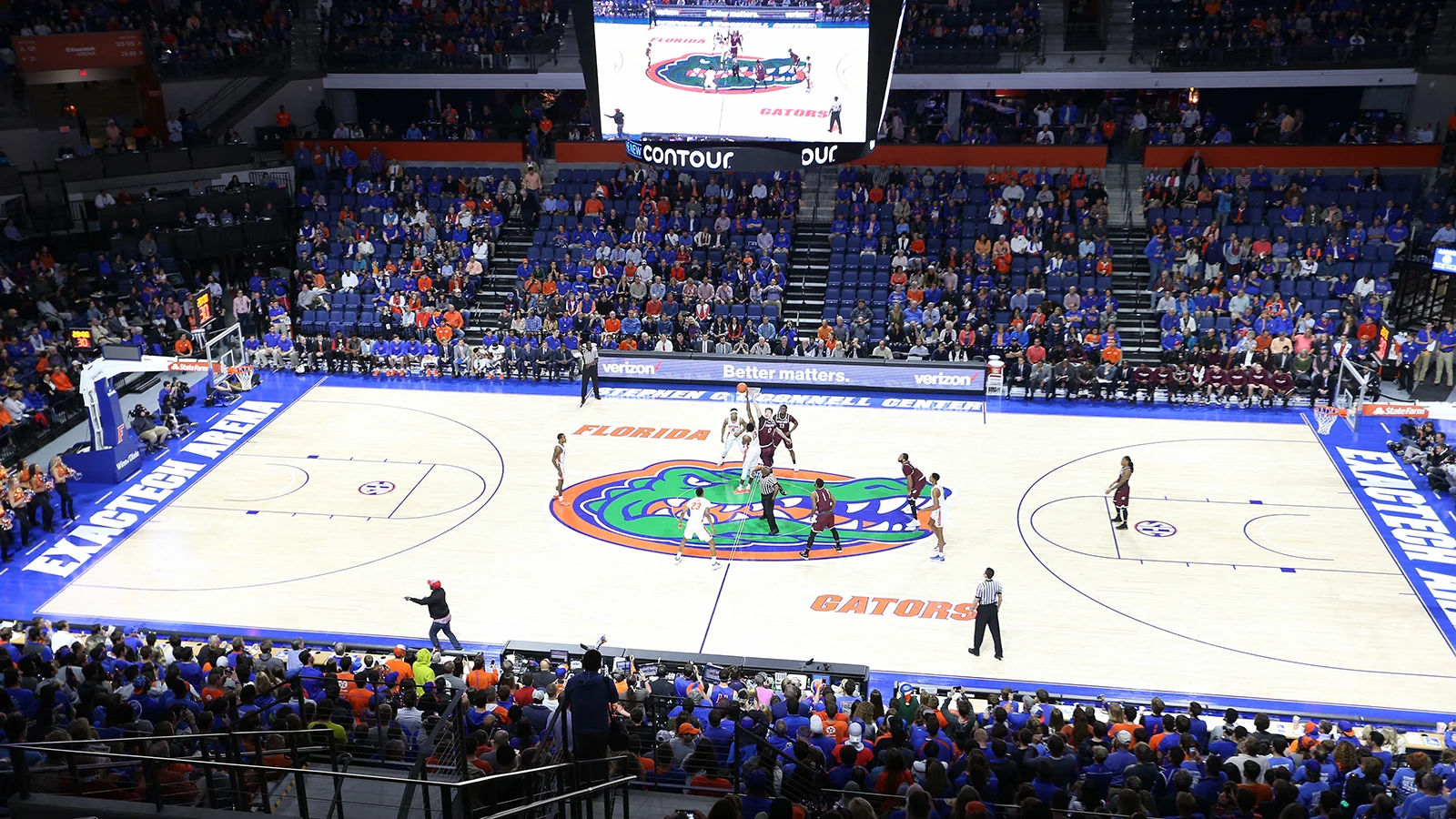
The cover shows an archived tipoff at Florida's Stephen C. O'Connell Center from the university's facility gallery. It illustrates the favorite's home arena, not a game in the upcoming season. The two player photographs below also show separately identified historical matchups.
The official 2026–27 SEC men's preseason order
Florida is the favorite in the SEC men's basketball preseason media poll released on October 12, 2026. Texas is second, followed by Arkansas, Tennessee and Alabama. The Texas announcement identifies the voters as a select panel of SEC and national media members. This is the published predicted order of conference finish, rather than a personal ranking created for this article.
| Media preseason position | SEC men's team |
|---|---|
| 1 | Florida |
| 2 | Texas |
| 3 | Arkansas |
| 4 | Tennessee |
| 5 | Alabama |
| 6 | Vanderbilt |
| 7 | Kentucky |
| 8 | Missouri |
| 9 | Texas A&M |
| 10 | Auburn |
| 11 | Georgia |
| 12 | Oklahoma |
| 13 | Ole Miss |
| 14 | LSU |
| 15 | Mississippi State |
| 16 | South Carolina |
The order is also reproduced in Oklahoma's October 12 report. Use the season and sport together when checking it. An October 2025 men's poll describes the previous season, while the SEC's football and women's basketball predictions are separate votes. A search result that simply says “SEC preseason rankings” can lead to any of those lists.
The table does not provide a probability of winning the league, a projected conference record or an NCAA Tournament seed. Consecutive positions establish an order, without establishing the size of the perceived gap. Texas being second and Arkansas third does not tell us that their teams are separated by a measurable number of points per possession.
It is also different from the national AP Top 25 and from NET rankings. The media are anticipating a conference race before regular-season results exist. National polls compare programs across conferences, while other evaluation systems use their own definitions and inputs. Our rankings explainer covers those distinctions.
The analysis below uses official roster information and completed performances checked through October 14. Its basketball judgments are interpretation, not explanations supplied by every voter. The useful next step is to identify which possessions could justify these expectations and which new evidence could overturn them. A preseason position gives supporters a starting question; it does not resolve the games that answer it.
Why Florida starts as the favorite
Florida's most concrete advantage is continuity across important roles. The school's September retention report says the Gators return 11 players, including four starters, and 81.8 percent of their 2025–26 scoring. That previous team finished 27–8 overall and 16–2 in the SEC. These are completed-season measures, rather than a projected record for the current group.
Thomas Haugh, Alex Condon, Boogie Fland and Rueben Chinyelu all appear on the current official roster. The retention report records Haugh's 17.1 points per game, Condon's 15.1, Fland's 11.6 and Chinyelu's 10.9. Chinyelu also averaged 11.2 rebounds. The numbers establish that Florida retains substantial production near the basket and from its lead contributors; they do not automatically add up to a future scoring average.
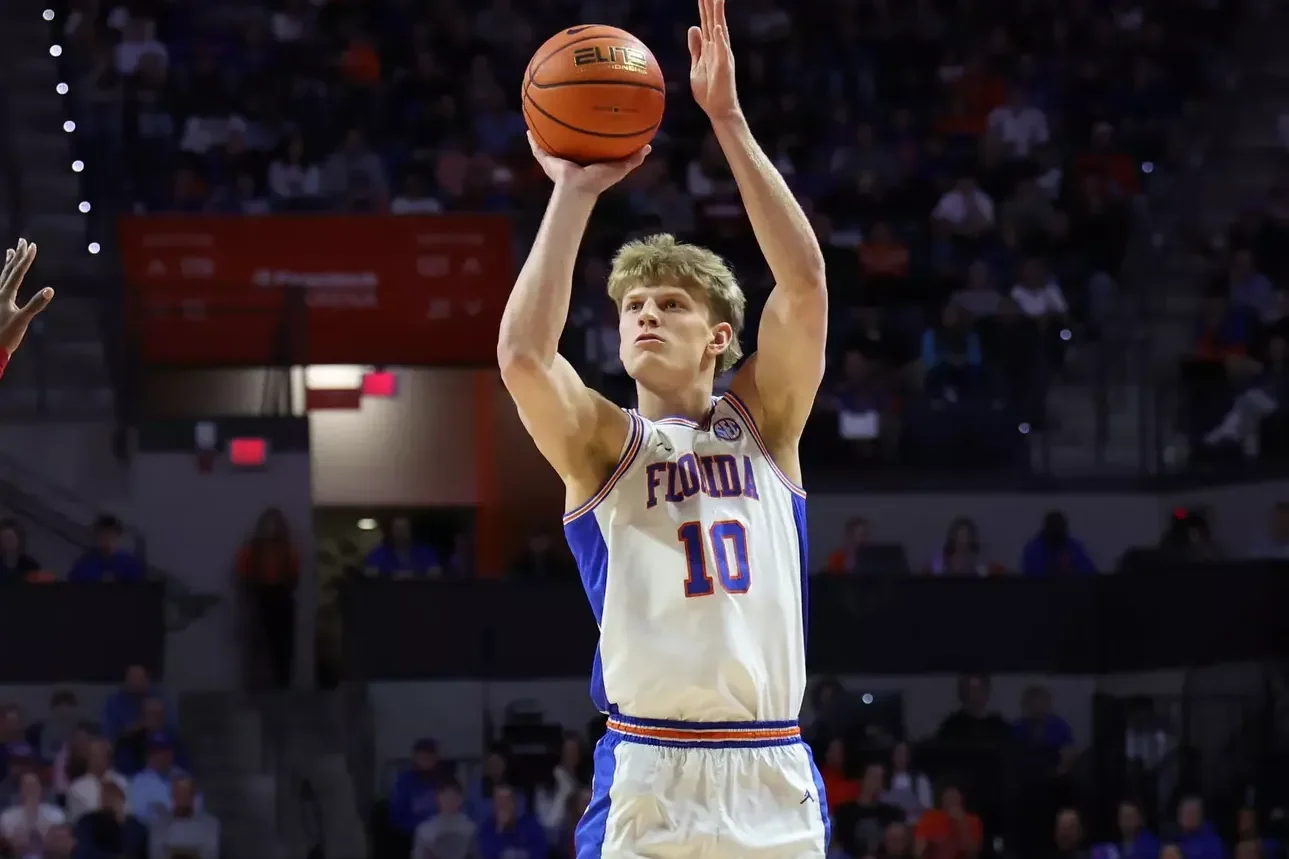
The October 12 awards announcement places Haugh and Chinyelu on the media's preseason first team and Condon on its second team. Haugh is the preseason choice for conference Player of the Year. Those selections reinforce the level of expectation; the award has not already been won for the coming season.
Continuity can help an offense reach its useful options earlier. A guard and screener who recognize each other's timing can begin a second action before the defense completes its recovery. A rebound secured by the center can release the ball handler without requiring another teammate to stay behind and collect it. These are reasons to investigate Florida's returning combinations, rather than simply count familiar names.
The main caution has a measurable foundation. Florida's preseason primer records 32.1 percent team three-point shooting in 2025–26, with Haugh at 32.6 percent. It also notes that the season ended in a second-round NCAA loss to Iowa. The Gators won the national championship in 2025; they did not win the 2026 tournament.
If opponents can help inside without consistently surrendering an effective outside option, returning size alone will not solve every half-court possession. Watch the quality of the kick-out pass, the receiver's readiness and the next action after a defender closes out. Improved spacing should create useful decisions even on a night when some open shots miss.
That makes Florida a sensible starting favorite without making the SEC race a foregone conclusion. Its evidence is unusually substantial for October, but November still has to test whether the familiar group handles new defenses and completes the possessions that end close games. The best case for retaining first place is visible execution across several opponents, not the repetition of a preseason accolade.
Texas and Arkansas offer different challenges
The poll places Texas second and Arkansas third, but their strongest arguments are not identical. Texas can build around a center with a completed season in its system and a new frontcourt partner with demonstrated production elsewhere. Arkansas combines a returning wing's growth with a substantial freshman group. In each case, the individual evidence is more useful than the assumption that assembling talented players settles how they will play together.
Texas combines a returning center with a new frontcourt partner
Matas Vokietaitis's biography records 15.6 points and 7.1 rebounds per game with starts in all 36 Texas games in 2025–26. Against BYU in the NCAA first round, he produced 23 points and 16 rebounds, nine on the offensive glass. That specific performance demonstrates a way he can create scoring opportunities beyond the first shot.
David Punch joins from TCU, where his 2025–26 averages were 14.1 points and 6.8 rebounds, with 66 blocks across 34 games. Those numbers belong to the Horned Frogs. They should not be presented as Texas production or simply added to Vokietaitis's totals to predict the new team's offense.
The pairing creates a practical spacing question. Can Punch make an effective next decision when the ball arrives away from the center's scoring area? Can a guard deliver the pass before the help defender settles between both players? An offensive rebound can rescue a missed shot, but it should not be the only answer to an initial possession without movement.
On defense, the relevant test is coordination rather than the combined block total. If one big helps toward a drive, the other players must account for the released receiver and the rebound. A blocked attempt does not finish the possession if the opponent collects the loose ball. Texas's second-place expectation will gain substance when those responsibilities work together across different opponents.
Arkansas mixes returning production with a freshman core
The Arkansas announcement records Billy Richmond III's return after averaging 11.2 points in 2025–26 and earning SEC All-Defensive recognition. It also reports Jordan Smith Jr.'s summer triple-double against Carleton University: 20 points, 11 rebounds and 11 assists. That was a Baha Mar Summer League performance, not an NCAA regular-season result.
Smith joins Miikka Muurinen, JJ Andrews and Abdou Toure in the freshman group identified on the current Razorbacks roster. Richmond supplies experience, but the younger players still have to recognize the next action in a new competitive setting. Summer success offers evidence of skills without settling how readily the same reads will appear against SEC defenses.
Watch how quickly the group turns an initial advantage into a second one. A drive that moves the first defender should lead to a timely pass or finish, rather than a pause that allows the defense to recover. Richmond's returning responsibilities and Smith's passing offer reasons to examine that process. The poll's third-place selection will be supported by repeated execution, not by treating a freshman's reputation as a completed college season.
The next group has several ways to move up
Tennessee, Alabama, Vanderbilt and Kentucky occupy positions four through seven. Reading those places as a single ladder of talent misses the different problems each team must solve. Some of their most persuasive evidence comes from a returning player's completed SEC season; other evidence belongs to a transfer's previous conference. Both can inform expectations, provided the comparison keeps that distinction visible.
Tennessee and Alabama must connect new pieces
Tennessee's first-team selection Juke Harris averaged 21.4 points and 6.5 rebounds at Wake Forest in 2025–26. He is the only newcomer on the five-player preseason first team. That distinction expresses confidence in what can travel with him; it does not mean he has already produced those averages against Tennessee's new schedule.
For the Volunteers, watch what happens when Harris attracts a second defender. An early pass can let a teammate attack an unsettled defense; a delayed pass can leave that teammate facing a reset possession. The same scorer can look very different depending on those connections. Defensive possessions matter too: getting a stop requires everyone to finish the rotation and locate a rebounder, rather than relying on an individual reputation.
Alabama's Amari Allen enters as a sophomore after averaging 11.4 points, 6.9 rebounds and 3.1 assists as a freshman. His second-team recognition gives the fifth-place pick a returning player whose contributions extend beyond scoring. Those rebounds and passes suggest useful ways to influence a game when his own shot is not falling.
The next question is whether Alabama turns those individual contributions into reliable sequences. A defensive rebound can begin an advantageous attack, but a careless first pass can erase it. An assist can produce a good shot without explaining whether the same decision works when a defender switches or denies the first receiver. Fans should examine repeatable choices across possessions, including the less visible work of covering space after an offensive mistake.
Vanderbilt and Kentucky bring different creation questions
Tyler Tanner returns to Vanderbilt after averaging 19.5 points, 5.1 assists and 2.4 steals in 2025–26. His first-team selection and Vanderbilt's sixth-place position are different judgments: the panel can value a guard highly while still asking how an entire team will hold up over league play.
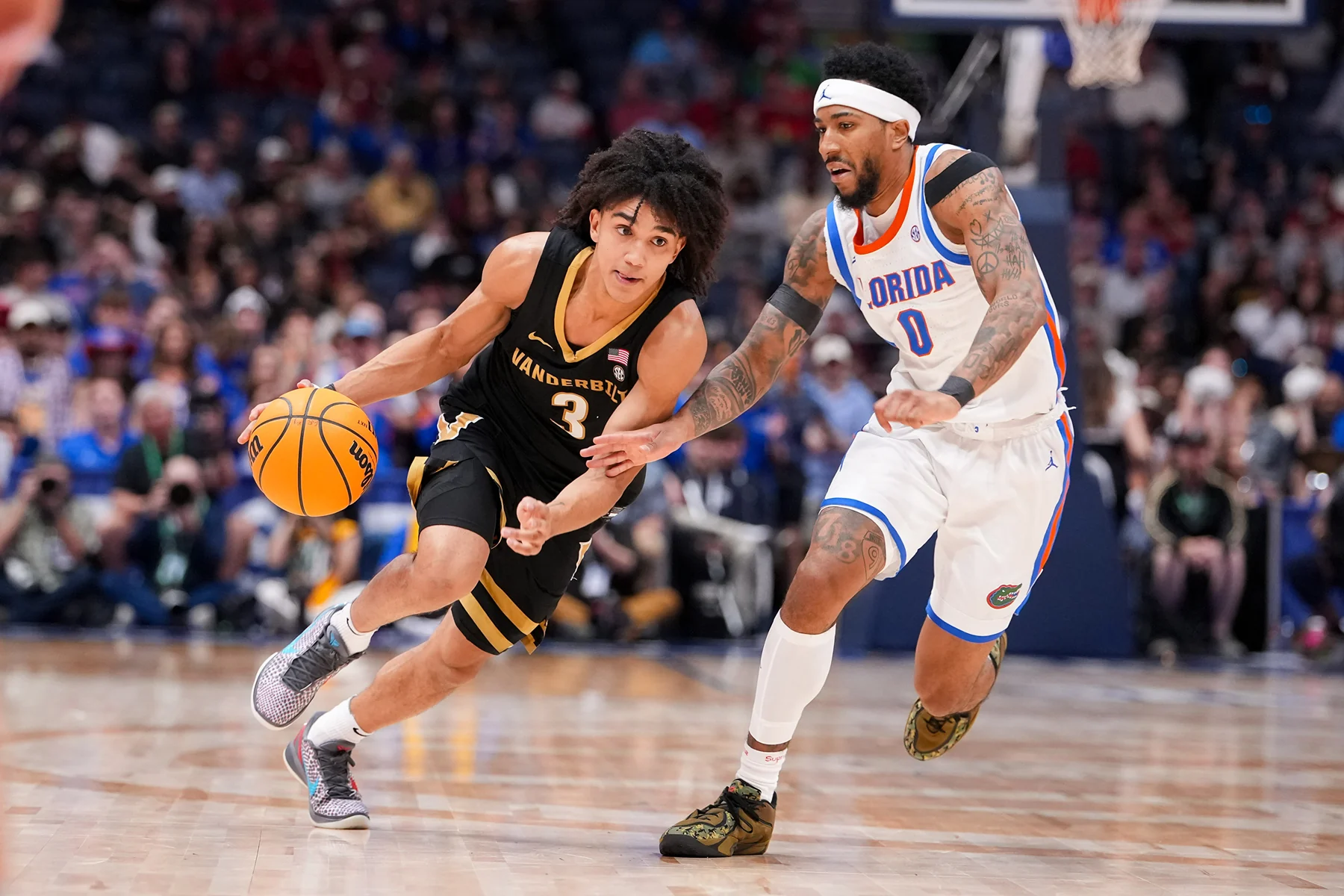
Tanner's creation raises a specific supporting question. When opponents make him release the ball, can the next receiver preserve the advantage instead of waiting for him to get it back? The answer affects both the quality of shots and the physical demand placed on one guard. A high individual scoring total can coexist with possessions that become harder to sustain late in a game.
Kentucky's Milan Momcilovic and Malachi Moreno offer a different combination. Momcilovic made 136 three-pointers at 48.7 percent for Iowa State last season. Moreno returns after 30 freshman starts at Kentucky, with 6.3 rebounds per game and 53 blocks. Those are completed records, not a forecast that either total will repeat.
A shooter can change where help defenders stand, potentially opening an interior catch or driving lane. The useful test is whether Kentucky actually creates those connected opportunities, including when opponents force the ball away from the preferred receiver. Moreno's defensive production also needs teammates to complete the possession after he contests. Seventh place leaves room for improvement, but shooting percentages and block totals alone do not establish the finished team.
Why the lower positions are less settled than they look
The second half of the order should not be treated as a list of teams without useful returning evidence. It expresses the panel's expectations relative to this particular league. A lower position neither eliminates a team's ability to win a difficult game nor explains the size of the perceived difference between adjacent places. The published order supplies positions, not a calibrated measure of that gap.
Oklahoma, picked twelfth, returns starters Xzayvier Brown and Derrion Reid. Brown averaged 15.4 points and 3.3 assists in 2025–26; Reid averaged 11.7 points and 4.4 rebounds. The Sooners also won 21 games and reached the College Basketball Crown final. That postseason event is distinct from the NCAA tournament.
Those returners provide an identifiable starting point for evaluating Oklahoma. Watch whether Brown can get the ball to a teammate while the defense is still moving, and whether the next action creates a shot without requiring him to restart the possession. Returning familiarity can help that process. It still has to coexist with enough stops and completed defensive possessions to change the team's results over a league schedule.
Mississippi State provides an even sharper separation between individual recognition and team expectation. Josh Hubbard made the preseason first team while the Bulldogs were picked fifteenth. The school's announcement records 1,947 career points and 311 career three-pointers entering 2026–27. Neither total is speculative new-season production.
An accomplished scorer can keep a difficult possession alive, but he cannot personally solve every transition defense, rebound or missed assignment. For Mississippi State, the useful issue is how the possessions around Hubbard's scoring develop. If an opponent denies his preferred catch, does someone else create an advantage? After a miss, does the team prevent an immediate return attack? Those questions explain why high individual expectations do not automatically translate into a high team prediction.
Fans of other lower-ranked teams should apply the same standard rather than assume a ranking has answered every roster question. Check actual availability and observed roles when games begin, and distinguish a listed player from a demonstrated rotation contribution. Do not turn an unsupported eligibility rumor into a settled explanation for a team's placement.
None of this calls for arbitrarily moving Oklahoma or Mississippi State above the official order. It calls for retaining uncertainty. Evidence of better possession quality across several opponents would justify revisiting an expectation; one impressive scoring night would establish much less. The preseason list is a useful baseline precisely because the games can test it.
The November evidence that should change the conversation
The upcoming schedule supplies opportunities to test these expectations before SEC standings exist. Florida's regular-season opener against Miami is November 2 in Tampa, at 6 p.m. Eastern on ESPN2. Its Players Era opener against Notre Dame follows November 17 in Las Vegas, with Houston or Rutgers listed for the next round. The latter opponent remains conditional.
Texas's November neutral-site tests include Baylor in San Antonio on November 15 and Georgetown in San Diego on November 26. The Georgetown game is listed for 11:30 a.m. Pacific, the same moment as 1:30 p.m. Central, on FS1. Saint Mary's or UCLA follows November 27; neither should be described as an already guaranteed Texas opponent.
Arkansas's announced calendar includes Virginia in Washington, D.C., on November 8, Indiana at Madison Square Garden on November 17, and Michigan State in Detroit on November 26. These games offer several settings in which its new group must operate away from Bud Walton Arena. They are upcoming opportunities, not wins already credited to the Razorbacks.
Compare the same basketball questions across opponents
Start with what happens after the first advantage. Florida's returning group can be judged on whether a drive, post catch or offensive rebound leads to an effective next action. Texas's new frontcourt combination can be examined through the spacing around an interior catch and the defensive response when one big helps. Arkansas's freshmen can be watched for how quickly they recognize the next pass when the initial scoring opportunity disappears.
Apply those questions consistently rather than reward the largest raw score. More possessions create more chances to score, commit turnovers and collect rebounds. A fast game and a slower game can therefore produce very different totals without proving that the larger total represents better execution. Where statistics are available, examine efficiency and opportunities alongside the final margin, then use the game action to understand how those numbers arose.
Keep a distinction between a missed open shot and a possession that never created a useful attempt. Both can end without points, but they identify different issues. Likewise, a defensive contest is incomplete if the opponent secures the rebound. Repeated live-ball turnovers, failed defensive recoveries or possessions rescued only by difficult individual shots deserve attention even during a comfortable win.
Opponent context remains essential. A decision that works against one defense may become harder against a different level of pressure or size. November observations should build a case across games, including responses to adjustments, rather than become a new definitive ranking after one night. Exhibitions can reveal choices and combinations while remaining separate from the regular-season record.
Use the games-today listing when planning viewing, and consult the rankings explainer before comparing different systems. The October media order gives fans a clear starting point. Connected offensive possessions, completed stops and verified availability will determine how much of that expectation survives the games.
Sign in with Google to join the discussion.