Michigan's 2026–27 basketball schedule opens against Oakland on November 2, brings a national championship rematch with UConn to Boston on November 6 and starts Big Ten play at Rutgers on December 9. The late-November Players Era tournament creates conditional opponents and can also remove the December 1 Mississippi Valley State game from the calendar.
This guide uses official information checked through October 14, 2026 to explain the tests behind those dates. The Wolverines defend the championship won in April, while Mike Boynton Jr. leads the current program and a new frontcourt works alongside returning guards. Confirmed results, exhibitions, future fixtures and basketball interpretation are kept distinct.
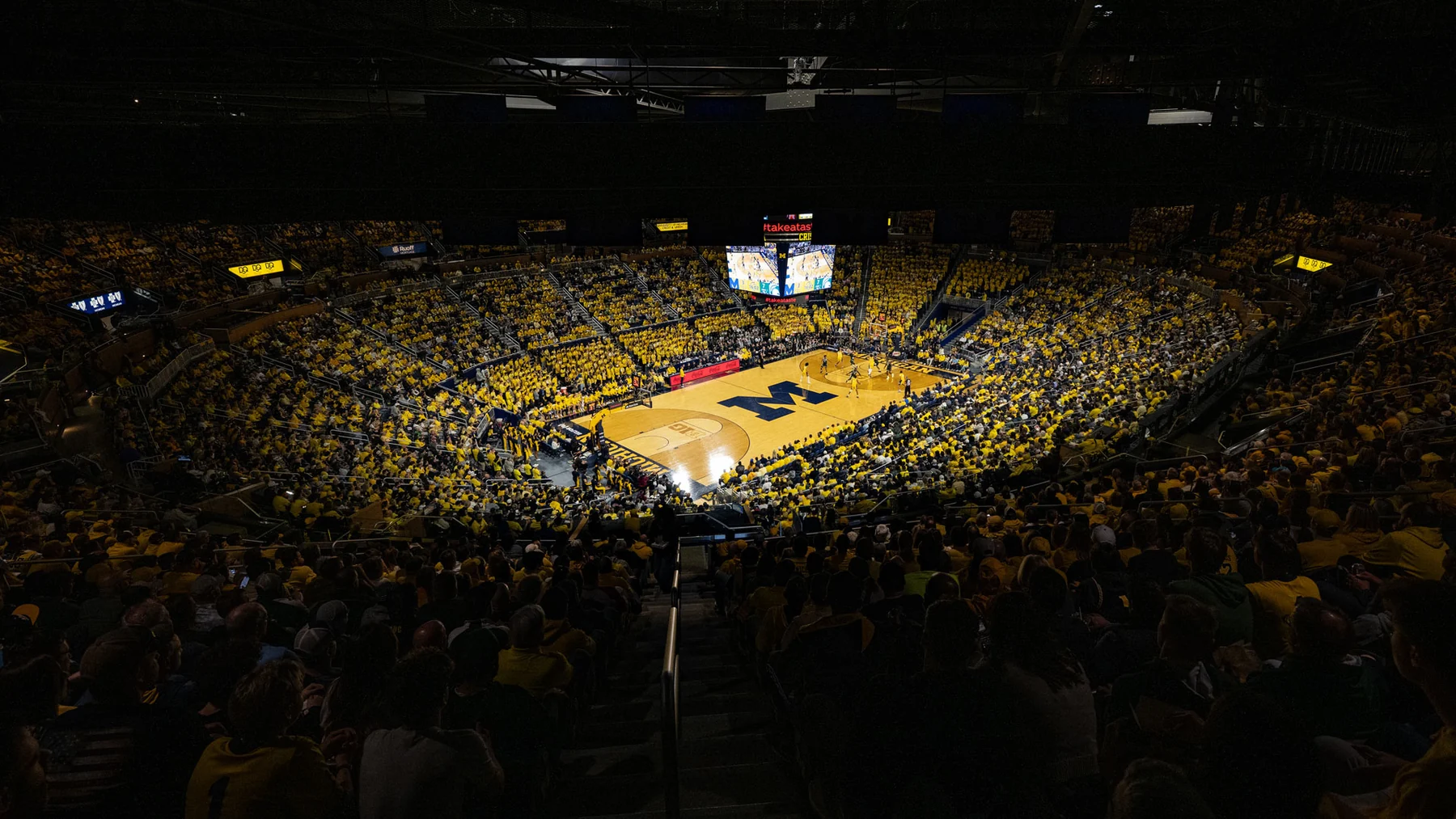
The cover is an archived Crisler Center crowd photograph from Michigan's March 2026 collection, used in its current venue guide. It shows the home building rather than an upcoming game. The championship celebration and October exhibition photographs below represent their separately identified events.
A new schedule begins after the 2026 championship
Michigan enters 2026–27 as the defending national champion, but its new schedule begins with a new record. The Wolverines beat UConn 69–63 at Lucas Oil Stadium on April 6, 2026, completing a 37–3 season. The official championship recap records the program's second NCAA title, following the 1989 championship. That achievement belongs to the completed 2025–26 team.
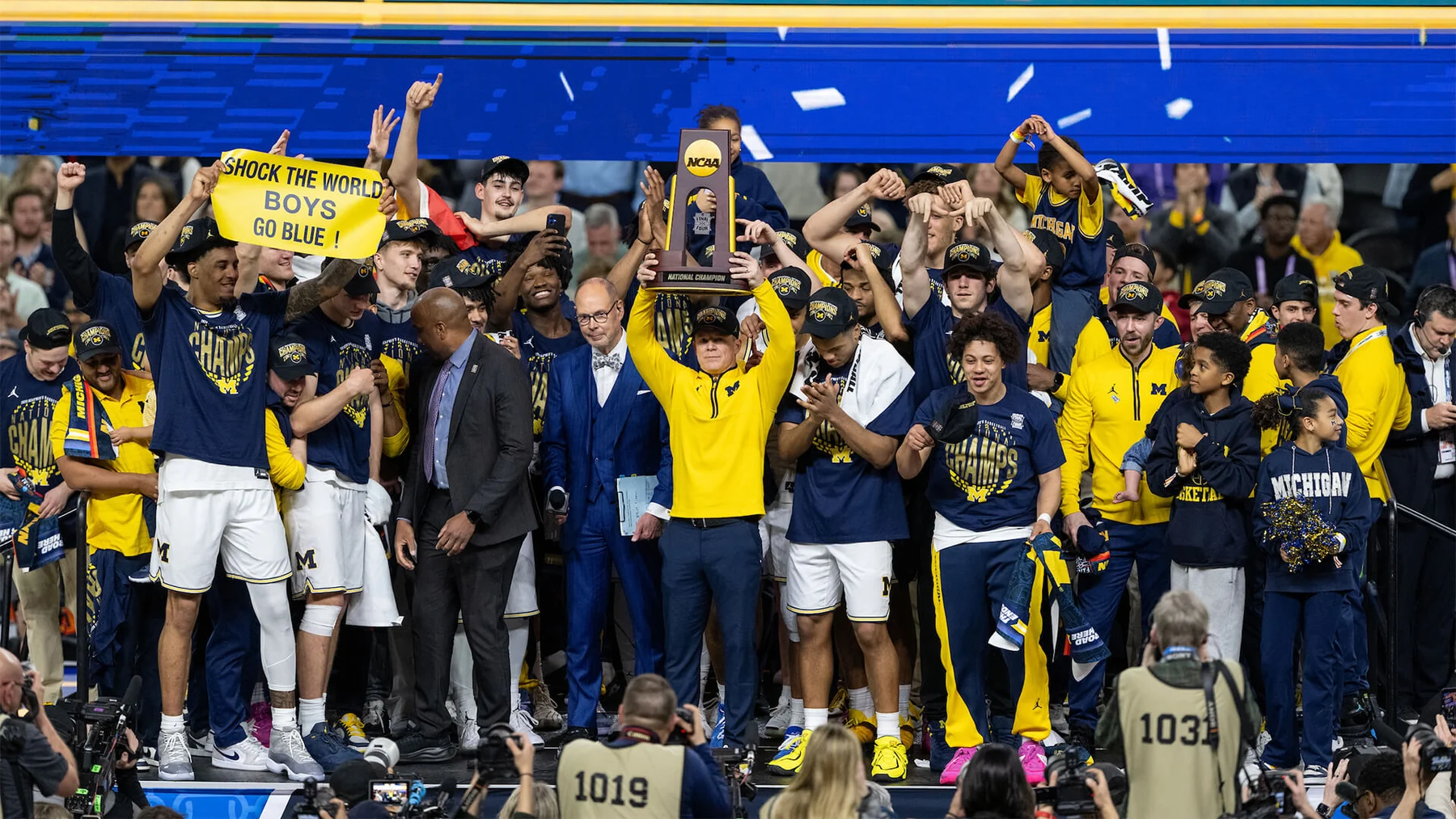
The title game provides a useful standard without requiring the next team to copy every possession. Michigan made only two three-pointers that night. Elliot Cadeau scored 19 points, and Trey McKenney supplied a late three-pointer and closing free throws. The victory demonstrated that the team could finish a game when its outside shooting did not supply a comfortable margin. The current group must establish its own ways to handle those difficult stretches.
The preparation record is already distinct from the regular-season record. Michigan beat Eastern Michigan 87–62 on October 11 at Crisler Center in its opening exhibition. The result offers evidence about live combinations, but it does not make Michigan 1–0 in the regular season. Oregon State on October 16 and Houston on October 25 are also exhibitions; Houston is scheduled at Van Andel Arena in Grand Rapids.
| Landmark | Confirmed date | Classification |
|---|---|---|
| Oakland at Michigan | November 2, 2026 | Regular-season opener |
| Michigan–UConn in Boston | November 6, 2026 | Neutral-site non-conference game |
| Michigan at Rutgers | December 9, 2026 | Big Ten opener |
| Northwestern at Michigan | December 12, 2026 | First conference home game |
The current official calendar begins the regular season against Oakland on November 2 at 6 p.m. Eastern. Conference play starts at Rutgers on December 9, before Northwestern visits three days later. The Big Ten record therefore begins before January, even though the league games are interrupted by further December non-conference dates.
Follow the progression rather than use the championship as a shortcut to a prediction. October helps identify working combinations. November changes the venues and opponents. December introduces conference possessions whose outcomes count directly toward the league standings. A successful transition would show players retaining their assignments across that progression, not merely recreating the emotions of a trophy ceremony.
UConn, Marquette and Villanova ask different early questions
The November 6 UConn game brings a championship rematch to TD Garden in Boston. The Huskies' event announcement confirms the Hall of Fame Series setting. Michigan's current calendar lists an 8 p.m. Eastern start. This is a neutral-site meeting, not a game at UConn's campus arena, and it takes place only four days after Michigan's regular-season opener.
The April final gives the meeting an understandable narrative, but a November possession belongs to the current teams. Use the old game to formulate questions rather than repeat its outcome. Can Michigan produce an advantage near the basket when the first outside shot is unavailable? Can it preserve a lead through defensive possessions instead of trading difficult jumpers? Those questions remain useful even when several of the players answering them have changed.
Marquette arrives at Crisler on November 11. The Golden Eagles' schedule lists 6 p.m. Central, which corresponds to 7 p.m. Eastern in Ann Arbor, with FS1 coverage. The different clocks describe the same game. The five-day interval after Boston gives Michigan another setting in which to test the connections that appeared in its first two regular-season outings.
At home, watch how the offense responds to an opponent taking away a preferred entry. A possession should not become a series of stationary passes merely because the first receiver is covered. The next cut, screen or drive should move a defender and create another decision. That is a proposed viewing test, not a claim that Marquette has already committed to a particular defensive plan.
After the November 15 home game against William & Mary, Michigan meets Villanova on November 21 at Xfinity Mobile Arena in Philadelphia. The Villanova calendar lists a 7 p.m. Eastern start on Fox. The Wolverines classify the game as neutral on their schedule. Whatever label an aggregator displays, the venue is the Philadelphia arena, rather than Villanova's Finneran Pavilion or Michigan's Crisler Center.
That distinction matters for both basketball and travel. A large off-campus arena presents another court and sightline without telling us the crowd's eventual composition. Michigan then begins Players Era in Las Vegas on November 24, so the Philadelphia game also precedes a tournament with several possible branches. Look for players who can maintain a clear responsibility as the setting changes: a guard locating an outlet against pressure, a big presenting a passing target and the weak-side defender recognizing the next rotation. Those habits will be more useful in the following week than a conclusion drawn solely from the prestige of the opponent's name.
Players Era changes the late-November calendar conditionally
Michigan opens Players Era 16 against Creighton on Tuesday, November 24, at T-Mobile Arena in Las Vegas. The venue's published listing gives an approximate start of 2:30 p.m. Pacific, or 5:30 p.m. Eastern. The event continues on November 26 and 27, with a separate championship game on November 28. November 25 has no scheduled games in this bracket.
The organizer's format consists of two eight-team brackets. Their winners meet for the overall title. Michigan's second opponent comes from TCU and Miami, but the path depends on the opening results. The TCU bracket announcement separates the winners' route from consolation games. Neither TCU nor Miami should already be written into Michigan's schedule as a confirmed opponent.
There is also a time distinction worth preserving. Michigan's calendar currently displays 12:30 p.m. Pacific for its November 26 listing, while the arena distinguishes afternoon championship-side slots from evening consolation slots. Recheck the assigned matchup and session after the opening round. A general tournament timetable is not enough to guarantee that every possible Michigan path occupies the same slot.
Basketball preparation changes with those branches. The November 25 pause permits a correction after the Creighton game, but the November 26–27 sequence requires a quicker response. Follow whether Michigan solves a recurring problem before a new opponent can use it: an entry pass arriving too late, a screen that separates two defenders or a second shot conceded after a good initial stop. Those are observable tests of adjustment, not predictions about which opponent the Wolverines will draw.
Why the December 1 game is not guaranteed
The school explicitly says its December 1 home game against Mississippi Valley State will not be played if Michigan advances to the Players Era championship. That condition on the official calendar changes how the end of November should be read. Michigan has not already canceled the game, and it has not already qualified for the final. The calendar describes two possible outcomes.
If Michigan reaches the November 28 title game, that contest takes place at Michelob ULTRA Arena rather than T-Mobile Arena. The organizer lists 7:30 p.m. Pacific, or 10:30 p.m. Eastern, with ESPN coverage. A supporter planning the entire week should confirm both the championship venue and the ticketed session. The earlier tournament games and the standalone final do not occupy the same building.
After Las Vegas, Michigan is scheduled to meet Louisville in Detroit on December 5. The possible December 1 change therefore alters the number and spacing of games before that showcase. It does not justify assuming that one branch automatically produces better preparation. Evaluate what Michigan actually played, how its rotation handled those possessions and the opponent it faced, rather than count every tentative row as a completed test.
The Big Ten slate is not a full double round robin
Michigan plays 20 conference games across the Big Ten's 18-team membership. The school's opponent breakdown assigns three home-and-away opponents and single games against the other 14 schools. That produces ten home games and ten road games, but it does not give every team the same opponent mix in the same venues.
Michigan's home-only group includes Illinois, Iowa, Maryland, Northwestern, Oregon, Purdue and Washington. Its road-only group includes Indiana, Nebraska, Penn State, Rutgers, UCLA, USC and Wisconsin. Those assignments shape the evidence the regular season will produce. Hosting a program once supplies a different sample from visiting it once; the standings still require the whole record to be interpreted.
That is why a comparison based solely on win totals can miss a meaningful difference. Our college basketball rankings explainer distinguishes records from systems that assess opponents and performance. Before describing one team's record as equivalent to another's, identify which games it played twice and where the single meetings took place.
Minnesota, Michigan State and Ohio State appear twice
| Repeat opponent | At Michigan | Michigan away |
|---|---|---|
| Minnesota | January 12 | February 16 |
| Michigan State | February 13 | February 26 |
| Ohio State | January 30 | March 7 |
The conference calendar puts the second Michigan State meeting less than two weeks after the first. Minnesota and Ohio State have longer intervals between meetings. That creates different opportunities for adjustment. A correction that can be implemented before the return trip to East Lansing differs from an improvement developed over several weeks before the finale in Columbus.
Track one recurring issue across each pair. If a guard is forced toward an uncomfortable passing angle in the first meeting, does the offense give him an earlier outlet in the second? If the opponent earns second shots, does the next game show clearer rebounding responsibilities? A changed result is worth recording, but the changed possession explains whether an adjustment actually worked.
The Los Angeles trip tests continuity away from home
Michigan visits USC on January 23 and UCLA on January 26. The Trojans' current schedule identifies Galen Center and a noon Pacific start for the first game. Both contests are in Los Angeles, providing two separate opponent tests during the same part of the calendar. The dates do not disclose Michigan's travel itinerary or guarantee how its players will recover.
The sequence sits between a January 19 home game against Oregon and the January 30 home game against Ohio State. Follow whether the same offensive and defensive responsibilities remain recognizable across the four matchups. A change of court should not require a player to relearn where the next pass is supposed to arrive or which teammate covers a screen.
The league finish also deserves attention: Maryland visits March 4, followed by the March 7 game at Ohio State. These are confirmed regular-season opportunities, not a promise of a particular tournament seed. The most useful late-season assessment will combine results with repeated possession evidence: how Michigan ends stops, initiates offense and manages decisions when a familiar opponent changes its approach.
What must the current rotation prove?
The current team has a different head coach as well as a different frontcourt. Michigan appointed Mike Boynton Jr. on July 10. He had already worked on the staff during the championship season, including as defensive coordinator. Dusty May raising the trophy in the April photograph represents that completed season; Boynton leads the 2026–27 program.
The same appointment announcement records the 2026 NBA Draft departures of Morez Johnson Jr., Yaxel Lendeborg and Aday Mara. They should not be placed into a projected current starting lineup. The new official roster instead includes J.P. Estrella, Moustapha Thiam, Jalen Reed and Quinn Costello, alongside returning guards Elliot Cadeau and Trey McKenney. Listed membership confirms who belongs to the team; it does not guarantee a particular five-man combination or minute distribution.
The October 11 Eastern Michigan game supplies an actual example of an emerging connection. The official exhibition recap describes Cadeau finding Thiam for an alley-oop off the opening tip. McKenney finished with 21 points, while Costello scored 16 off the bench and made four three-pointers. These are results from one exhibition, rather than season averages or proof that every opponent will allow the same options.
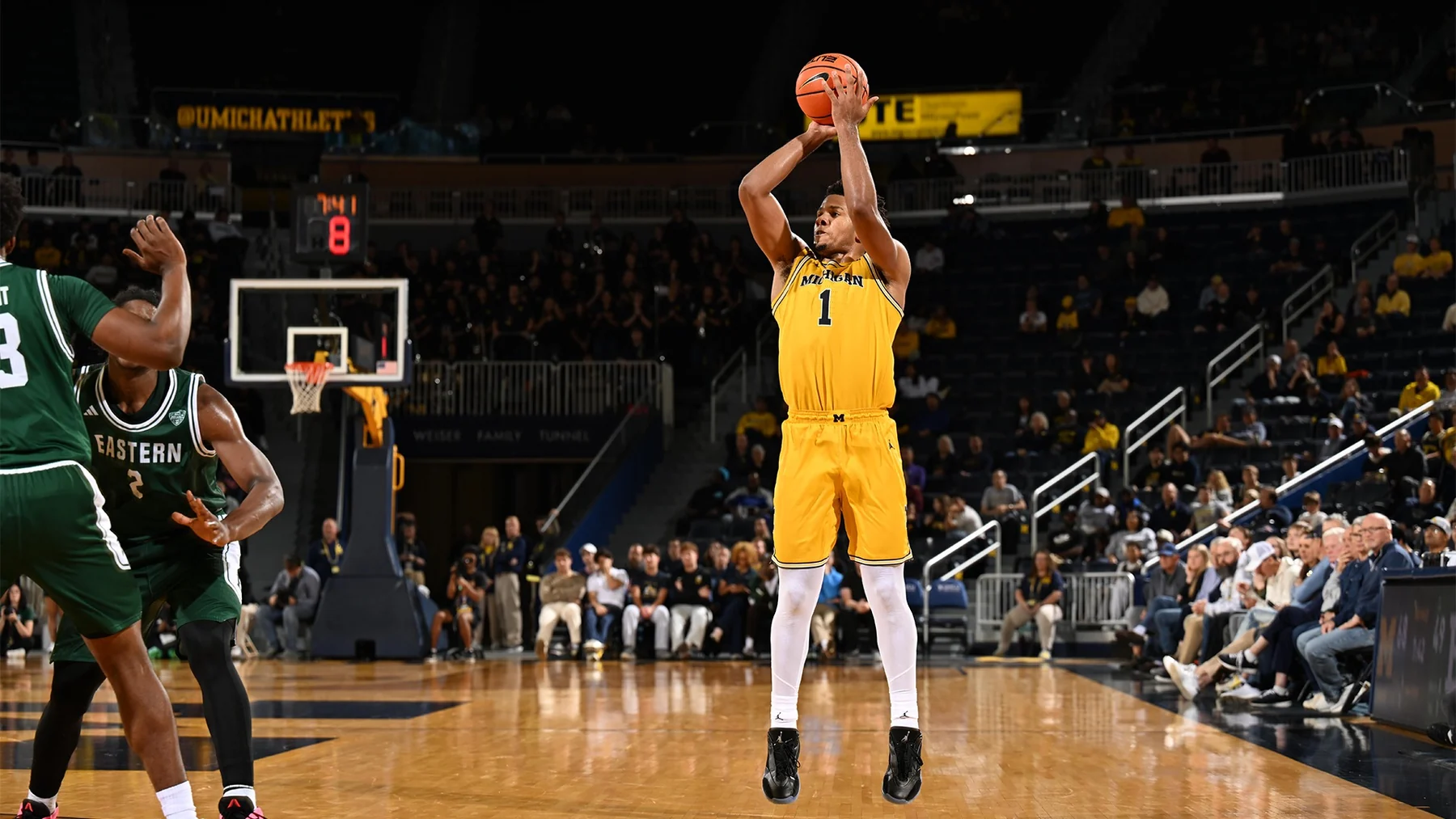
That combination creates a useful viewing question. If a defender leaves Costello to help on a Cadeau drive or a Thiam finish, can Michigan move the ball to the space he has vacated? If the defense stays attached to the shooter, can the guard and center complete their action inside? A made shot is the final outcome; the decision that produced it shows whether the lineup's spacing is doing useful work.
McKenney's biography records 9.9 points per game in 2025–26 and appearances off the bench in all 40 games. His expanded opportunities should therefore be evaluated against that actual previous role, not treated as a continuation of an old starting assignment. Follow his choices when a closeout takes away the catch-and-shoot attempt: the next pass or controlled drive can preserve an advantage even without immediate scoring.
Reed's return to action in the exhibition is also a completed observation, not a medical forecast. The school reported his first game since the November 2025 Achilles injury at LSU. One appearance cannot settle his eventual workload. As November's opponents change, judge the whole rotation through repeated responsibilities: protecting the basket without losing shooters, finishing rebounds and giving the ball handler a clear next option. The schedule supplies those tests; the championship banner does not answer them.
Planning broadcasts and trips beyond Crisler
The schedule moves between Crisler Center, other cities and several broadcast partners. A Michigan logo beside a date does not establish either a home game or access through one subscription. Start with the actual matchup, then identify its venue, clock and designated network. That sequence is especially useful for the Las Vegas tournament and the January Los Angeles trip.
Read local times before choosing a broadcast
Michigan explicitly publishes start times local to the game site. Ann Arbor and Boston use Eastern time, Las Vegas and Los Angeles use Pacific, and Lincoln uses Central. The January 5 game at Nebraska is listed at 6 p.m. Central, which is 7 p.m. Eastern. The UCLA game on January 26 is listed at 7 p.m. Pacific, which is 10 p.m. Eastern. Those are conversions of the same starts, not separate scheduling announcements.
| Game | Published local start | Designated coverage |
|---|---|---|
| Oakland at Michigan, November 2 | 6 p.m. Eastern | Big Ten Network |
| UConn–Michigan in Boston, November 6 | 8 p.m. Eastern | TNT, truTV and HBO Max |
| William & Mary at Michigan, November 15 | 2 p.m. Eastern | B1G+ |
| Louisville–Michigan in Detroit, December 5 | Noon Eastern | Peacock/NBCSN |
The October 6 announcement also leaves two time decisions open. The January 30 Ohio State home game and February 6 Wisconsin road game will have their starts finalized no later than one week before each contest. Do not choose one of the alternative windows displayed on the calendar and present it as a settled tip.
B1G+ and Big Ten Network are distinct listings. The exhibitions and the William & Mary game carry B1G+, while the Oakland opener carries BTN. Confirm that your service actually includes the listed event before subscribing. For a daily overview, our games today page can help locate the matchup; the official game listing remains the direct reference when the provider or time changes.
Confirm the venue and ticket for the specific game
A Crisler ticket does not cover the November 6 game at TD Garden, the November 21 game at Xfinity Mobile Arena or the December 5 meeting at Little Caesars Arena. The same distinction applies to Houston's October 25 exhibition at Van Andel Arena. Confirm the building before selecting seats or arranging a hotel, even when a showcase takes place within Michigan.
The official single-game pricing guide lists Oakland at $15–85 and Marquette at $20–100, varying by seating location. These are published price ranges, not a guarantee that the lowest-priced seats remain available or that a particular checkout includes every fee. Use the school's ticket link for the specific date and check the seats actually offered.
The current Crisler guide asks guests to save mobile tickets before arrival and says doors generally open 60 minutes before the event. Crisler has a no-bag policy, including clear bags, with inspected exceptions for necessary medical or childcare items. Review the event's parking and accessibility information as well; policies for another Michigan sport should not be substituted for a men's basketball visit.
When March arrives, follow the confirmed tournament bracket rather than extrapolate from the previous title. The Big Ten Tournament is scheduled for March 9–14 in Indianapolis, but Michigan's entry round depends on its seed. Subsequent NCAA dates do not establish a Wolverines berth or a return to the championship game. The regular season supplies the evidence that determines those next opportunities.
Sign in with Google to join the discussion.