The NCAA men's rulebook sets the frame
The quickest way to understand men's college basketball rules is to follow three questions: who controls the ball, what makes that control end and which penalties change the next possession. Most confusing whistles become easier to follow once those questions are separated. A foul, a violation and a timeout can all stop play, but they do not carry the same consequences.
This guide covers NCAA men's basketball as checked on October 20, 2026. The NCAA maintains a men's rulebook, case interpretations and season-specific guidance. Do not automatically transfer a rule from the NBA, high school or the women's college game. Even when the action looks familiar, the timing, foul penalty or review procedure can be different.
Men's college basketball continues to use two halves. The NCAA discussed a possible move to quarters in May 2026, but a discussion about evaluating a future change is not an adopted change. The practical point is to read an announcement's status as carefully as its headline. A proposal, an approved interpretation and a rule already in force are three different things.
The 2026-27 points of emphasis include post play physicality, offensive three-second violations, freedom of movement and traveling. An emphasis generally tells officials which existing responsibilities deserve particular attention; it does not give a defender permission to ignore another part of the rulebook. A game with early whistles may reveal adjustment to enforcement rather than a newly invented sport.
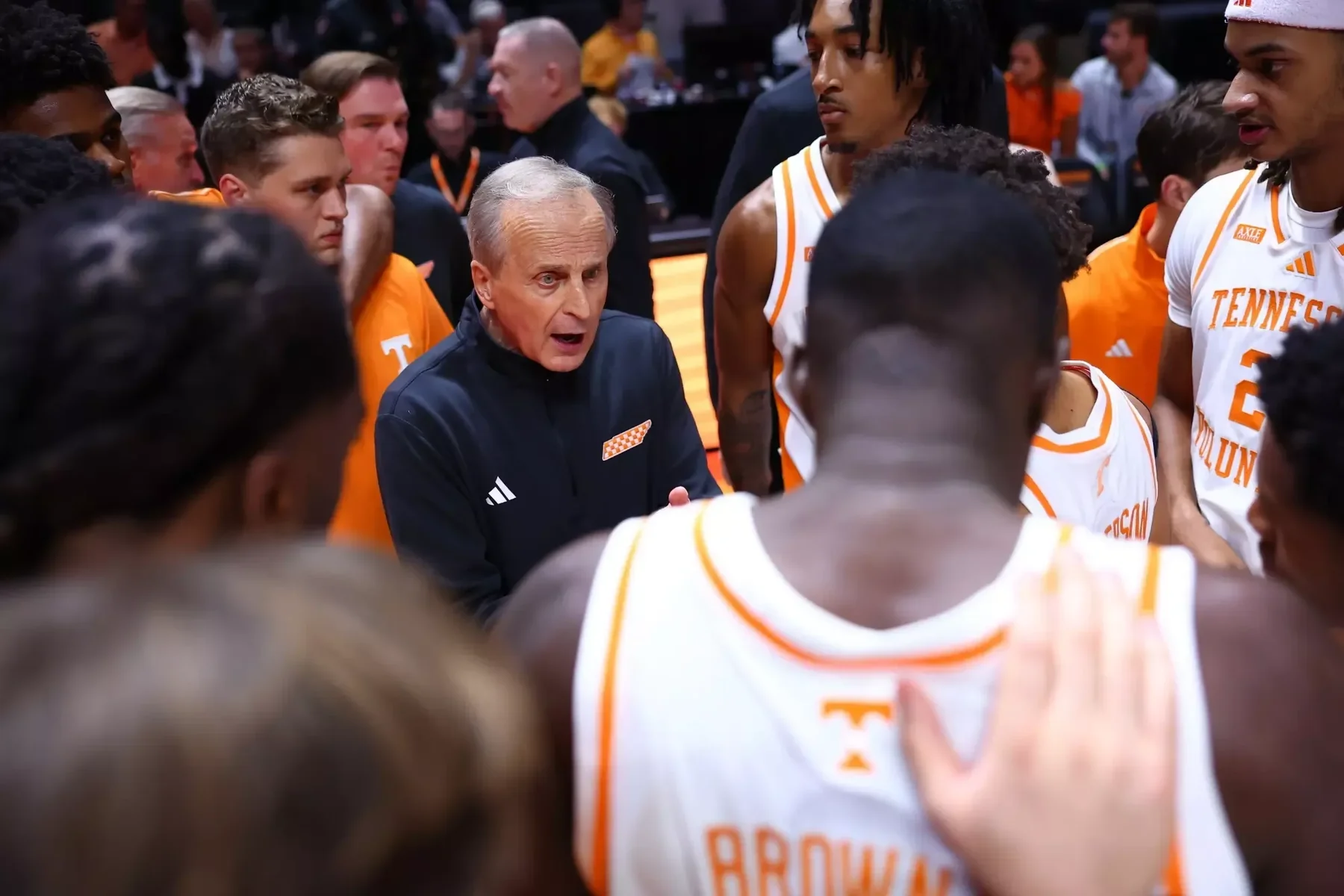
Consider an illustrative Tennessee possession. A guard enters the ball, a forward establishes position and a screener tries to free a shooter. To understand a whistle, locate the action that prompted it: illegal movement by the screener, displacement in the post, a ballhandling violation or something else. Watching only the player nearest the ball can miss the decisive event.
For fans following a new team, this is also a useful way to evaluate discipline. Ask whether mistakes are random or whether the same action repeatedly creates trouble. That distinction helps explain why a coach changes a lineup or simplifies an offensive set. The remainder of this guide focuses on those possession and strategy consequences, while leaving specialized equipment and game-length details to their own dedicated explanations.
Possession rules reward decisions before the clock expires
The shot clock and backcourt count
The standard men's college shot clock is 30 seconds. A common second-chance situation, an offensive rebound in the frontcourt after the shot touches the rim, produces a 20-second reset. A timeout does not independently supply a fresh clock. The reset depends on the event and where play resumes, so do not assume every whistle means another full possession.
For 2026-27, the NCAA instructs officials to call the ten-second backcourt violation when the shot-clock display reaches 19 rather than 20, aligning administration with clocks that measure tenths. This remains a ten-second requirement; it is not permission to linger for an extra second because an older broadcast graphic looked different.
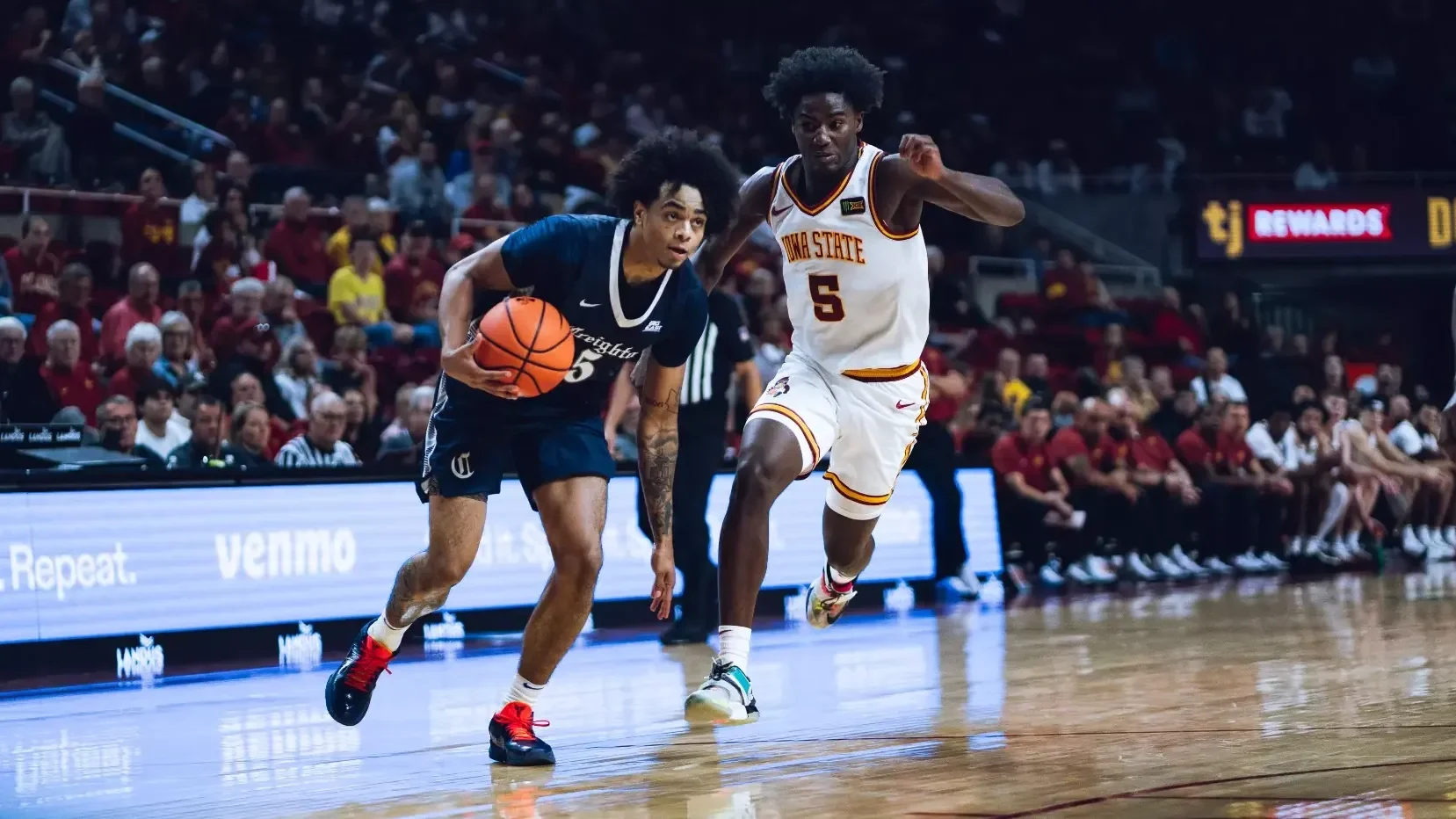
The tactical effect of pressure is broader than forcing steals. Suppose Creighton spends much of the opening possession advancing through a press. Even if the Bluejays cross safely, they may have less time for the first screen, the reversal and the next attack. A defender who never touches the ball can still have changed the quality of the eventual shot. That is an illustrative situation, rather than a claim about a particular game.
Traveling, dribbling and the pivot foot
Traveling is best understood through control and the pivot foot, not by counting every footstep visible in a replay. For an ordinary established pivot, the ball must leave the hand to begin a dribble before that foot is lifted. A player may lift the pivot to pass or shoot, but must release the ball before returning it to the floor. The circumstances of a catch or a dribble ending determine which foot becomes the pivot.
Ending a dribble also changes the available choices. A player cannot simply begin another dribble after stopping unless a qualifying event permits it. This is why a trap can succeed before a turnover appears: picking up the ball early leaves the handler dependent on teammates creating an outlet.
Watch the supporting players as closely as the ballhandler. Does a teammate show a safe passing angle? Does another stand behind a defender and turn a legal pivot into a desperate pass? A traveling call may be charged to one player while the underlying offensive problem involves several. Understanding that sequence makes the whistle useful evidence about execution.
Finally, distinguish urgency from panic. A rushed shot before the horn can be legal and still be a poor outcome. A patient possession can be productive if it reaches a good attempt on time. The clock establishes the legal boundary; the offense's decisions determine how well it uses the space inside it.
Fouls change the available lineups
Player fouls and the team bonus are different counts
A player's foul total and his team's foul total answer different questions. The individual count helps determine whether he can remain in the game; the team count helps determine penalties for qualifying fouls. An ordinary fifth personal foul disqualifies a player. Technical and flagrant categories have additional rules, so a scoreboard's simple foul column is not a complete explanation of every unusual penalty.
In the men's game, the seventh team foul in a half ordinarily brings a one-and-one on a qualifying nonshooting defensive foul: make the first free throw to receive the second. The tenth ordinarily brings two. Team fouls reset at halftime. Shooting fouls, offensive team-control fouls and special penalties must be treated separately; being in the bonus does not mean every whistle earns the same free throws.
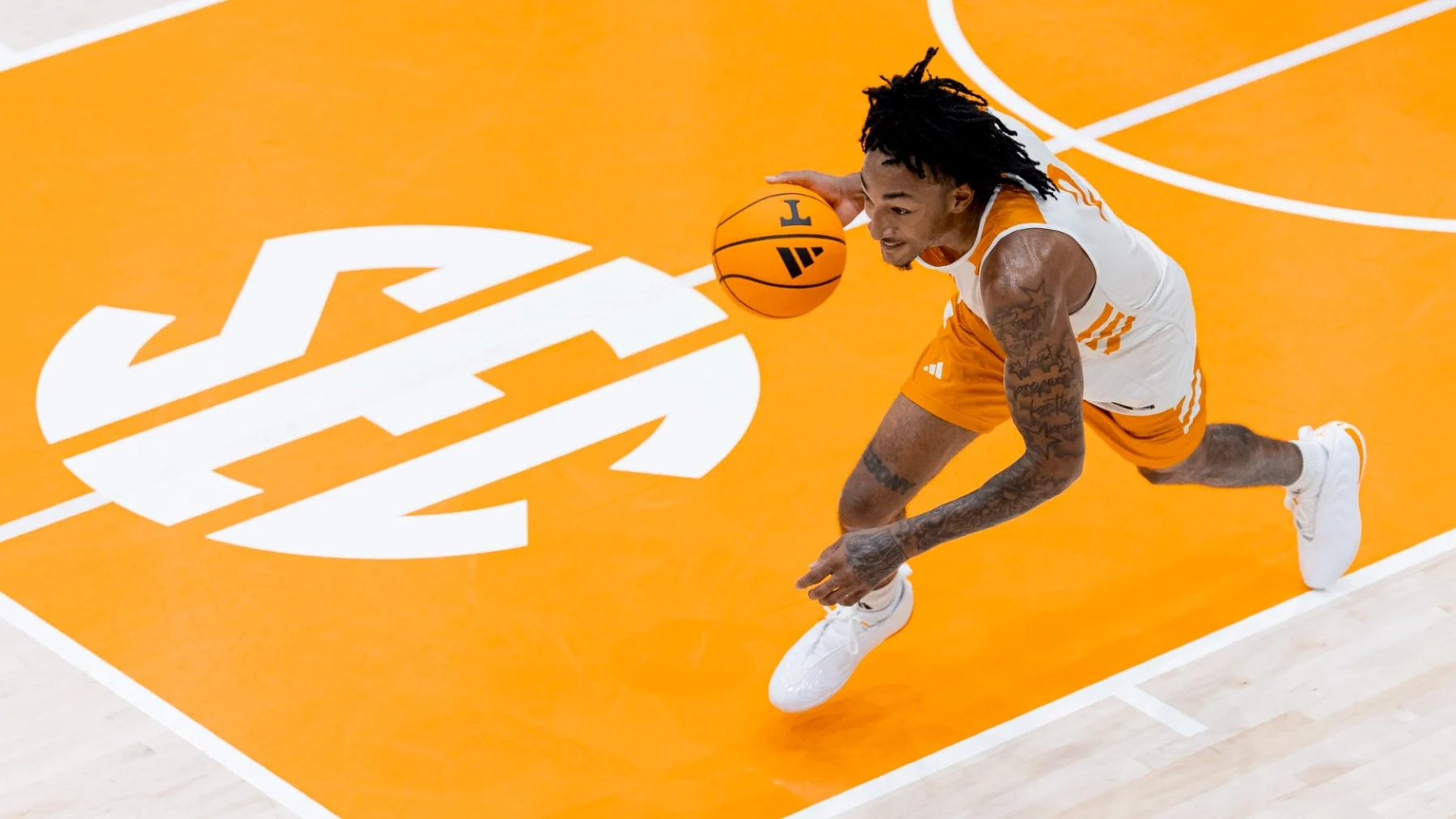
The strategic consequences begin before disqualification. Imagine a Tennessee interior defender with four fouls facing repeated drives. His coach must weigh his remaining defensive value against the risk of losing him for good. Removing him preserves availability but may weaken the current lineup. Leaving him in preserves the matchup but asks him to defend without making an avoidable mistake. Neither choice can be judged solely from the next basket.
Legal position matters more than who falls down
On a charge-or-block play near the basket, look at the defender's legal position and when it was established. For a secondary defender trying to draw a charge against a shooter, the relevant timing precedes the offensive player's plant to launch. The restricted-area provisions matter too. A dramatic collision or a defender landing on his back does not, by itself, prove an offensive foul.
That is why the best replay may begin before the contact. A close-up of the collision can hide the earlier movement that decides the play. Ask whether the defender arrived in time, whether the contact involved a legal position and which type of play is actually being judged.
For the offense, foul pressure can change the opponent's choices. A drive that forces a vulnerable defender to rotate may be worthwhile even if a teammate ultimately takes the shot. For the defense, disciplined positioning can prevent the problem before a desperate reach or late collision occurs. Fans get a more accurate picture by following the sequence that creates the contact rather than treating every whistle as an isolated argument.
Substitutions and timeouts are coaching resources
College basketball does not impose a small match-long substitution quota. Eligible players may leave and return at legal opportunities. That freedom is one reason a coach can tailor a rotation to fouls, fatigue and matchups. It does not mean a replacement can run onto the floor whenever the coach wants.
Substitutes report to the scorer's table and wait for the official to admit them at an appropriate opportunity. Free-throw administration and certain late-game situations have specific restrictions. In particular, the clock stopping after a made basket late in the game does not by itself create an unrestricted substitution window. A timeout may be needed to arrange the desired personnel.
Imagine Creighton protecting a narrow lead with one group better suited to defense and another better suited to receiving an inbounds pass and making free throws. The staff must plan the next legal chance to change players. A player who is ideal for the next defensive possession might be a poor fit if the team first needs to advance the ball against pressure. The sequence matters as much as the names.
This explains why a timeout can have several purposes at once. It can organize a play, stop a deteriorating possession, rest a fatigued lineup or permit a personnel change. Evaluating it only by whether the next drawn-up shot goes in misses those other possible benefits. Conversely, spending one too casually can remove a useful option later.
Team timeouts and media timeouts are distinct. A scheduled television break follows the applicable broadcast format; it is not simply a coach deciding to stop an opponent's run. Fans should therefore avoid assuming every long stoppage has reduced a team's remaining timeout count. Watch the official signal and the broadcast explanation.
On the bench, preparation begins before the whistle. A replacement needs to know the assignment, who is leaving and what coverage the team will use. A fresh defender who does not know the call can create a larger problem than a tired player who understands it. That is an analytical reason to watch the first possession after substitutions carefully.
The useful fan question is therefore broader than whether a coach should have used the bench. Ask whether the change was legally available, which problem it was intended to solve and what it meant for the following possession. Basketball's substitution freedom creates many possible answers, but the timing of the opportunity determines which answers can actually be used.
Goaltending, basket interference and the three-point line
A defender's athletic ability does not remove the legal limits on a shot contest. Goaltending includes touching a descending shot entirely above ring level when it has a possibility of entering the basket. A ball that has contacted the backboard has additional protection under the NCAA men's provisions. The timing and location of contact matter, rather than simply whether the defender reached higher than the shooter.
Basket interference covers related but different actions involving the basket, the ring and the space above it. The rules changes applying to 2025-26 and 2026-27 also classify placing a hand on the backboard or ring to gain an advantage as basket interference. The familiar cry of ?he touched it? therefore needs a second question: touched what, where and at which stage of the play?
For a shot blocker, good timing can mean choosing not to reach once the legal opportunity has passed. For a teammate, it can mean securing rebounding position while the contest happens. A clean block is not the only useful defensive outcome; forcing a difficult attempt without committing a violation may be better than producing an impressive-looking touch that cannot stand.
At the other end of the possession, the three-point line changes how teams create space. A shooter on the line has attempted a two, while the applicable release position determines the value of a shot taken from beyond it. A player does not gain a third point simply by drifting backward after releasing the ball.
Consider an illustrative Creighton kick-out pass. If the receiver catches with a foot touching the line, the defense may have conceded a long two rather than a three. If the receiver establishes himself beyond the arc before the shot, the same general action can produce a different scoring opportunity. The floor markings affect both the shot's value and how urgently a defender needs to close out.
That does not mean every three is a better choice than every two. Distance, balance, time and defensive pressure still matter. The rules describe how an attempt is valued; the quality of the possession depends on whether the team generated a reasonable shot for that player. Fans can watch the feet on the catch, the balance on the rise and the defender's arrival to understand why two nearly identical-looking possessions produced different outcomes.
Late-game reviews and challenges: what fans should watch
A challenge is a limited tool
The men's coach's challenge is not a universal right to reconsider anything a team dislikes. Its specified categories include out-of-bounds calls, called basket interference or goaltending, and restricted-area plays. A team needs a legal timeout remaining. A successful first challenge earns a second and final challenge; an unsuccessful challenge costs the timeout and ends the team's challenge opportunity.
Officials retain other authorized review responsibilities, including relevant timing, scoring and shot-value questions. An appeal about a permitted administrative or rules matter is also different from a coach's challenge. The existence of a monitor does not make every disputed contact reviewable, and a camera angle that convinces a viewer does not enlarge the review's legal scope.
That scope matters when judging a coach. Before asking why he did not challenge, ask whether the play belonged to an eligible category and whether the required resource remained. A coach cannot spend a challenge on a general disagreement about an ordinary foul merely because the potential consequence is large.
Read the situation before judging the decision
Late-game strategy becomes much clearer if fans pause to identify the score, the game clock, the shot clock, team fouls and remaining timeouts. Those facts define the problem. A team down two with the ball faces a different choice from a team down three without it, even if both sequences occur with very little time left.
For an illustrative SEC finish, imagine Tennessee needing to inbound against pressure. A timeout could prevent a dangerous turnover, permit the right receivers to enter or clarify the next action. Saving it preserves flexibility, but only if the current possession remains viable. The quality of the decision depends on the information available before the outcome, rather than whether a difficult shot later happens to fall.
Review breaks add another layer. Teams can communicate and prepare while officials resolve the authorized issue, but the eventual ruling determines possession, score or time. Until it is announced, distinguish a plausible explanation from a confirmed decision. A slowed replay may make the action easier to see while still leaving the decisive angle obscured.
Use the daily games page to find a game and the scores page to follow its result. When watching, start with the possession and the applicable rule. Then evaluate the execution and coaching choice. That sequence produces a more useful basketball discussion than beginning with the whistle and working backward toward a preferred conclusion.
Sign in with Google to join the discussion.