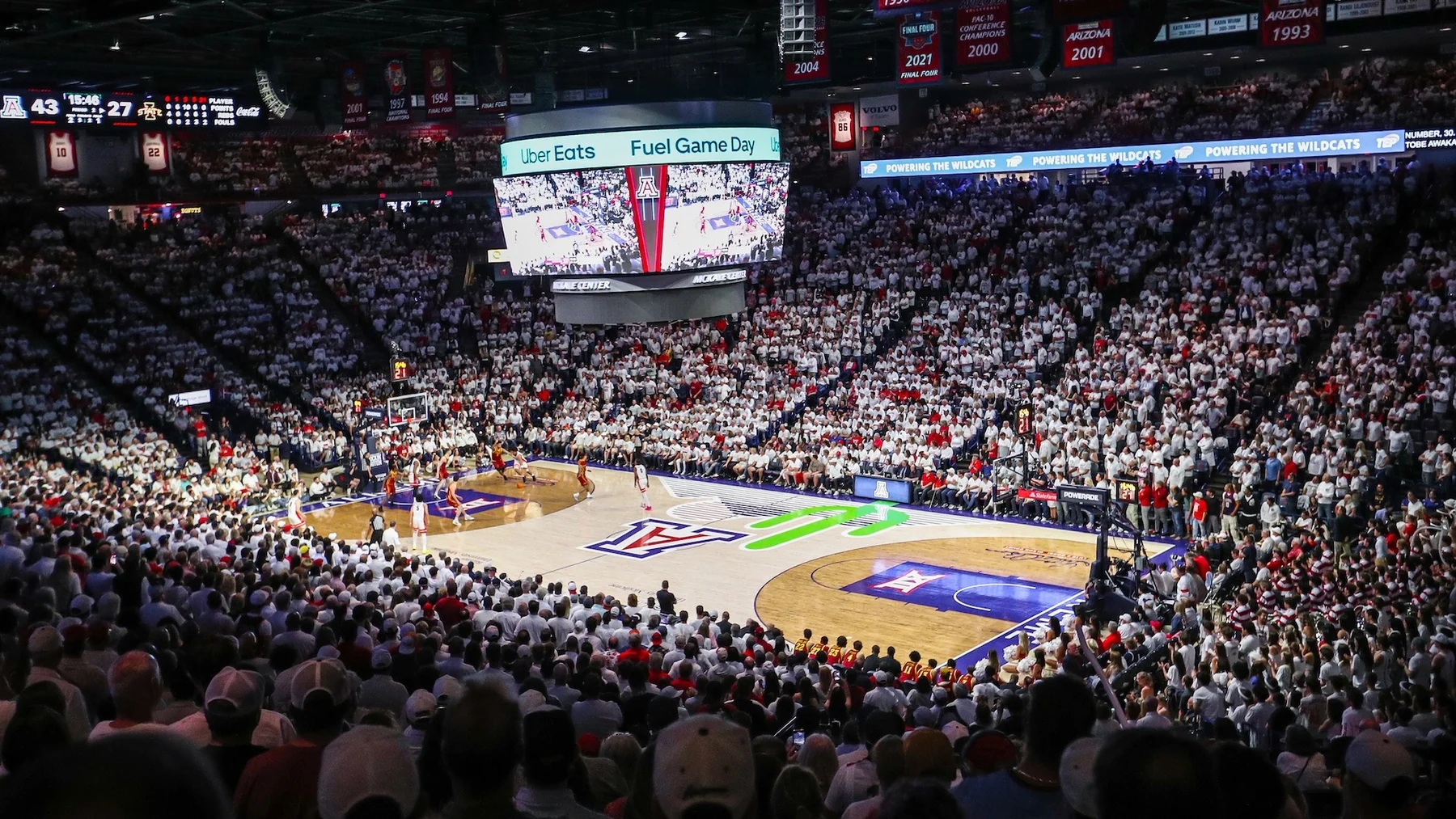
Arizona's 2026–27 schedule opens against UCLA in Las Vegas on November 2 and moves into an eighteen-game Big 12 race on January 2. This guide explains the non-conference tests, February's short turnarounds and the practical details of watching or attending, using information checked on October 14, 2026. The cover is an archival McKale crowd scene from the school's venue gallery, illustrating Arizona's home arena rather than a future game.
Arizona's season calendar at a glance
Arizona opens its 2026–27 regular season against UCLA in Las Vegas on November 2, 2026. Big 12 play begins at Iowa State on January 2, 2027 and ends at Houston on March 6. The central planning distinction is between the October exhibitions, the non-conference schedule and the 18-game league race. Dates below were checked on October 14, 2026.
| Date | Stage or matchup | Site |
|---|---|---|
| October 13, 16 and 23, 2026 | Home exhibition slate | Tucson |
| November 2 | Regular-season opener vs. UCLA | Las Vegas |
| November 23–25 | Maui Invitational | Lahaina |
| January 2, 2027 | Big 12 opener at Iowa State | Ames |
| March 6 | Regular-season finale at Houston | Houston |
| March 9–13 | Big 12 tournament | Kansas City |
Use the current Arizona schedule for individual listings and the conference calendar for the league framework. One naming detail deserves attention: Arizona's current December 1 opponent is listed as LSU New Orleans. Fans should not assume that a shortened older reference to “LSU” means the SEC program in Baton Rouge.
An exhibition can reveal substitutions, spacing and defensive assignments while remaining a different competition from the regular season. Summer tour results and the Red-Blue Showcase likewise should not be inserted into a regular-season win-loss record. This guide uses them only if their separate context is relevant; it does not turn October testing into a prediction of Arizona's conference finish.
The season name spans two calendar years. November and December games fall in 2026, while the league schedule and March tournament fall in 2027. A date copied without its year can send an otherwise accurate calendar entry into the wrong season, particularly when a fan is comparing historical rivalry games with the next scheduled meeting.
Venue labels also change the meaning of a fixture. A Las Vegas opener is a neutral event, an Auburn visit is an opponent's home game, and a Tucson game offers Arizona its familiar floor. The following sections explain why those differences and the sequence between games deserve as much attention as the opponent's name.
The non-conference games that test different parts of the team
UCLA opens the season on a neutral floor
The November 2 UCLA game is more than a recognisable name at the top of the calendar. UCLA's announcement identifies T-Mobile Arena in Las Vegas and a third consecutive season of neutral-site meetings. The previous two were in Phoenix and Inglewood. The series continues outside the teams' current conference schedules.
For Arizona, opening on a neutral floor immediately tests whether the new group can communicate without relying on its normal home routine. Watch the spacing around a first ball screen, who advances the ball against pressure and whether a defensive stop finishes with a rebound. Those are questions about the upcoming team, not claims that the old rivalry determines this year's result. An early win or loss supplies evidence, but one evening will not establish a permanent ceiling.
The opening-night setting also changes fan planning. A Tucson season ticket is not a ticket to Las Vegas, and a neutral listing should not be interpreted as a game at UCLA's campus. Confirm the event and the building before treating the opponent label as an address.
Auburn and UConn create an early road-and-home comparison
Auburn's own schedule release confirms Arizona's November 13 visit to Neville Arena. Arizona then hosts UConn in Tucson on November 18, as confirmed by the Wildcats' season release. That five-day separation offers an early comparison of how the same Arizona group operates away from home and back at McKale.
The relevant comparison is not simply whether the point total rises in Tucson. Different opponents can force different possessions. On the road, watch how Arizona identifies a play and gets into it when the first option is interrupted. At home, ask whether familiar surroundings produce better decisions or merely more energy. A team that creates a good first shot but cannot recover after an opponent changes coverage still has a preparation problem to solve.
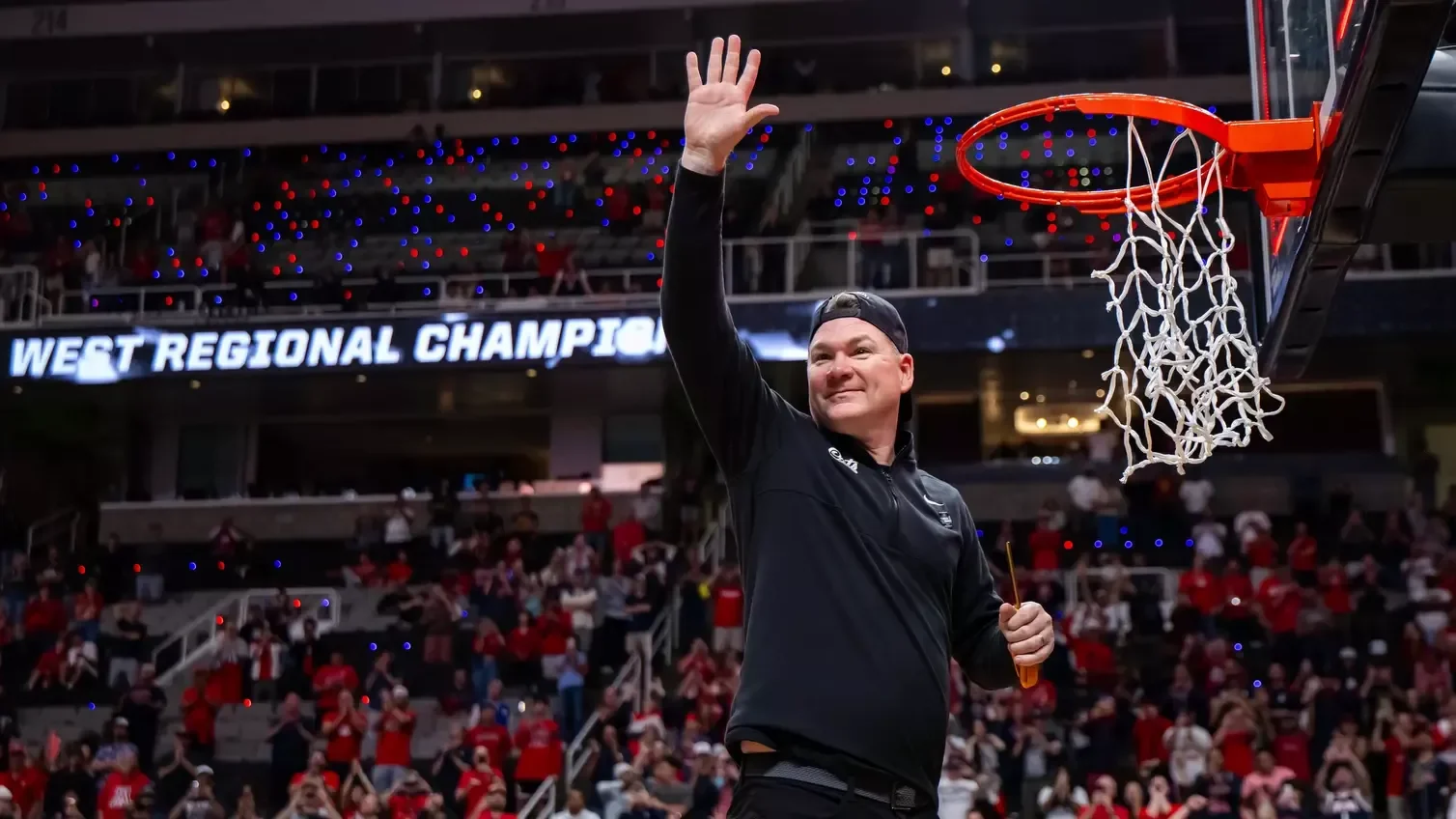
The photograph illustrates the program's recent postseason experience. It does not supply a result for the next group. Fans should separate the confidence that comes from that history from the work required to make a new rotation function against November opponents.
Maui asks Arizona to prepare between games
The Maui Invitational bracket puts Arizona against Colorado State on November 23, with further games on November 24 and 25. VCU or Providence is the next opponent; the final day's opponent comes from the other half containing BYU, Clemson, Ole Miss and Washington. Those later names are alternatives, not several additional games already fixed on Arizona's schedule.
Three consecutive dates create a different test from a normal week. Coaches have less time to install a new opponent plan, and players have less time to recover between appearances. Watch whether Arizona retains the details of its defensive assignments after changing opponents, and whether the bench can maintain the intended pace without creating preventable fouls or turnovers. This is an analytical reason to follow the whole event, even if the first game attracts the most attention.
The bracket also creates uncertainty that affects supporters. Arizona's second and third tip times depend on the route through the tournament. Book plans around the event's dates and the correct ticket package, then follow the actual bracket. Do not build a viewing schedule around a predicted championship matchup and overlook another placement game that Arizona could instead play.
What the 18-game Big 12 format means for Arizona
The Big 12's format gives each team three home-and-home opponents and one meeting with each of the other twelve. Arizona's repeated opponents are Arizona State, BYU and Houston, according to the school's matchup announcement. The arithmetic is six games against those three plus twelve single meetings: eighteen, with nine at home and nine away.
That structure matters because the schedule is not a complete home-and-away round robin. Arizona hosts Kansas but visits Texas Tech, and there is no second regular-season meeting against either. A difficult night in Lubbock cannot be followed by an automatic return game in Tucson. Conversely, a strong home performance against Kansas would be the season's only league meeting with that opponent.
The repeat pairings create different information. After the first BYU or Houston meeting, each staff can examine what worked and what the opponent took away. In the return game, watch whether Arizona changes the point at which it brings help, the route used to feed the interior, or the lineup handling a late-clock possession. A second game can reveal adaptation more clearly than an initial meeting when both teams are still discovering the matchup.
It also prevents an overly simple reading of two teams' identical records. Both might have nine home dates, yet their single-meeting opponents and locations can differ. A record remains the starting point for the league race; it does not establish that the teams faced the same sequence or the same collection of road tests. Keep that distinction visible when discussing whether Arizona has improved against the wider conference.
For fans, select viewing priorities from the actual structure. The Arizona State series preserves two rivalry dates; BYU and Houston offer two opportunities to assess adjustment; a single road meeting asks the team to solve the problem that evening. None of those categories requires assigning an unverified preseason difficulty score. The calendar supplies the opportunity, and the games will supply the evidence of how Arizona uses it.
February's quick turnarounds deserve extra attention
Houston and TCU visit within three days
The conference calendar places Houston at Arizona on Saturday, February 6, 2027 and TCU at Arizona on Monday, February 8. Those are two games separated by one intervening calendar day. Calling the gap exactly forty-eight hours would require fixed tip times; the more useful fact is that Arizona must change opponent plans across a short Saturday-to-Monday window.
Both games being in Tucson removes a transfer between cities. It does not remove the physical work of the first game, the film review or the need to prepare for a different set of players. Watch how quickly Arizona identifies the next opponent's actions, and whether its defensive communication remains precise when substitutions change the group on the floor.
The league calendar also places road visits to West Virginia and Cincinnati before this home pair. The sequence is therefore a more useful planning unit than “two home games” alone. How Arizona manages the earlier travel and the first home game's workload could affect preparation, but the dates do not establish that any player will be fatigued or unavailable.
Houston is a repeat opponent, with the return meeting in March confirmed in its official schedule release. Fans can use the February matchup as an initial reference for the later one. TCU is a single league meeting, so the short turnaround asks Arizona to solve that particular regular-season matchup without relying on a rematch.
Kansas at home is followed by BYU on the road
Kansas's current schedule confirms the February 20 game in Tucson. Arizona then travels to BYU for Monday, February 22, which the Cougars' October 13 television announcement lists at 7 p.m. Mountain time on ESPN. Winter Mountain Standard Time is the same clock used in Tucson.
This pair has the same calendar separation as Houston and TCU, with the additional requirement of reaching a different road environment. Observe whether Arizona keeps its basic offensive decisions consistent after the transfer: making an early pass, establishing spacing and recognising when a defender has taken away the intended entry. Those details can reveal preparation even before a shooting percentage settles.
The Kansas game should not become an excuse to overlook the next date. Emotion, crowd response and the result of a prominent home matchup can dominate discussion, yet Monday asks for a separate plan. A strong team must carry useful habits from one game while discarding solutions that do not fit the next opponent. That is the reason to follow these two fixtures together without pretending their outcomes can already be known.
Which basketball questions should fans track?
The current roster supplies a clearer set of watch points than a prediction based on last season's record. Motiejus Krivas returns as a senior centre. His 2025–26 biography records 73 blocks and a February 9, 2026 performance at Kansas with 14 points, 15 rebounds and six blocks. That particular game illustrates his interior contributions; it should not be converted into an expected line against Kansas next February.
Watch whether Arizona's perimeter defenders and its centre finish the same defensive possession together. A blocked shot can be recovered by the offence, while a disciplined rebound ends the chance. Krivas' size makes positioning around the basket an obvious focus, but the guards' ability to stay connected to the ball and identify a free shooter matters to what he is asked to cover.

Derek Dixon's profile supplies a different starting point. The sophomore transfer recorded 90 assists against 38 turnovers at North Carolina in 2025–26 and made 39.7 percent of his three-point attempts. Those are prior-school numbers, not Arizona averages. The upcoming schedule can show how his decisions translate when teammates, spacing and the purpose of his possessions change.
A useful observation is what follows a denied first pass. Does the ball move to another side, does the guard create a second angle, or does the group wait until the shot clock becomes the opponent? That question applies in Las Vegas, Auburn and Tucson without assuming Dixon has already been assigned an entire starting or closing role.
Caleb Holt enters as a freshman with McDonald's All-American experience. That establishes his background, while college matchups still have to demonstrate his contribution. Watch whether he recognises the next defensive rotation and makes a useful decision after receiving a pass, rather than judging him only by a dramatic finish.
Together, these examples frame an interior returner, a college transfer and a first-year guard. The calendar will expose them to different settings and preparation windows. Follow the quality of connected possessions across those settings; isolated highlights and the reputation of the opponent cannot establish that the new group has solved every responsibility.
Watching and attending: times, tickets and the Tucson clock
Translate the listed tip time before making plans
Arizona's official calendar lists times in Mountain Standard Time, UTC minus seven. Tucson does not change its clock for daylight saving time. An Arizona listing therefore needs a date-specific conversion when it is compared with a broadcast announcement or the local time at an away venue. The following conversions use the published times and the actual November dates.
| Matchup | Tucson MST | Event local time | U.S. Eastern time |
|---|---|---|---|
| UCLA, November 2 | 8 p.m. | 7 p.m. PST, Las Vegas | 10 p.m. EST |
| Colorado State, November 23 | 9:30 p.m. | 6:30 p.m. HST, Lahaina | 11:30 p.m. EST |
Keep the source label attached to a saved calendar entry. “Eight o'clock” alone is insufficient when the game is in Las Vegas, the school publishes Tucson time and a national broadcaster displays Eastern time. A household arranging a late game or a supporter travelling to the arena needs the appropriate local clock, rather than a convenient but ambiguous number.
The U.S. television assignment is also game-specific. The Big 12's October 13 release describes multiple national partners. NBC lists UCF at Arizona on January 6 at 9 p.m. ET on Peacock and NBCSN. One game's platform does not establish the next game's availability.
Start with the current matchup's watch link and confirm access through the provider in your country. A television channel, an authenticated stream and a separate streaming subscription are different ways of reaching a game. Before planning a gathering, check that the household's service carries the specific listing; a conference name on a subscription page is not enough to establish every fixture.
Match the ticket to the venue and competition
Use Arizona's official basketball ticket portal for Tucson dates and the relevant event organiser for neutral-site games. Verify the event name, building, date and seating details on the offer itself. This guide does not quote a current seat price or promise inventory; those details belong to the particular offer available when you make the purchase.
Maui provides a concrete package distinction. Its official event page describes school-specific packages covering that team's three games, alongside an all-tournament option covering all twelve matchups. Following Arizona for three dates is different from choosing only the championship session. Since the bracket route is unresolved, select the access that matches the games you actually intend to attend.
Before departure, revisit the fixture rather than relying on the first announcement saved months earlier. Check the final tip time, the venue's current entry information and the ticket's delivery instructions. Those checks make the basketball plan usable: they connect the opponent on the calendar to a specific place and a specific way to watch.
The March finish is a route, not a guaranteed destination
Arizona finishes its scheduled league season with Colorado in Tucson on March 3 and a visit to Houston on March 6, 2027. Houston's own release confirms Fertitta Center as the finale's venue. The Big 12 tournament then runs March 9–13 at T-Mobile Center in Kansas City. That gives fans a confirmed sequence of dates, with Arizona's tournament seed and resulting matchups still unresolved.
The final home date and the Houston trip should be assessed through the standings and the team's condition when March actually arrives. A fixture's position at the end of the calendar does not automatically make it a title decider. It could concern the league race, seeding, preparation or several of those questions. The season's completed results will determine which description fits.
The NCAA's official 2027 tournament announcement places the Opening Round on March 16–17 in Dayton and Wichita, followed by first- and second-round games on March 18–21. Regionals follow on March 25–28, with the Final Four on April 3 and 5 in Detroit. These are the competition's dates and sites, not a confirmed itinerary for Arizona.
As of this guide's October cutoff, no Arizona NCAA seed or assigned opening site exists. Enter the postseason dates as conditional plans and wait for the actual selection and bracket before attaching a Wildcats opponent or destination. The published rankings explainer helps distinguish a poll position from the separate process that selects and seeds a tournament field.
The useful season view therefore combines firm appointments with open basketball questions. November tests different floors and preparation windows; the eighteen league games introduce repeated opponents and single meetings; February compresses recovery and travel; March asks the team to carry its accumulated habits into another competition. Follow that progression through real performances, while using the official fixture listings to keep each viewing or travel plan current.
Sign in with Google to join the discussion.